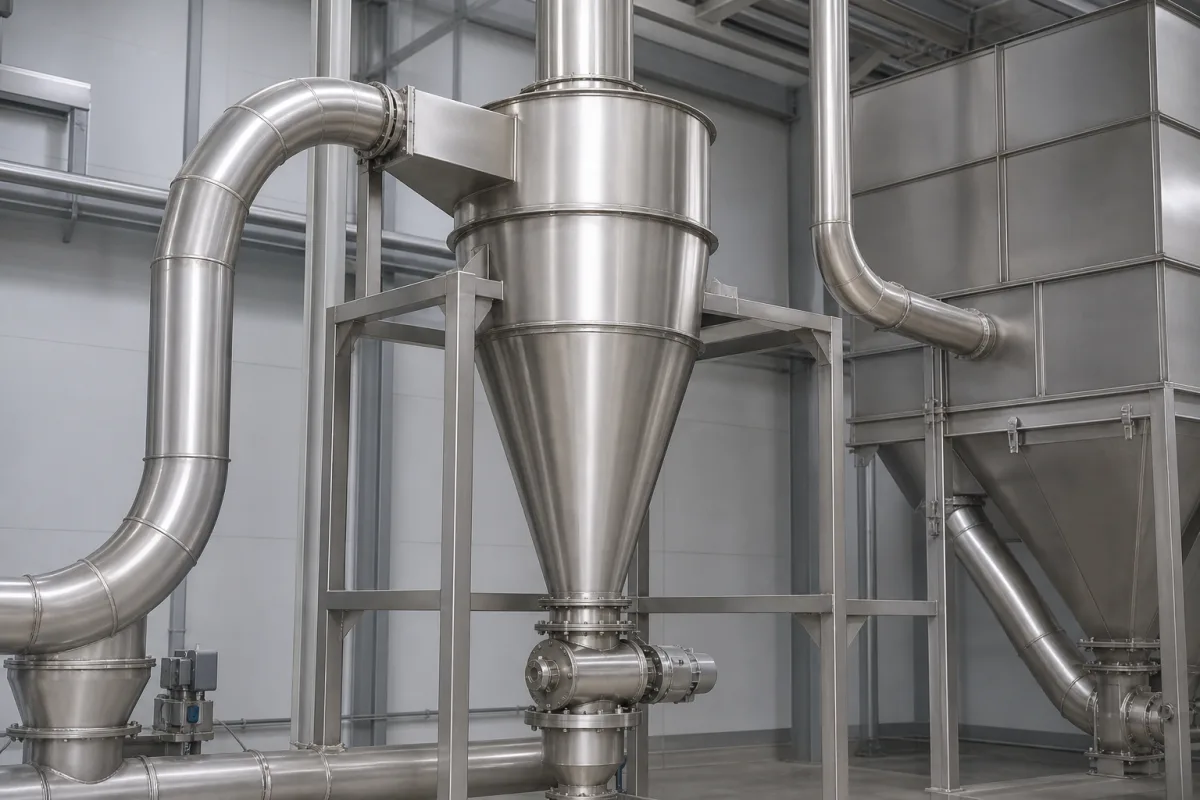
Cyclone separators (cyclone collectors, multicyclones) · removing particles from gas by centrifugal and inertial force, conventional, high-efficiency and high-throughput designs, collection efficiency by particle size, gas flow per unit, inlet temperature and dust loading, and use as precleaners and product recovery
In a cyclone separator, dust-laden gas is forced to change direction and spin inside the cyclone body, so particles are thrown outward and collected at the dust outlet while the cleaned gas leaves through the gas exit. Ask three things first: what particle size and loading you need to capture and at what efficiency, what gas flow, temperature and pressure drop the system allows, and whether the cyclone is a final collector, a precleaner or a product-recovery step.
Gas-solid cyclone separators, high-efficiency cyclones and multicyclones for air pollution control, product recovery and process gas cleaning. Liquid hydrocyclones, fabric filters and electrostatic precipitators are outside this page except where compared.
CNFX editorial research · Sources checked October 12, 2026 · 4 sources
Check collection efficiency by particle size and cyclone class
The US EPA Air Pollution Control Technology Fact Sheet on cyclones (EPA-452/F-03-005) describes them as removing particulate matter by centrifugal and inertial forces induced by forcing particle-laden gas to change direction. They are also called cyclone collectors, centrifugal separators and inertial separators, and small cyclones operating in parallel form a multicyclone. Cyclones mainly control particles larger than 10 µm, although high-efficiency designs target PM10 and PM2.5. [1]
EPA notes that efficiency rises with particle size and density, inlet velocity, cyclone body length, the number of gas revolutions, the ratio of body diameter to gas exit diameter, dust loading and smoothness of the inner wall. It falls with higher gas viscosity, body diameter, gas exit diameter, inlet duct area and gas density, and EPA names air leaking into the dust outlet as a factor that lowers efficiency. Higher-efficiency cyclones have higher pressure drops, and design is driven by the allowed pressure drop rather than a target efficiency. Multicyclones are reported to collect 80–95% of 5 µm particles. [1]
Give the supplier the gas flow, temperature, pressure and composition, the dust type, particle size distribution, density and loading, the required efficiency or outlet concentration, the allowable pressure drop, the material and wear lining, the dust discharge arrangement (rotary valve, airlock), and whether a downstream filter follows.
02
Size flow, temperature and loading, and decide the cyclone's role
EPA gives typical gas flows of 0.5–12 m³/s (1,060–25,400 scfm) for a single cyclone; higher flows, up to about 50 m³/s, use multiple cyclones in parallel. Inlet temperature is limited only by construction materials, with operation recorded up to 540 °C (1,000 °F). Typical dust loadings are 2.3–230 g/m³, and cyclones work more efficiently at higher loadings provided they do not choke. [1]
EPA says cyclones "themselves are generally not adequate to meet stringent air pollution regulations, but they serve an important purpose as precleaners" for fabric filters or ESPs. They are also used for product recovery after spray drying, crushing, grinding and calcining, and for catalyst recovery in fluid catalytic cracking. EPA says fuel- and wood-waste-fired combustion units use multiple cyclones. [1]
One supplier, AGS, states a collection efficiency of 60–70% and air volumes from 1,000 to 1,000,000 m³/h for its air cyclones. [2]
Editorial calculation: 12 m³/s is 43,200 m³/h.
A laboratory study of a two-stage cyclone separator published in ACS Omega (2018) tested talcum powder with a 1.73 µm median diameter at an inlet concentration of 1,040 mg/m³ and air flows of 85, 120, 177, 226, 290 and 332 m³/h. Above 177 m³/h the collection efficiency for particles above 5.0 µm was 100% and for all particle sizes was greater than 75%; above 290 m³/h the second cyclone's efficiency for particles below 2.0 µm was, in the authors' words, "basically above 90%". As flow rose, the first cyclone's cut-off diameter fell from 1.53 to 1.26 µm and the second cyclone's from 1.00 to 0.63 µm, and pressure drop rose with flow, with measured pressure drop within 5% of the simulation. [4]
03
Choose inlet type, pressure drop and dust-hazard measures
EPA's fact sheet classifies cyclones by how gas enters and dust leaves: tangential inlet with axial discharge, axial inlet with axial discharge, tangential inlet with peripheral discharge, and axial inlet with peripheral discharge, the first two being in widest use. It puts the best operating inlet velocity at about 18.3 m/s (60 ft/s) and gives pressure drops of 0.5–1 kPa (2–4 in. H₂O) for low-efficiency, high-throughput units, 1–1.5 kPa (4–6 in.) for conventional units and 2–2.5 kPa (8–10 in.) for high-efficiency units. Multiple-tube cyclones put a large number of small tubes with axial inlet vanes in one housing to combine high efficiency with large throughput, and wet cyclonic separators add water spray. [1]
The same sheet lists the advantages as low capital cost, no moving parts, dry collection and small space, and the drawbacks as low efficiency below 10 µm, inability to handle sticky or tacky materials and high pressure drop on high-efficiency units. In 2002 dollars it gives a single conventional cyclone a capital cost of $4,600–7,400 per standard m³/s ($2.20–3.50 per scfm) and annual O&M of $1,500–18,000 per standard m³/s. [1]
Where the collected solids are combustible, OSHA warns that any combustible material can burn rapidly when finely divided and that dust suspended in air at the right concentration can explode, including metals such as aluminium and iron that do not burn in larger pieces; ask the supplier how the cyclone and its hopper are protected and rated for your dust. [3]
Editorial calculation: at 18.3 m/s inlet velocity, a 1 m³/s gas flow needs an inlet of about 1 ÷ 18.3 ≈ 0.055 m², for example 0.15 × 0.36 m; at $4,600–7,400 per m³/s a 5 m³/s single cyclone would be about $23,000–37,000 in 2002 dollars before ductwork and installation. [1]
04
Trace what each part controls
This is a functional reference built from the sources cited; it is not one maker's design.
Fill the specification fields with values for your gas stream
A cyclone quotation needs values for your gas stream. The table explains each field, gives published values where a reviewed source states them, and says what to ask the supplier for.
Explore company information and manufacturing capabilities, then discuss the scope of your project with a relevant supplier.
Share this page
Compiled and source-reviewed by the CNFX editorial team.
Published product pages show what a company offers, not tested performance. Confirm the legal seller, factory and scope for your order. How we source and review
· Page last updated 13 October 2026
Buyer questions
How efficient is a cyclone separator?
EPA estimates 70–90% for PM with conventional single cyclones and 80–99% with high-efficiency designs, falling sharply for PM2.5. [1]
Can a cyclone meet strict emission limits alone?
EPA says cyclones "themselves are generally not adequate to meet stringent air pollution regulations", but serve as precleaners for fabric filters or ESPs. [1]
What flow does one cyclone handle?
EPA gives 0.5–12 m³/s typical for a single unit; larger flows use multicyclones. [1]
What pressure drop does a cyclone have?
EPA gives 0.5–1 kPa for low-efficiency units, 1–1.5 kPa for conventional and 2–2.5 kPa for high-efficiency cyclones, with about 18.3 m/s as the best inlet velocity. [1]
Can a cyclone separate particles below 2 µm?
In a 2018 ACS Omega laboratory study of a two-stage cyclone, the second cyclone's efficiency for particles below 2.0 µm was "basically above 90%" at air flows above 290 m³/h, and its cut-off diameter fell to 0.63 µm at 332 m³/h. [4]
Sources and what still needs a direct check
Sources checked 2026-10-12. The EPA fact sheet (archived copy) is a US government reference. AGS describes its own cyclones.