Industry-Verified Manufacturing Data (2026)

Communication Modules

Based on aggregated insights from multiple verified factory profiles within the CNFX directory, the standard Communication Modules used in the Machinery and Equipment Manufacturing sector typically supports operational capacities ranging from standard industrial configurations to heavy-duty production requirements.

Technical Definition & Core Assembly

A canonical Communication Modules is characterized by the integration of Processor Chip and Network Interface. In industrial production environments, manufacturers listed on CNFX commonly emphasize Printed Circuit Board (PCB) construction to support stable, high-cycle operation across diverse manufacturing scenarios.

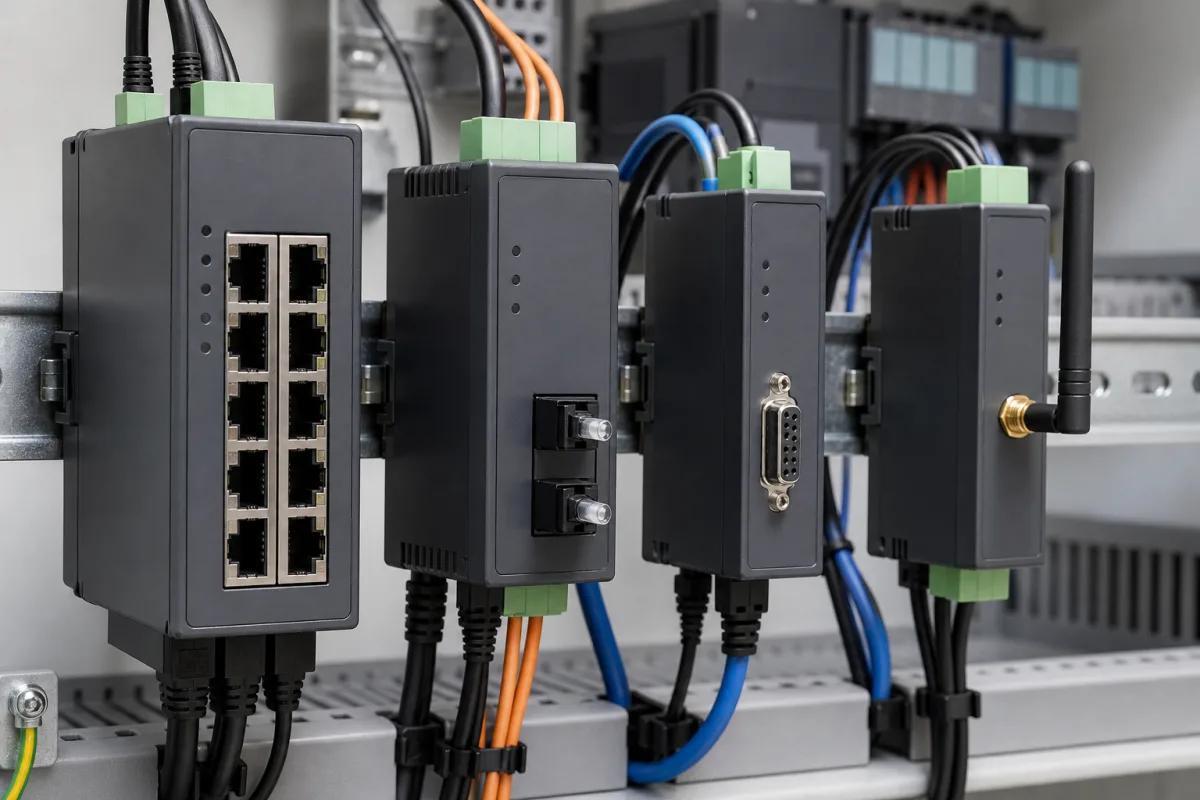
Hardware components that enable data exchange between control system devices and external networks.
Product Specifications

Technical details and manufacturing context for Communication Modules

Definition
Communication modules are specialized hardware components within a Central Process Control System that facilitate data transmission and reception between controllers, sensors, actuators, and external systems. They convert control signals into standardized communication protocols (such as Ethernet, Profibus, Modbus, or fieldbus standards) and vice versa, ensuring reliable, real-time data exchange across the industrial automation network.
Working Principle
Communication modules operate by receiving digital or analog signals from the central processor or field devices, encoding them into a specific protocol format, and transmitting them over wired or wireless networks. They also receive incoming data, decode it, and pass it to the control system for processing. This involves protocol conversion, signal conditioning, error checking, and network management functions.
Common Materials
Printed Circuit Board (PCB), Integrated Circuits (ICs), Connectors, Plastic/ Metal Housing
Technical Parameters
  • Data transmission rate (Mbps) Per Request
Components / BOM
  • Processor Chip
    Manages protocol conversion and data processing
    Material: Silicon
  • Network Interface
    Physical connection point for network cables
    Material: Copper alloy, Plastic
  • Memory Module
    Stores configuration data and buffers transmission data
    Material: Semiconductor materials
  • Power Regulator
    Converts and stabilizes input voltage for internal components
    Material: Electronic components on PCB
Engineering Reasoning
0-60°C ambient temperature, 0-95% relative humidity non-condensing, 10-30 VDC supply voltage
Semiconductor junction temperature exceeding 125°C, dielectric breakdown at >500 VDC isolation voltage, signal integrity loss at >-20 dBm receiver sensitivity
Design Rationale: Thermal runaway in power regulation ICs due to excessive current density (>10^6 A/cm²), electromigration in copper traces at current densities >10^5 A/cm², latch-up in CMOS circuits from transient overvoltage (>0.7V above VDD)
Risk Mitigation (FMEA)
Trigger Electrostatic discharge (ESD) event exceeding 8 kV human body model
Mode: Gate oxide breakdown in Ethernet PHY transceiver
Strategy: TVS diode arrays with <1 ns response time and 15 kV ESD protection rating
Trigger Sustained vibration at 200 Hz resonance frequency with >5 g acceleration
Mode: Solder joint fatigue cracking leading to intermittent connection loss
Strategy: Underfill epoxy encapsulation with CTE matching of 15 ppm/°C and corner reinforcement

Industry Taxonomies & Aliases

Commonly used trade names and technical identifiers for Communication Modules.

Applied To / Applications

This component is essential for the following industrial systems and equipment:

Industrial Ecosystem & Supply Chain DNA

Complementary Systems
Downstream Applications
Specialized Tooling

Application Fit & Sizing Matrix

Operational Limits
data rate: 10 Mbps to 1 Gbps
temperature: -40°C to +85°C
voltage range: 9-36 VDC
operating humidity: 5% to 95% non-condensing
Media Compatibility
✓ Industrial Ethernet networks ✓ Modbus TCP/IP systems ✓ Wireless LAN environments
Unsuitable: High-voltage electrical substations with EMI interference
Sizing Data Required
  • Network protocol requirements (e.g., Ethernet/IP, PROFINET)
  • Required data throughput (Mbps/Gbps)
  • Number of connected devices/nodes

Reliability & Engineering Risk Analysis

Failure Mode & Root Cause
Corrosion-induced signal degradation
Cause: Exposure to moisture, chemicals, or harsh environments leading to oxidation of connectors and circuit board traces, resulting in intermittent or complete loss of communication signals.
Thermal stress failure
Cause: Prolonged operation at high temperatures or thermal cycling causing solder joint fatigue, component degradation, or expansion/contraction damage to internal connections, leading to module malfunction.
Maintenance Indicators
  • Intermittent or erratic communication signals (e.g., dropped packets, signal noise, or inconsistent data transmission)
  • Visible corrosion, discoloration, or moisture ingress on module housing or connectors
Engineering Tips
  • Implement environmental sealing and proper IP-rated enclosures with desiccants to protect against moisture and corrosive atmospheres, especially in industrial settings.
  • Ensure adequate thermal management through proper heat sinking, ventilation, and maintaining ambient temperature within manufacturer specifications to prevent thermal stress-related failures.

Compliance & Manufacturing Standards

Reference Standards
ISO/IEC 11801: Information technology - Generic cabling for customer premises ANSI/TIA-568.2-D: Balanced Twisted-Pair Telecommunications Cabling and Components Standards EN 55032: Electromagnetic compatibility of multimedia equipment - Emission requirements
Manufacturing Precision
  • Connector pin alignment: +/-0.1mm
  • PCB trace width: +/-10% of nominal dimension
Quality Inspection
  • Electromagnetic Compatibility (EMC) testing
  • Signal integrity and bit error rate testing

Factories Producing Communication Modules

Verified manufacturers with capability to produce this product in China

✓ 98% Supplier Capability Match Found

S Sourcing Manager from Singapore Feb 09, 2026
★★★★★
"Testing the Communication Modules now; the technical reliability results are within 1% of the laboratory datasheet."
Technical Specifications Verified
P Procurement Specialist from Germany Feb 06, 2026
★★★★☆
"Impressive build quality. Especially the technical reliability is very stable during long-term operation. (Delivery took slightly longer than expected, but technical support was excellent.)"
Technical Specifications Verified
T Technical Director from Brazil Feb 03, 2026
★★★★★
"As a professional in the Machinery and Equipment Manufacturing sector, I confirm this Communication Modules meets all ISO standards."
Technical Specifications Verified
Verification Protocol

“Feedback is collected from verified sourcing managers during RFQ (Request for Quote) and factory evaluation processes on CNFX. These reports represent historical performance data and technical audit summaries from our B2B manufacturing network.”

13 sourcing managers are analyzing this specification now. Last inquiry for Communication Modules from Poland (58m ago).

Supply Chain Compatible Machinery & Devices

Automated Assembly Line System

Integrated production system for sequential component assembly operations

Explore Specs →
Automated Powder Coating System

Integrated industrial system for applying dry powder coatings to metal substrates.

Explore Specs →
Centrifugal Pump Impeller

Rotating component that transfers energy to fluid in centrifugal pumps.

Explore Specs →
High-Precision CNC Laser Cutting Machine

Computer-controlled industrial machine using focused laser beams to cut sheet metal with micron-level accuracy.

Explore Specs →

Frequently Asked Questions

What are the key components in industrial communication modules for machinery?

Industrial communication modules typically include a Printed Circuit Board (PCB), Integrated Circuits (ICs), connectors, and durable plastic or metal housing. The BOM consists of memory modules, network interfaces, power regulators, and processor chips for reliable data exchange.

How do communication modules enhance machinery manufacturing operations?

Communication modules enable seamless data exchange between control system devices and external networks, facilitating real-time monitoring, remote diagnostics, and integration with industrial IoT systems in machinery manufacturing environments.

What materials ensure durability in industrial communication modules?

Industrial communication modules use robust materials including high-quality PCBs, industrial-grade ICs, reliable connectors, and protective plastic or metal housing to withstand harsh manufacturing environments with vibration, temperature fluctuations, and electromagnetic interference.

Can I contact factories directly on CNFX?

CNFX is an open directory, not a transaction platform. Each factory profile provides direct contact information and production details to help you initiate direct inquiries with Chinese suppliers.

Get Quote for Communication Modules

Request technical pricing, lead times, or customized specifications for Communication Modules directly from verified manufacturing units.

Your business information is encrypted and only shared with verified Communication Modules suppliers.

Thank you! Your message has been sent. We'll respond within 1–3 business days.

Need to Manufacture Communication Modules?

Connect with verified factories specializing in this product category

Add Your Factory Contact Us
Previous Product
Communication Module
Next Product
Communication Network