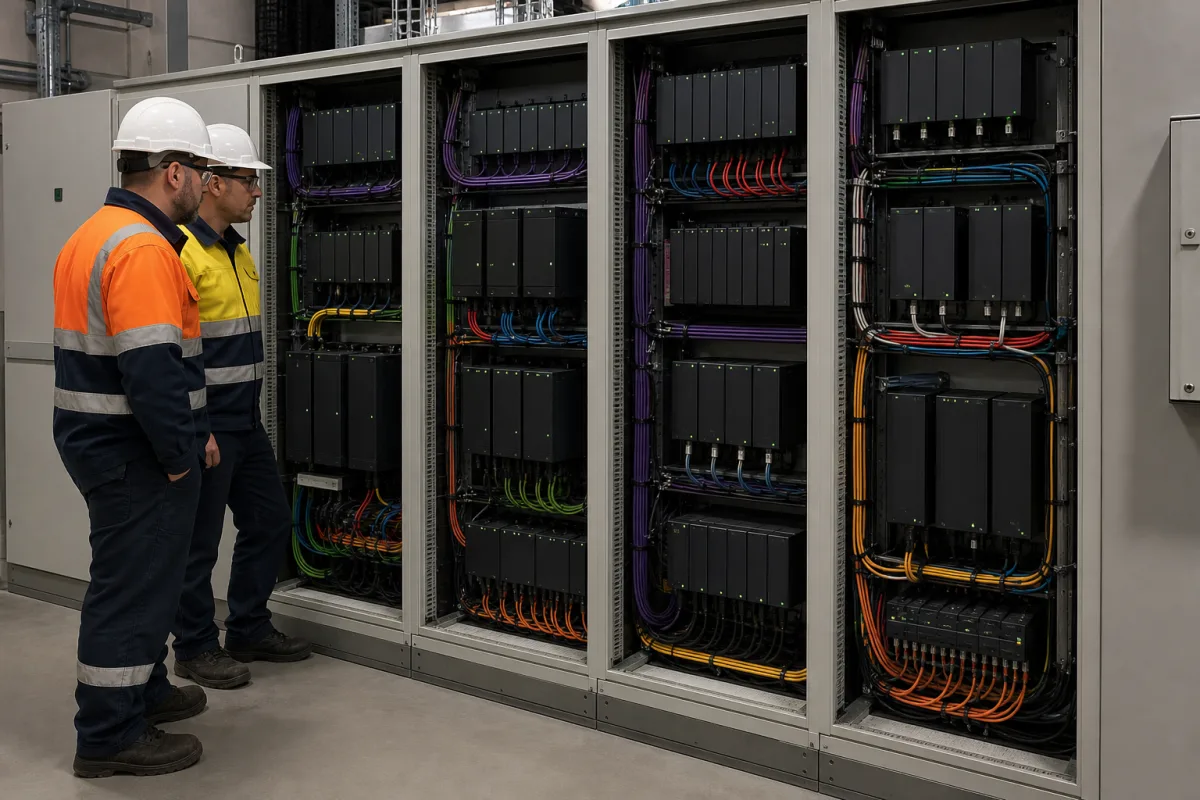
Automation control system (Level 1 and Level 2 automation of a hot strip mill)
Level 1 and Level 2 automation of a hot strip mill · setup, width, temperature, flatness and crown models, the gauge, tension and looper loops of the finishing train, and replacing mill automation in stages while the mill keeps rolling
A hot strip mill's automation is split into layers: Level 1 runs the drives, gaps and loopers in real time, and Level 2 calculates what each bar should see before and while it is rolled, using process models. Buying it, new or as a replacement, means defining which layer covers what, who supplies the models, how the fast loops in the finishing train are handled, and how the change-over happens without stopping production.
Level 1 (basic) and Level 2 (process) automation of hot strip mills: setup and process models, gauge, tension and looper control, product tracking, HMI and business interfaces, and their replacement on running mills. Complete mills are covered on the Integrated hot strip rolling and finishing system page; run-out cooling and coiling temperature control on the Run-out table for a hot strip mill page; mill stands on the Heavy-duty rolling mill stand page; reheating furnaces on the Reheating furnace page; arc furnace process control on the Process control system for electric arc furnace steelmaking page.
CNFX editorial research · Sources checked October 12, 2026 · 3 sources
Engineers from Usiminas (P. S. da S. Vallim and co-authors, ABM rolling seminar 2011) describe the control models of the edger, roughing mill and Hot Strip Mill 2 at Cubatão, focusing on "the control models of level-2, of the automation, also pointing some interactions with level-1", and covering set-up, width and temperature, flatness and crown. [2] When International Steel Group replaced the automation of its 84-inch hot strip mill in Cleveland, the work was split three ways: one supplier took "all Level 1 functionality" and project management, a second provided "new process models for the Roughing Mill, Finish Mill, and Coiling Temperature Control areas", and a third the business computer interfaces, HMI and "non-model Level 2 functionality". [1]
Layer
Functions named in the sources
Source
Level 2 models
Set-up; width and temperature; flatness and crown; roughing, finishing and coiling temperature models
Write the functional split as a table for the tender: every function from furnace charging to coiling, which level it sits in, and who supplies it.
02
The fast loops in the finishing train: gauge, tension and looper
Francesco Cuzzola of Danieli Automation and Thomas Parisini of the University of Trieste write that finishing mills roll in tandem "with 5–7 successive stands" and that "Tension control turns out to be the key to stable mill": during Automatic Gauge Control tuning, strip tension "can present wide fluctuations due to quick roll gap movements", and limiting those fluctuations improves AGC. Looper position and interstand tension therefore need a simultaneous control scheme. [3]
They note that multivariable looper controllers have been used on real mills, citing Sovel SA in Greece and Algoma in Canada, and aim their nonlinear design at short off-gauge lengths "even for thin products (0.7-1.2 mm)" and gauge setup on the fly. [3]
Ask bidders how gauge, tension and looper loops interact in their Level 1 design, what thinnest strip and setup-on-the-fly they have commissioned, and on which mills.
03
Replacing automation in stages on a running mill
For the ISG 84-inch mill, the new systems' functional scope covered "the entire process from furnace charging through to coiling", on "open, standards-based hardware and software", and "In consideration of the mill's production requirements, the transition from the old to new system will be managed in stages." [1]
The Usiminas paper sets out the expectations attached to adopting the control models on its new hot strip line, by equipment. [2]
Specify the cut-over plan: which areas change in which outage, how old and new systems coexist, and what data and models are carried over.
04
Mill automation tender details
Paste it into your enquiry below or into an email to a maker, then replace every bracket.
Explore company information and manufacturing capabilities, then discuss the scope of your project with a relevant supplier.
Share this page
Compiled and source-reviewed by the CNFX editorial team.
Each manufacturer above links to the page on that company's own website where the product is listed, with the date we checked it. How we source and review
· Page last updated 13 October 2026
Buyer questions
What does Level 2 do in a hot strip mill?
It runs the process models; the Usiminas paper covers set-up, width and temperature, flatness and crown models and their interaction with Level 1. [2]
Why is interstand tension so important?
Danieli Automation researchers say tension control is key to a stable finishing mill, since tension fluctuations from quick gap moves disturb AGC. [3]
Can automation be replaced without a long shutdown?
ISG managed the transition on its 84-inch mill in stages because of production requirements. [1]
Is coiling temperature control part of this?
ISG's model supplier covered coiling temperature control; run-out cooling equipment has its own page. [1]
Sources and what still needs a direct check
Sources checked 2026-10-12. AIST reported the ISG hot strip mill automation contract; ABM published the Usiminas paper on hot strip mill control models; the IFAC 2005 congress proceedings carry the Danieli Automation looper control paper.