Industry-Verified Manufacturing Data (2026)

Cooler

Based on aggregated insights from multiple verified factory profiles within the CNFX directory, the standard Cooler used in the Machinery and Equipment Manufacturing sector typically supports operational capacities ranging from standard industrial configurations to heavy-duty production requirements.

Technical Definition & Core Assembly

A canonical Cooler is characterized by the integration of Core/Tube Bundle and Fins. In industrial production environments, manufacturers listed on CNFX commonly emphasize Aluminum construction to support stable, high-cycle operation across diverse manufacturing scenarios.

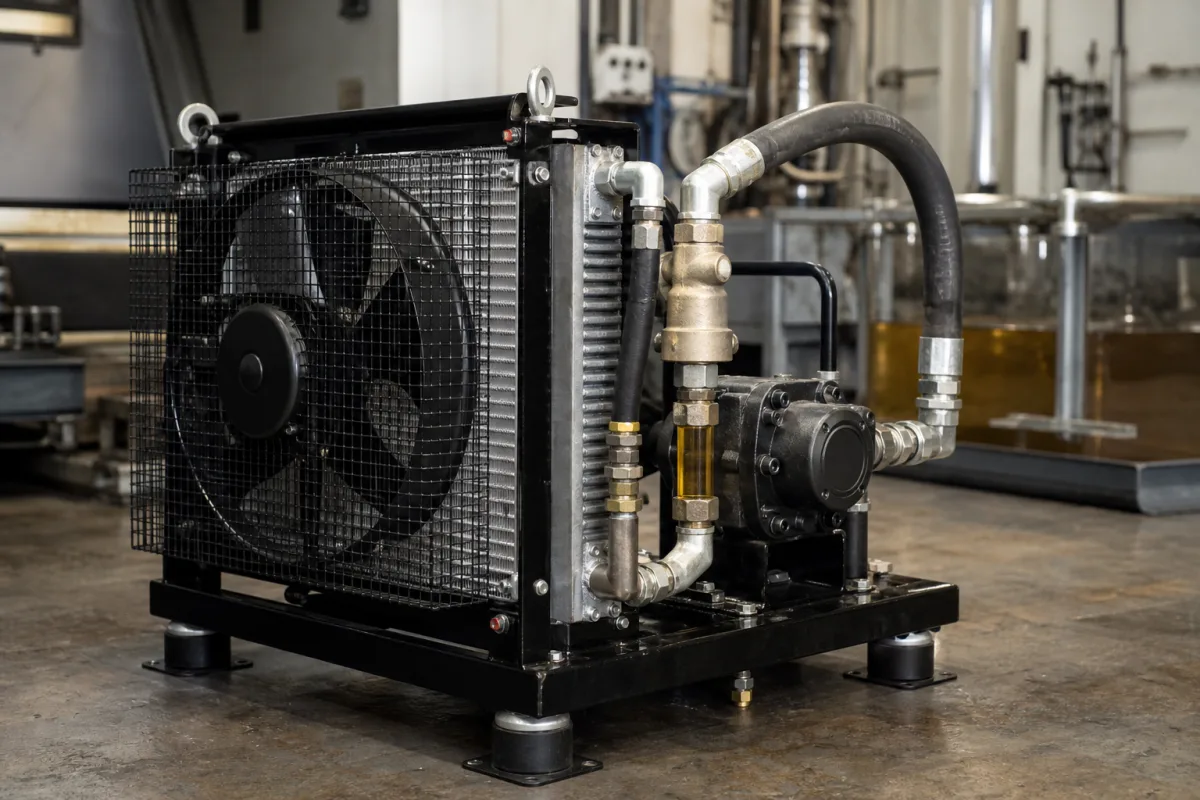
A heat exchanger component within a lubrication system that removes excess heat from lubricating oil to maintain optimal operating temperatures.
Product Specifications

Technical details and manufacturing context for Cooler

Definition
In lubrication systems, a cooler is a critical component designed to dissipate heat generated by friction and mechanical processes. It functions as a heat exchanger that transfers thermal energy from the lubricating oil to a cooling medium (typically air or water), preventing oil degradation, maintaining viscosity, and protecting machinery components from overheating damage.
Working Principle
Hot lubricating oil flows through tubes or channels within the cooler while a cooling medium (air or water) flows over or around them. Heat transfers from the oil to the cooling medium through conduction and convection, reducing the oil temperature before it returns to lubricate system components.
Common Materials
Aluminum, Copper, Stainless Steel
Technical Parameters
  • Core dimensions (length × width × height) or tube diameter (mm) Standard Spec
Components / BOM
  • Core/Tube Bundle
    Primary heat transfer surface where oil flows and releases heat
    Material: Aluminum or Copper
  • Fins
    Increase surface area for enhanced heat dissipation to cooling medium
    Material: Aluminum
  • Headers/Manifolds
    Distribute oil flow into multiple tubes and collect cooled oil
    Material: Aluminum or Steel
  • Housing/Casing
    Structural enclosure that directs cooling medium flow and protects internal components
    Material: Steel or Aluminum
Engineering Reasoning
0.5-4.0 MPa (5-40 bar) at 20-90°C oil temperature with 10-100 L/min flow rate
Thermal stress exceeding 250 MPa yield strength at 150°C differential temperature across tube-plate joints
Design Rationale: Thermal fatigue from cyclic temperature gradients exceeding 80°C between oil inlet (90°C) and cooling medium (10°C), causing differential expansion stresses at brazed joints exceeding material endurance limit of 180 MPa for copper-nickel alloys
Risk Mitigation (FMEA)
Trigger Calcium carbonate scaling deposition exceeding 0.5 mm thickness on cooling tube interior surfaces
Mode: Thermal conductivity reduction from 50 W/m·K to below 15 W/m·K, causing oil outlet temperature rise above 65°C design limit
Strategy: Integrate ultrasonic anti-fouling transducers operating at 25-40 kHz frequency with automated citric acid flush system activated at 0.3 mm scale detection
Trigger Galvanic corrosion at dissimilar metal interfaces (copper tubes to steel headers) with electrolyte pH below 6.5
Mode: Wall thickness reduction exceeding 0.8 mm/year corrosion rate, leading to pinhole leaks at tube-to-header joints
Strategy: Implement cathodic protection with sacrificial zinc anodes and apply 200 μm thick epoxy-phenolic coating with 10^12 Ω·cm resistivity

Industry Taxonomies & Aliases

Commonly used trade names and technical identifiers for Cooler.

Applied To / Applications

This component is essential for the following industrial systems and equipment:

Industrial Ecosystem & Supply Chain DNA

Complementary Systems
Downstream Applications
Specialized Tooling

Application Fit & Sizing Matrix

Operational Limits
pressure: Maximum operating pressure: 10 bar (145 psi), typical working pressure: 2-6 bar
flow rate: Oil flow rate range: 10 to 500 L/min
temperature: Inlet oil temperature range: 40°C to 120°C, Outlet target: 30°C to 80°C
cooling capacity: Heat removal capacity: 5 to 200 kW
Media Compatibility
✓ Mineral-based lubricating oils ✓ Synthetic lubricants (PAO, PAG, esters) ✓ Hydraulic fluids (ISO VG 32-68)
Unsuitable: Corrosive chemical media or abrasive slurry with >5% solids concentration
Sizing Data Required
  • Required heat dissipation (kW)
  • Oil flow rate (L/min)
  • Available cooling water temperature and flow rate

Reliability & Engineering Risk Analysis

Failure Mode & Root Cause
Fouling and scaling
Cause: Accumulation of mineral deposits, biological growth, or particulate matter on heat transfer surfaces, reducing thermal efficiency and increasing pressure drop due to poor water quality, inadequate filtration, or insufficient chemical treatment.
Corrosion and pitting
Cause: Electrochemical degradation of metal components, particularly in tubes, headers, or fins, caused by aggressive water chemistry (low pH, high chloride content), galvanic couples, or inadequate corrosion inhibitors.
Maintenance Indicators
  • Significant drop in cooling efficiency (e.g., higher outlet temperatures than normal under same load conditions)
  • Unusual noises such as knocking, rattling, or excessive vibration indicating loose components, flow-induced vibration, or cavitation
Engineering Tips
  • Implement a robust water treatment program with regular monitoring of pH, conductivity, and biocide levels to prevent scaling, fouling, and corrosion
  • Conduct periodic infrared thermography surveys to detect uneven temperature distribution across the cooler, indicating blocked tubes or fouling before it causes operational issues

Compliance & Manufacturing Standards

Reference Standards
ISO 9001:2015 - Quality Management Systems CE Marking (EU) - Safety, Health, Environmental Protection ASTM B209 - Standard Specification for Aluminum and Aluminum-Alloy Sheet and Plate
Manufacturing Precision
  • Flatness: +/- 0.5 mm per meter
  • Fin spacing: +/- 0.2 mm
Quality Inspection
  • Pressure Leak Test (e.g., hydrostatic or pneumatic)
  • Thermal Performance Test (e.g., heat dissipation measurement)

Factories Producing Cooler

Verified manufacturers with capability to produce this product in China

✓ 96% Supplier Capability Match Found

P Procurement Specialist from Australia Feb 28, 2026
★★★★★
"The technical documentation for this Cooler is very thorough, especially regarding technical reliability."
Technical Specifications Verified
T Technical Director from Singapore Feb 25, 2026
★★★★★
"Reliable performance in harsh Machinery and Equipment Manufacturing environments. No issues with the Cooler so far."
Technical Specifications Verified
P Project Engineer from Germany Feb 22, 2026
★★★★★
"Testing the Cooler now; the technical reliability results are within 1% of the laboratory datasheet."
Technical Specifications Verified
Verification Protocol

“Feedback is collected from verified sourcing managers during RFQ (Request for Quote) and factory evaluation processes on CNFX. These reports represent historical performance data and technical audit summaries from our B2B manufacturing network.”

9 sourcing managers are analyzing this specification now. Last inquiry for Cooler from USA (1h ago).

Supply Chain Compatible Machinery & Devices

Heavy-Duty CNC Plasma Cutting Machine

Industrial machine for precision metal cutting using plasma arc technology

Explore Specs →
Automated Assembly Line System

Integrated production system for sequential component assembly operations

Explore Specs →
Automated Powder Coating System

Integrated industrial system for applying dry powder coatings to metal substrates.

Explore Specs →
Centrifugal Pump Impeller

Rotating component that transfers energy to fluid in centrifugal pumps.

Explore Specs →

Frequently Asked Questions

What materials are available for this lubrication system cooler?

This cooler is available in aluminum, copper, and stainless steel materials to suit different industrial applications and corrosion resistance requirements.

How does this cooler maintain optimal operating temperatures in machinery?

The cooler functions as a heat exchanger within the lubrication system, efficiently removing excess heat from circulating oil to prevent overheating and ensure machinery operates within safe temperature ranges.

What are the main components of this industrial cooler?

Key components include the core/tube bundle for heat transfer, fins to increase surface area, headers/manifolds for fluid distribution, and a housing/casing for structural protection.

Can I contact factories directly on CNFX?

CNFX is an open directory, not a transaction platform. Each factory profile provides direct contact information and production details to help you initiate direct inquiries with Chinese suppliers.

Get Quote for Cooler

Request technical pricing, lead times, or customized specifications for Cooler directly from verified manufacturing units.

Your business information is encrypted and only shared with verified Cooler suppliers.

Thank you! Your message has been sent. We'll respond within 1–3 business days.

Need to Manufacture Cooler?

Connect with verified factories specializing in this product category

Add Your Factory Contact Us
Previous Product
Coolant Tank/Reservoir
Next Product
Cooling and Quenching Unit