Industry-Verified Manufacturing Data (2026)

Cooling Heat Exchanger or Chiller Unit

Based on aggregated insights from multiple verified factory profiles within the CNFX directory, the standard Cooling Heat Exchanger or Chiller Unit used in the Machinery and Equipment Manufacturing sector typically supports operational capacities ranging from standard industrial configurations to heavy-duty production requirements.

Technical Definition & Core Assembly

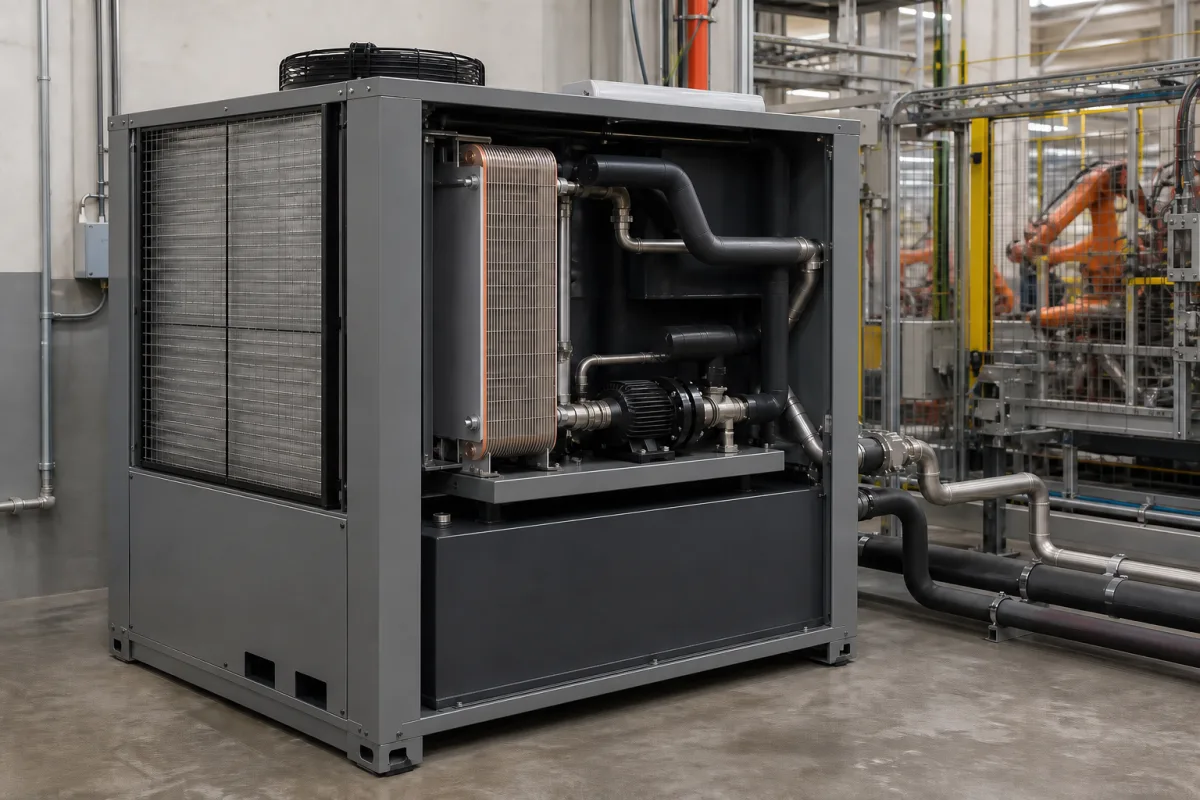
A canonical Cooling Heat Exchanger or Chiller Unit is characterized by the integration of Heat Exchanger Core and Compressor. In industrial production environments, manufacturers listed on CNFX commonly emphasize Copper construction to support stable, high-cycle operation across diverse manufacturing scenarios.

A component within a Coolant Management System that removes heat from the coolant through heat exchange or refrigeration cycles.
Product Specifications

Technical details and manufacturing context for Cooling Heat Exchanger or Chiller Unit

Definition
A critical component of the Coolant Management System responsible for regulating coolant temperature by transferring heat from the coolant to another medium (air, water, or refrigerant). It maintains optimal operating temperatures for machinery and processes, preventing overheating and ensuring system efficiency.
Working Principle
Operates through heat exchange principles: in a heat exchanger, hot coolant flows through tubes or plates while a cooler medium (air or water) absorbs heat; in a chiller unit, a refrigeration cycle (compression, condensation, expansion, evaporation) extracts heat from the coolant, typically using a refrigerant.
Common Materials
Copper, Aluminum, Stainless Steel
Technical Parameters
  • Cooling capacity, indicating the rate of heat removal from the coolant. (kW) Per Request
Components / BOM
  • Heat Exchanger Core
    Facilitates heat transfer between coolant and cooling medium.
    Material: Copper or Aluminum
  • Compressor
    In chiller units, compresses refrigerant to initiate the cooling cycle.
    Material: Steel or Cast Iron
  • Evaporator Coil
    Absorbs heat from the coolant in chiller units via refrigerant evaporation.
    Material: Copper
Engineering Reasoning
0.5-3.5 MPa (5-35 bar) at 5-40°C coolant temperature
Compressor discharge pressure exceeding 4.2 MPa (42 bar) or evaporator approach temperature dropping below 2°C
Design Rationale: Refrigerant flash gas formation in expansion valve causing liquid slugging in compressor scroll elements
Risk Mitigation (FMEA)
Trigger Coolant glycol concentration dropping below 30% by volume
Mode: Ice crystal formation on evaporator tubes causing refrigerant flow restriction
Strategy: Automated glycol concentration monitoring with 35% minimum setpoint interlock
Trigger Condenser fouling exceeding 0.00025 m²·K/W thermal resistance
Mode: Compressor head pressure rising above 3.8 MPa (38 bar) causing thermal overload trip
Strategy: Differential pressure monitoring across condenser with 15 kPa delta-P alarm threshold

Industry Taxonomies & Aliases

Commonly used trade names and technical identifiers for Cooling Heat Exchanger or Chiller Unit.

Applied To / Applications

This component is essential for the following industrial systems and equipment:

Industrial Ecosystem & Supply Chain DNA

Complementary Systems
Downstream Applications
Specialized Tooling

Application Fit & Sizing Matrix

Operational Limits
pressure: Up to 10 bar (operating pressure)
flow rate: 5-500 L/min (coolant flow capacity)
temperature: -20°C to 150°C (coolant inlet range)
slurry concentration: Up to 20% solids by weight (for slurry applications)
Media Compatibility
✓ Water-glycol mixtures ✓ Mineral oil-based coolants ✓ Synthetic ester fluids
Unsuitable: Chlorinated solvents or highly corrosive acids
Sizing Data Required
  • Required heat removal capacity (kW)
  • Coolant inlet temperature (°C)
  • Maximum allowable pressure drop (bar)

Reliability & Engineering Risk Analysis

Failure Mode & Root Cause
Fouling
Cause: Accumulation of scale, biological growth, or debris on heat transfer surfaces, reducing efficiency and increasing pressure drop.
Corrosion
Cause: Chemical attack from water chemistry (e.g., low pH, high chlorides) or galvanic action between dissimilar metals in the system.
Maintenance Indicators
  • Abnormal increase in approach temperature (difference between refrigerant and water temperatures)
  • Unusual noises such as grinding, knocking, or excessive vibration from compressor or pumps
Engineering Tips
  • Implement regular water treatment and filtration to control scaling, corrosion, and biological growth
  • Establish predictive maintenance with vibration analysis, infrared thermography, and regular tube cleaning schedules

Compliance & Manufacturing Standards

Reference Standards
ISO 9001:2015 - Quality management systems ANSI/ASHRAE 15 - Safety standard for refrigeration systems CE Marking - Directive 2014/68/EU (Pressure Equipment Directive)
Manufacturing Precision
  • Tube wall thickness: +/-0.1mm
  • Heat exchanger plate flatness: 0.05mm per meter
Quality Inspection
  • Hydrostatic pressure test
  • Leak detection test (helium or refrigerant)

Factories Producing Cooling Heat Exchanger or Chiller Unit

Verified manufacturers with capability to produce this product in China

✓ 94% Supplier Capability Match Found

P Procurement Specialist from United Arab Emirates Jan 19, 2026
★★★★★
"Standard OEM quality for Machinery and Equipment Manufacturing applications. The Cooling Heat Exchanger or Chiller Unit arrived with full certification."
Technical Specifications Verified
T Technical Director from Australia Jan 16, 2026
★★★★★
"Great transparency on the Cooling Heat Exchanger or Chiller Unit components. Essential for our Machinery and Equipment Manufacturing supply chain."
Technical Specifications Verified
P Project Engineer from Singapore Jan 13, 2026
★★★★★
"The Cooling Heat Exchanger or Chiller Unit we sourced perfectly fits our Machinery and Equipment Manufacturing production line requirements."
Technical Specifications Verified
Verification Protocol

“Feedback is collected from verified sourcing managers during RFQ (Request for Quote) and factory evaluation processes on CNFX. These reports represent historical performance data and technical audit summaries from our B2B manufacturing network.”

19 sourcing managers are analyzing this specification now. Last inquiry for Cooling Heat Exchanger or Chiller Unit from USA (28m ago).

Supply Chain Compatible Machinery & Devices

Automated Assembly Line System

Integrated production system for sequential component assembly operations

Explore Specs →
Automated Powder Coating System

Integrated industrial system for applying dry powder coatings to metal substrates.

Explore Specs →
Centrifugal Pump Impeller

Rotating component that transfers energy to fluid in centrifugal pumps.

Explore Specs →
High-Precision CNC Laser Cutting Machine

Computer-controlled industrial machine using focused laser beams to cut sheet metal with micron-level accuracy.

Explore Specs →

Frequently Asked Questions

What is the primary function of a cooling heat exchanger or chiller unit in machinery manufacturing?

It removes heat from coolant in a Coolant Management System through heat exchange or refrigeration cycles, maintaining optimal operating temperatures for machinery and equipment.

What materials are commonly used in these cooling units and why?

Copper, aluminum, and stainless steel are used for their excellent thermal conductivity, corrosion resistance, and durability in industrial environments, ensuring efficient heat transfer and long service life.

What are the key components in a typical cooling heat exchanger or chiller unit?

The main components include a heat exchanger core for heat transfer, a compressor for refrigeration cycles, and an evaporator coil for coolant cooling, working together to efficiently manage thermal loads.

Can I contact factories directly on CNFX?

CNFX is an open directory, not a transaction platform. Each factory profile provides direct contact information and production details to help you initiate direct inquiries with Chinese suppliers.

Get Quote for Cooling Heat Exchanger or Chiller Unit

Request technical pricing, lead times, or customized specifications for Cooling Heat Exchanger or Chiller Unit directly from verified manufacturing units.

Your business information is encrypted and only shared with verified Cooling Heat Exchanger or Chiller Unit suppliers.

Thank you! Your message has been sent. We'll respond within 1–3 business days.

Need to Manufacture Cooling Heat Exchanger or Chiller Unit?

Connect with verified factories specializing in this product category

Add Your Factory Contact Us
Previous Product
Cooling Fan
Next Product
Cooling Integration Plate