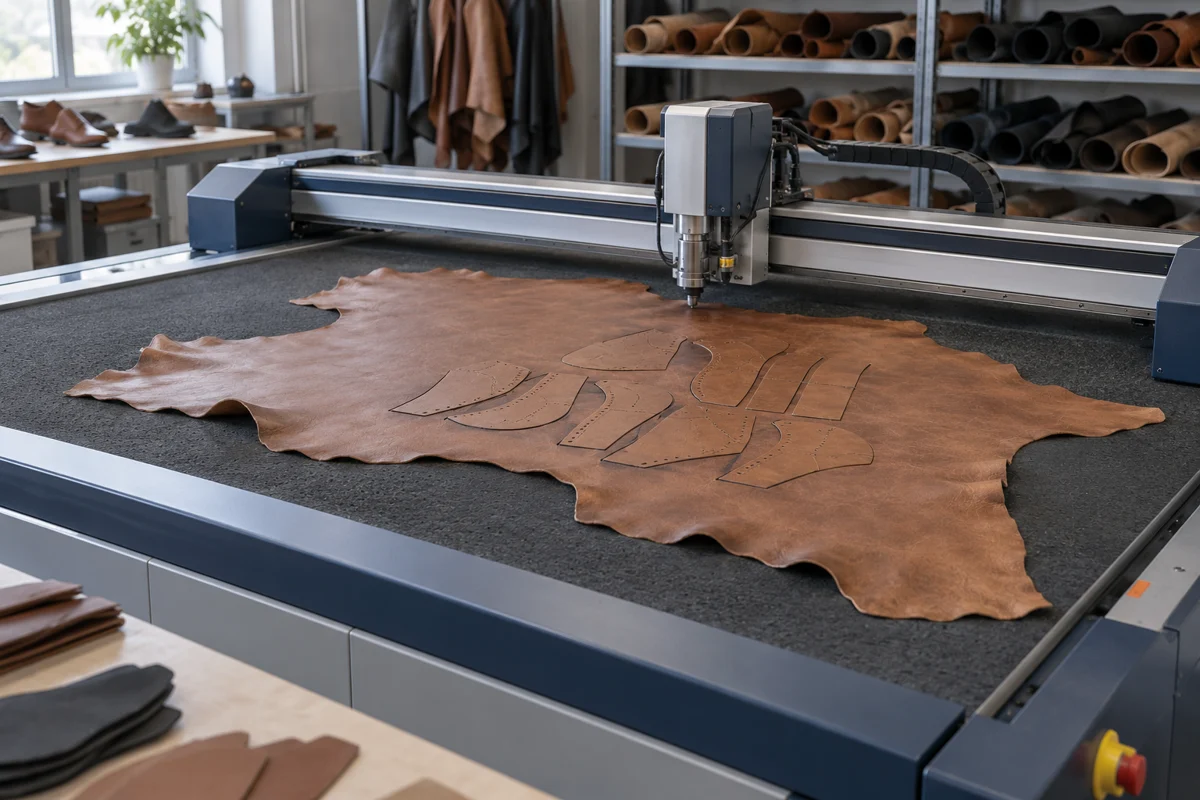
With genuine leather, the cutter is only half the system: yield depends on how the hide's outline, defects and quality zones are captured and how parts are nested around them. This guide reads a Chinese CNC leather cutter's specification and sets it against the software functions described by Zünd and Lectra.
Editorial reference for CNC knife hide cutting; published Ruizhou catalogue fields and platform-specific Zünd/Lectra workflow descriptions are separate. No model certification or manufacturing BOM has been verified.
CNFX editorial research · Sources checked October 12, 2026 · 4 sources
Ruizhou publishes its RZCUT5-3016SF-2H CNC leather cutting machine with these parameters [1].
Size the table to your hides
The published 3,000 × 1,600 mm working area is the material envelope, not the overall machine footprint [1]. Lay out the largest hides and the required margin before selecting a table; there is no hide-size distribution here to establish how many will fit.
Resolution is not cutting accuracy
Ruizhou labels 0.01 mm as machine resolution and 0.025 mm as software resolution [1]. Neither is a measured positioning-accuracy or finished-part tolerance specification. Have the trial report identify the commanded geometry, measured edges, leather condition and cutting settings.
Combined head, camera, projectors and nesting software. The page also shows a two-head machine photograph, without a drawing tying every illustrated option to the delivered configuration [1]
Servo motors, linear guides and rack; HP-GL / GP-GL compatible; network port [1]
Supply and safety
220 V is listed without phase/frequency or connection load. The safety field says automatic laser device, without a safety-function specification or validation report [1]
The speed and thickness ranges are separate catalogue fields. They do not establish 1,200 mm/s cutting through every 6 mm hide, and pump motor power does not state the vacuum available at the material. Ask for a trial with the selected blade, hide and hold-down settings.
02
Compare an ultrasonic knife with a CO2 laser on leather
Some cutting systems offer an ultrasonic knife or a CO2 laser head besides the oscillating blade. A university study at King Fahd University of Petroleum and Minerals cut 1.4 mm buffalo leather both ways. Its ultrasonic generator held the horn between 19,850 and 20,250 Hz and drove an 18 mm cutting tool; the CO2 laser trials varied power from 20 to 30 W, cutting speed from 10 to 30 m/min and standoff distance from 1.5 to 1.9 mm. [4]
Editorial calculation: the laser speed range of 10–30 m/min equals about 167–500 mm/s, inside the 100–1,200 mm/s range Ruizhou lists for its knife machine; the study did not test an oscillating blade, so it does not rank either method against one. [4][1] Editorial note: if a supplier offers a laser or ultrasonic head, ask for kerf width and edge photographs on your own hide and thickness, since these results come from one 1.4 mm buffalo leather.
Result reported
Ultrasonic cutting
CO2 laser cutting
Settings varied
Delay time 0.1–0.4 s, cutting time 0.02–0.12 s, shaking time 0.02–0.08 s [4]
Power 20–30 W, speed 10–30 m/min, standoff 1.5–1.9 mm [4]
A digital knife cutter combines controlled tool motion, material hold-down and a pattern file. Ruizhou lists servo motors, linear guides and gear rack, a combined head, zoned vacuum and a network interface [1]. The functional breakdown below explains those roles; it is not a manufacturing BOM with approved replacement part numbers.
Assembly or provision
Role and evidence boundary
Motion bridge and drive
Guides and rack transmit servo-controlled motion across the bed. The published specification does not identify gantry alloy, rack grade or bearing part numbers [1].
Cutting head and tools
The head carries the selected oscillating blade or other listed tools along the pattern. Tool names establish available functions, not an automatic tool-changing mechanism or a universal stainless-steel head [1].
Vacuum bed and pump
Divisional vacuum absorption holds material against the bed; a 9 kW pump and frequency converter are listed. Bed material, seal compound, vacuum level and leakage allowance are not specified [1].
Control and operator interface
The page lists a touch-screen LCD, CNC software and computer display, with HP-GL/GP-GL commands through a network port. Specific CAD import modules and ERP connections require a software configuration [1].
Camera and projection
Camera and projection are listed. The manufacturer’s workflow illustration shows manual flaw checking/marking, contour photography and flaw recognition, grading and auto-nesting; it gives no defect taxonomy, detection test or operator-correction specification [1].
Dust collection, if the selected process needs it
No extraction assembly or filter is identified for this Ruizhou model in the reviewed specification. Include its need and interface in the quotation for the chosen cutting or milling operation; do not treat it as included.
Tool changing and consumables
Ruizhou lists an oscillating blade head, milling cutter, hobbing cutter and creasing wheel, plus pen tools, but automatic changeover is not established. The maker excludes blades and mats from its one-year guarantee; obtain the actual tool-change procedure and matching consumable identifiers [1].
Do not order a replacement head, blade holder, seal or optical unit from this functional list. This page has no model-specific manufacturing materials, quantities or interchangeable spare-part approval.
04
Turn catalogue fields into an installation and trial specification
The published RZCUT5-3016SF-2H table covers motion, tools and a few utilities [1]. The remaining fields below explain what the quotation must state rather than supplying anonymous values for the whole category.
Field
What is established, and what the order still needs
Cutting width / length · mm
Working area is 3,000 × 1,600 mm. Obtain the machine axis drawing before assigning those dimensions to length and width; allow for the actual hide outline and permitted edge margin [1].
Leather thickness · mm
0.5–6 mm is listed. Test the actual hide, finish and stack with the quoted tool; the material list also includes PU and board and does not supply a material-by-tool limit table [1].
Cutting speed · mm/s or m/min
100–1,200 mm/s is the catalogue range, equivalent to 6–72 m/min by unit conversion. Complete hide throughput also includes capture, nesting, loading and removal; it is not this number multiplied by shift length [1][2].
Positioning accuracy · mm
Not stated as a tested accuracy. Keep machine resolution 0.01 mm and software resolution 0.025 mm under their published names; request an accuracy test with its method and conditions [1].
Vacuum pump power · kW
9 kW pump rating is listed. Specify vacuum zones, material support and measured hold-down conditions separately; pump power is not suction pressure [1].
File and software compatibility
HP-GL and GP-GL compatible commands plus a network port are listed. Demonstrate import, units and scale with the actual design files; a command format does not establish every CAD file importer [1].
Compressed-air pressure and consumption
Not given for this configuration. Establish whether the selected tool or actuator needs air, then obtain pressure, flow, air quality and connection requirements; do not assume pneumatic clamping.
Electrical supply
220 V is listed. Phase, frequency, protective devices and the approved connection schedule are not given; specify them for the destination site [1].
Total installed / operating power · kW
Not stated. Do not substitute the 9 kW pump rating for whole-machine connection load or measured consumption [1].
Room temperature · °C
No operating range in the reviewed model specification. Include the workshop conditions in the order and obtain limits for the assembled machine and capture equipment.
Relative humidity · %RH
No operating or condensation limit stated here. Specify the room and leather-conditioning procedure used in the acceptance trial rather than inventing a universal expansion allowance.
Machine weight · kg
Not supplied in the reviewed table. Obtain shipping and installed masses plus support/load information before planning lifting or floor capacity.
Overall footprint and access · mm
Not supplied. The 3,000 × 1,600 mm cutting area is not an installation drawing; include loading, removal, pump location and service access.
Width and length are shown together because the source provides one working-area pair. Unknown utility or environmental values remain open; none is a proven category-wide specification.
05
Capture the hide before cutting
Ruizhou’s illustrated sequence starts with checking and marking leather flaws, then photographing the contour and recognising flaws, grading, auto-nesting and cutting [1]. The illustration does not specify recognition limits or grading rules. Zünd describes the capture controls in its own Mind software in more detail [2].
Material defects and up to five quality zones are detected; results can be checked and corrected, and zones added [2]
Stretch direction
The leather's stretch direction can be defined for part placement [2]
Area check
The precise hide area is calculated and can be compared with the area invoiced by the supplier [2]
Marking off-line
Lectra's digital hide marking lets two operators mark one hide at once, without chalk dust or chemical remover [3]
Matching on the cutter
Lectra aligns the marked defect map with the hide once placed on the conveyor and adjusts buffers around flaws [3]
Zünd Mind and Lectra Versalis Automotive are separate platforms. Their detailed correction, quality-zone and matching functions are comparison questions for a Ruizhou demonstration, not established specifications of the Ruizhou software. The manufacturer’s illustrated workflow shows intended steps, without validating their accuracy or coverage.
06
Nest parts for yield
Nesting places parts around defects and into the right quality zones.
Ask the supplier to prove yield on your hides
Use a documented acceptance trial on your hides and actual part-quality rules. Record the eligible material area, accepted part area, rejected pieces, manual corrections and elapsed time from loading to removal; define the utilisation denominator before comparing methods. Reusing the same digital maps for a software comparison and cutting matched physical hides are different tests. This is a proposed test plan, not a reported production result.
Zone placement
Parts are placed according to designated zones, with vertical and horizontal defect handling [2]
Modes
Manual, interactive or fully automatic nesting [2]
Customer rules
Lectra preloads OEM requirements so grading and nesting follow them [3]
Reporting
Lectra compares hide markings with cutting data to benchmark defects found and efficiency [3]
Ruizhou
Automatic nesting software, camera and projector are included [1]
07
Plan the cutting room around the software
Capture, nesting, cutting and part removal should flow without the cutter waiting.
Software that covers digitising parts, capture, nesting, cutting and parts removal [2]
Projection and cameras at the cutter for placing and checking [2][1]
Off-line marking stations so the cutter is not idle during marking [3]
Consumables: blades and cutting mat are excluded from Ruizhou's one-year warranty [1]
Obtain the isolation and safe tool-change instructions, blade/mat replacement criteria, bed/vacuum cleaning procedure and camera calibration checks for the delivered configuration. No maintenance interval or cleaning chemical is established in the reviewed product page.
Record which capture, nesting, reporting and integration modules are licensed. Zünd describes a perpetual software-use license with software maintenance billed annually; that is Zünd’s licensing arrangement, not a Ruizhou contract term [2].
08
Copy this RFQ and fill in the brackets
Paste it into your enquiry below or into an email to a maker, then replace every bracket.
Product: CNC knife leather cutting system, quantity [ ]
Material: genuine hide species / finish [ ], or PU roll [ ]; largest outline [ ]; thickness [mm]
Parts and rules: design files [ ], units [ ]; stretch / rotation / quality zones [ ]
Cutting table: working area [ ]; tool configuration [ ]; hold-down trial conditions [ ]
Capture: contour [ ]; defects marked / detected [ ]; operator correction [ ]; offline station [ ]
Nesting: manual / interactive / automatic [ ]; required reports and utilisation denominator [ ]
Software: included modules and licenses [ ]; demonstrated CAD import [ ]; ERP interface [ ]
Site: supply phase / voltage / frequency [ ]; air availability [ ]; room conditions [ ]
Installation: overall drawing, support loads, handling masses and service clearances
Trial: our hide set [ ], accepted-part tolerance [ ], defect rules [ ], full-cycle target [ ]
Delivery: destination [ ], installation / training [ ], spares and maintenance instructions [ ]
The companies below cover different cutting processes. Current website scope is shown for each; it is not a verified supply contract or proof of the complete capture-and-nesting system.
Guangdong Ruizhou Technology Co.,Ltd.
Foshan, Guangdong (contact region; workshop to be verified), CN
Its named RZCUT5-3016SF-2H page lists CNC knife cutting, zoned vacuum, camera, projection and nesting software. A workflow graphic illustrates flaw marking, contour photography, grading and auto-nesting; specific classification rules, defect-detection performance and delivered hardware configuration require demonstration.
Its shoe-leather category lists digital vibrating/oscillating knife cutters alongside hydraulic die presses, strap cutters and CO2 laser machines. Select the knife-cutting configuration explicitly; the reviewed category does not establish defect-zone software or measured yield. The current site uses Foshan Dafeng branding.
Its LC3235 page describes large-format genuine-leather cutting with a vibrating knife, visual recognition and automatic nesting. The homepage calls the leather system 3235CT-ZP; confirm the quoted configuration rather than assuming those labels identify one unchanged machine.
Explore company information and manufacturing capabilities, then discuss the scope of your project with a relevant supplier.
Share this page
Compiled and source-reviewed by the CNFX editorial team.
Each manufacturer above links to the page on that company's own website where the product is listed, with the date we checked it. How we source and review
· Page last updated 13 October 2026
Buyer questions
What working area do CNC leather cutters have?
For the named Ruizhou model, the page lists a 3,000 × 1,600 mm working area, 0.5–6 mm cutting thickness and 100–1,200 mm/s speed. These separate fields do not prove every thickness can be cut at the maximum speed or provide the overall installation footprint. [1]
How does software improve leather yield?
It captures the hide contour, defects and quality zones, then nests parts around them; Zünd's Mind detects up to five quality zones. [2]
Can defects be marked away from the cutter?
Yes. Lectra's digital marking lets operators mark hides off-line, then aligns the defect map once the hide is on the cutter. [3]
Can I check the hide area I paid for?
Zünd's software calculates the hide area for comparison with the supplier's invoiced area. [2]
Does a CO2 laser burn the edge of leather?
In a King Fahd University study on 1.4 mm buffalo leather, CO2 laser cuts at 20–30 W showed carbonization at the edges, while ultrasonic cuts did not; average kerf was 0.1391 mm for laser and 0.2899 mm for ultrasonic. [4]
Sources and what still needs a direct check
Sources checked 2026-10-12. Standards bodies and regulations define the requirements; manufacturer pages show published ranges for those models only. CNFX does not certify products or suppliers.
Ruizhou’s graphics illustrate grading and flaw recognition, but detection performance, grading rules, correction functions and the delivered head/tool configuration still require confirmation. Automatic tool changeover is not established.
Measured part accuracy, material-specific speed/thickness limits, vacuum pressure, full connection load, air requirement and installation/environmental limits require delivered-model documents and a trial.
The phrase automatic laser device does not identify a validated protective function; model-specific safety documents and certificate scope have not been verified.
Buyer enquiry
Request manufacturing insight
for Automated Leather Cutting System
Ask for use case, specification boundaries, supplier type, and RFQ preparation
information for this product.
Where it goes
Straight to the CNFX editorial desk, and to the manufacturer if this product is
linked to a claimed profile. Nothing is broadcast to a supplier list.
Your details stay here
We do not sell or rent enquiry data, and we do not add you to a mailing list.
Used only to answer this request.
No commission, no middleman
CNFX is a directory. We take no cut of any order and never negotiate on a
supplier's behalf.
What to include
Share your product specifications, quantity, destination and target delivery date.
Need to Manufacture Automated Leather Cutting System?
Compare manufacturer profiles with relevant product and process capability.