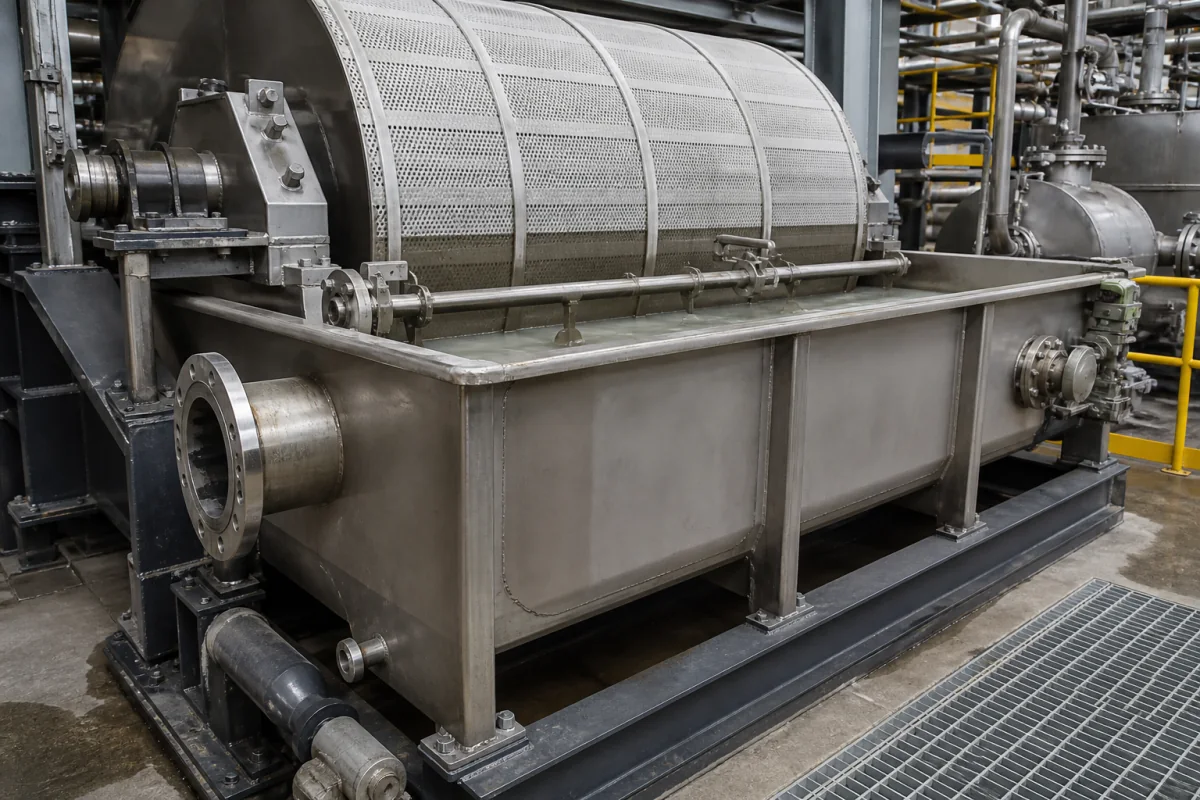
Slurry tank of a rotary drum vacuum filter: the vat level, submergence and agitation that set cake thickness and moisture
The slurry vat under a rotary drum vacuum filter · Submergence of 10 to 37.5% that sets cake formation against drying, glands above about 40%, an oscillating agitator that keeps solids suspended, and a level held between losing prime and overflowing
This page covers the slurry vat of a rotary drum vacuum filter: the trough under the drum into which slurry is pumped, its agitator and its level control. Ask three things first: what submergence the vat level gives and how that splits the drum's turn between cake formation and drying, how the agitator keeps solids from settling, and how the level is held so the filter neither loses its vacuum seal nor overflows.
Slurry vats (troughs) of rotary drum vacuum filters, with their submergence, agitation and level control, and vat level control on related rotary vacuum filters. Complete rotary drum vacuum filters, with drum sizing, discharge and vacuum, are covered on the Industrial rotary drum vacuum filter page; general reagent and storage tanks on their own pages. Paper machine stock and dilution tanks and filter press feed tanks are outside this page.
CNFX editorial research · Sources checked October 12, 2026 · 3 sources
Vat level sets submergence, and submergence splits each turn between forming and drying cake
Micronics describes the drum turning through a vat into which slurry is pumped: while submerged, vacuum draws suspended solids onto the cloth to form cake; out of the slurry, vacuum dries it. To separate formation from drying the drum is submerged from 10% up to 37.5%, and production is set directly by drum speed, in minutes per revolution, and by submergence, that is the vat level. High submergence gives thick cake that can stay wet because dry time is short; for low moisture the submergence is reduced to give more dry time, at the cost of thinner cake and lower output; form time against dry time is fine-tuned with the bridge blocks in the rotary valve. [1]
911 Metallurgist adds that for maximum throughput a drum filter runs at the highest submergence and drum speed, but that every increase in submergence takes drum area away from washing and drying, that submergence above about 40% needs glands where the drum shaft and valve hub pass through the trough, and that high submergence can complicate the geometry or the discharge. [2]
Editorial calculation, with an assumed drum speed of 2 minutes per revolution: at 37.5% submergence each part of the cloth spends about 45 s forming cake in the vat; at 10% about 12 s, leaving the rest of the turn for washing, drying and discharge. [1]
Give the supplier the slurry flow, solids concentration and particle size, density and settling rate, the target cake thickness and moisture, drum size and speed range, the submergence range wanted, whether washing is needed, and how slurry and overflow are piped.
02
Keep the solids moving and the level between losing prime and overflowing
Micronics fits an oscillating agitator that sweeps the bottom of the vat to suspend and distribute solids evenly, notes that drum filters are fitted with variable-frequency drives on the drum, discharge roll and agitator in a good share of installations, and that the agitator and discharge roll can indirectly help or hinder the production rate. [1] A Peterson Filters patent on rotary vacuum disc filters describes the level limits that apply to such vats: too high and the slurry spills over emergency overflows and must be pumped back to the flotation cells; too low and air is drawn into the top of the filter sectors, the siphon breaks and the filter loses its prime, so the prime level is the lower limit. It holds the level by returning excess filtrate to the feed and sets rotation speed from the level measurement to give the longest dry time for the lowest cake moisture. [3]
Vat condition
Effect
Source
Submergence high
Thick cake, higher moisture, less wash and dry area. [1][2]
Explore company information and manufacturing capabilities, then discuss the scope of your project with a relevant supplier.
Share this page
Compiled and source-reviewed by the CNFX editorial team.
Each manufacturer above links to the page on that company's own website where the product is listed, with the date we checked it. How we source and review
· Page last updated 13 October 2026
Buyer questions
How deep is a rotary drum vacuum filter submerged in its vat?
Micronics gives 10% up to 37.5% to separate cake formation from drying; 911 Metallurgist notes glands are needed above about 40%. [1][2]
What does raising the vat level do to the filter cake?
Higher submergence gives thicker cake but higher moisture because dry time is shorter; lower submergence gives drier, thinner cake and less output. [1]
What happens if the vat level falls too low?
A Peterson patent explains that air is drawn into the top of the filter sectors, the siphon breaks and the filter loses its prime. [3]
Sources and what still needs a direct check
Sources checked 2026-10-12. Micronics describes its own drum filters; 911 Metallurgist summarises vacuum filtration practice; a Peterson Filters patent describes vat level control.