Industry-Verified Manufacturing Data (2026)

End Effector/Gripper

Based on aggregated insights from multiple verified factory profiles within the CNFX directory, the standard End Effector/Gripper used in the Machinery and Equipment Manufacturing sector typically supports operational capacities ranging from standard industrial configurations to heavy-duty production requirements.

Technical Definition & Core Assembly

A canonical End Effector/Gripper is characterized by the integration of Gripper Jaws/Fingers and Actuator Mechanism. In industrial production environments, manufacturers listed on CNFX commonly emphasize Aluminum alloy construction to support stable, high-cycle operation across diverse manufacturing scenarios.

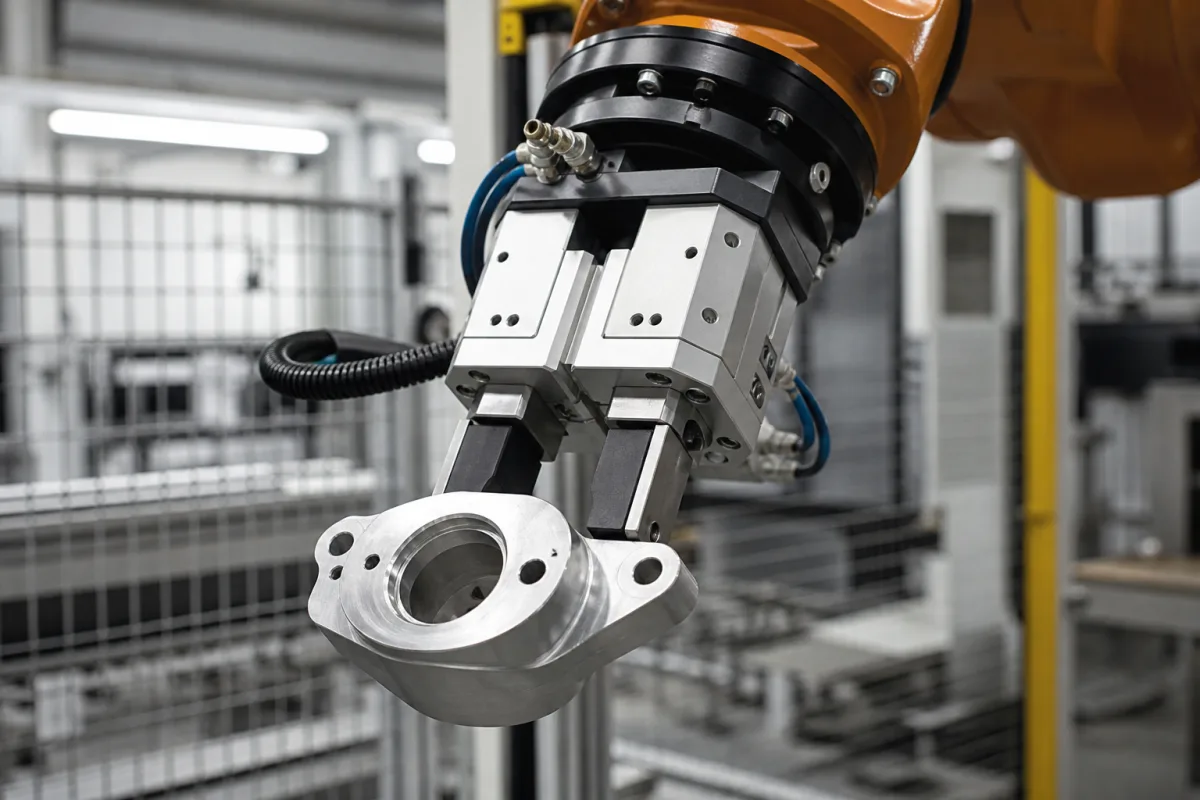
The terminal component of a robotic arm or conveyor system that directly interacts with objects for manipulation, handling, or processing.
Product Specifications

Technical details and manufacturing context for End Effector/Gripper

Definition
An end effector or gripper is the specialized tooling attached to the end of a robotic arm or integrated into a conveyor system, designed to perform specific tasks such as grasping, lifting, rotating, placing, or processing workpieces. It serves as the interface between the automation system and the objects being handled, enabling precise control and manipulation in industrial applications.
Working Principle
End effectors operate through various mechanisms depending on their type: mechanical grippers use jaws or fingers that close via pneumatic, hydraulic, or electric actuators to grasp objects; vacuum grippers use suction cups connected to vacuum generators to lift smooth surfaces; magnetic grippers use electromagnets or permanent magnets for ferrous materials; and specialized effectors may use adhesive, needle, or custom tooling for specific tasks. They receive control signals from the robotic controller or conveyor system to execute precise movements and force application.
Common Materials
Aluminum alloy, Stainless steel, Engineering plastics, Rubber
Technical Parameters
  • Gripping range or jaw opening width (mm) Standard Spec
Components / BOM
  • Gripper Jaws/Fingers
    Direct contact surfaces that grasp and hold objects, often customizable for different workpiece shapes
    Material: Aluminum alloy or hardened steel
  • Actuator Mechanism
    Provides the motion to open and close the gripper jaws, typically pneumatic cylinder, electric motor, or hydraulic piston
    Material: Stainless steel, aluminum
  • Mounting Interface
    Connection point that attaches the end effector to the robotic arm or conveyor system, ensuring proper alignment and load transfer
    Material: Steel
  • Sensors
    Detect object presence, grip confirmation, or measure applied force for feedback control
    Material: Electronic components, plastic housing
Engineering Reasoning
0.5-2.5 MPa gripping force, 0.1-1.0 mm positional accuracy, -20°C to 80°C ambient temperature
Gripping force exceeds 3.0 MPa causing structural yield, positional error exceeds 2.0 mm causing misalignment, temperature exceeds 100°C causing polymer degradation
Design Rationale: Von Mises stress exceeding 250 MPa yield strength of 6061-T6 aluminum, thermal expansion coefficient mismatch (23.6 μm/m·K aluminum vs 70 μm/m·K polymer) causing binding, Coulomb friction coefficient dropping below 0.15 at 100°C
Risk Mitigation (FMEA)
Trigger Hydraulic pressure surge to 4.0 MPa
Mode: Piston seal extrusion and hydraulic fluid leakage
Strategy: Integrate 3.5 MPa pressure relief valve with 10 ms response time
Trigger Electromagnetic interference at 150 MHz frequency
Mode: Servo motor encoder signal corruption causing position loss
Strategy: Implement Faraday cage shielding with 40 dB attenuation at 150 MHz

Industry Taxonomies & Aliases

Commonly used trade names and technical identifiers for End Effector/Gripper.

Applied To / Applications

This component is essential for the following industrial systems and equipment:

Industrial Ecosystem & Supply Chain DNA

Complementary Systems
Downstream Applications
Specialized Tooling

Application Fit & Sizing Matrix

Operational Limits
pressure: 0-10 bar
other spec: Max object weight: 50 kg, Gripping force: 10-500 N
temperature: -20°C to 80°C
Media Compatibility
✓ Metal parts ✓ Plastic components ✓ Packaged goods
Unsuitable: Corrosive chemical baths
Sizing Data Required
  • Object dimensions and weight
  • Required gripping force
  • Cycle rate and duty cycle

Reliability & Engineering Risk Analysis

Failure Mode & Root Cause
Gripper slippage or misalignment
Cause: Wear on gripping surfaces, contamination buildup, or loss of pneumatic/hydraulic pressure due to seal degradation or leaks
Mechanical jamming or binding
Cause: Debris ingress, lack of lubrication, misalignment from impact damage, or worn internal components like bearings and slides
Maintenance Indicators
  • Inconsistent gripping force or dropped parts during operation
  • Unusual grinding, squeaking, or hissing noises during actuation
Engineering Tips
  • Implement regular cleaning and inspection schedules to prevent contamination buildup, and use protective covers when not in operation
  • Establish preventive maintenance for lubrication of moving parts and pressure system checks, and calibrate gripping force sensors periodically

Compliance & Manufacturing Standards

Reference Standards
ISO 9409-1:2004 (Manipulating industrial robots - Mechanical interfaces) ANSI/RIA R15.06-2012 (Industrial Robots and Robot Systems - Safety Requirements) CE Marking (EU Machinery Directive 2006/42/EC)
Manufacturing Precision
  • Bore diameter: +/-0.01mm
  • Parallelism of mounting surface: 0.05mm
Quality Inspection
  • Dimensional verification with CMM (Coordinate Measuring Machine)
  • Load capacity and repeatability testing

Factories Producing End Effector/Gripper

Verified manufacturers with capability to produce this product in China

✓ 94% Supplier Capability Match Found

T Technical Director from United Arab Emirates Jan 14, 2026
★★★★★
"Impressive build quality. Especially the technical reliability is very stable during long-term operation."
Technical Specifications Verified
P Project Engineer from Australia Jan 11, 2026
★★★★☆
"As a professional in the Machinery and Equipment Manufacturing sector, I confirm this End Effector/Gripper meets all ISO standards. (Delivery took slightly longer than expected, but technical support was excellent.)"
Technical Specifications Verified
S Sourcing Manager from Singapore Jan 08, 2026
★★★★★
"Standard OEM quality for Machinery and Equipment Manufacturing applications. The End Effector/Gripper arrived with full certification."
Technical Specifications Verified
Verification Protocol

“Feedback is collected from verified sourcing managers during RFQ (Request for Quote) and factory evaluation processes on CNFX. These reports represent historical performance data and technical audit summaries from our B2B manufacturing network.”

9 sourcing managers are analyzing this specification now. Last inquiry for End Effector/Gripper from Vietnam (1h ago).

Supply Chain Compatible Machinery & Devices

Heavy-Duty CNC Plasma Cutting Machine

Industrial machine for precision metal cutting using plasma arc technology

Explore Specs →
Automated Assembly Line System

Integrated production system for sequential component assembly operations

Explore Specs →
Automated Powder Coating System

Integrated industrial system for applying dry powder coatings to metal substrates.

Explore Specs →
Centrifugal Pump Impeller

Rotating component that transfers energy to fluid in centrifugal pumps.

Explore Specs →

Frequently Asked Questions

What materials are best for end effectors in harsh manufacturing environments?

Stainless steel offers corrosion resistance for wet or chemical environments, while aluminum alloy provides lightweight strength for high-speed applications. Engineering plastics and rubber are ideal for delicate object handling.

How do sensors improve gripper performance in equipment manufacturing?

Integrated sensors provide real-time feedback on grip force, position, and object detection, enabling precise manipulation, error prevention, and adaptive handling of varied components in automated systems.

What mounting interfaces are compatible with industrial robotic arms?

Standard interfaces include ISO 9409-1 flange mounts, quick-change adapters, and custom mounting plates designed to integrate with major robotic arm brands like Fanuc, KUKA, and ABB for seamless installation.

Can I contact factories directly on CNFX?

CNFX is an open directory, not a transaction platform. Each factory profile provides direct contact information and production details to help you initiate direct inquiries with Chinese suppliers.

Get Quote for End Effector/Gripper

Request technical pricing, lead times, or customized specifications for End Effector/Gripper directly from verified manufacturing units.

Your business information is encrypted and only shared with verified End Effector/Gripper suppliers.

Thank you! Your message has been sent. We'll respond within 1–3 business days.

Need to Manufacture End Effector/Gripper?

Connect with verified factories specializing in this product category

Add Your Factory Contact Us
Previous Product
End Effector Mount
Next Product
End Supports/Bearings