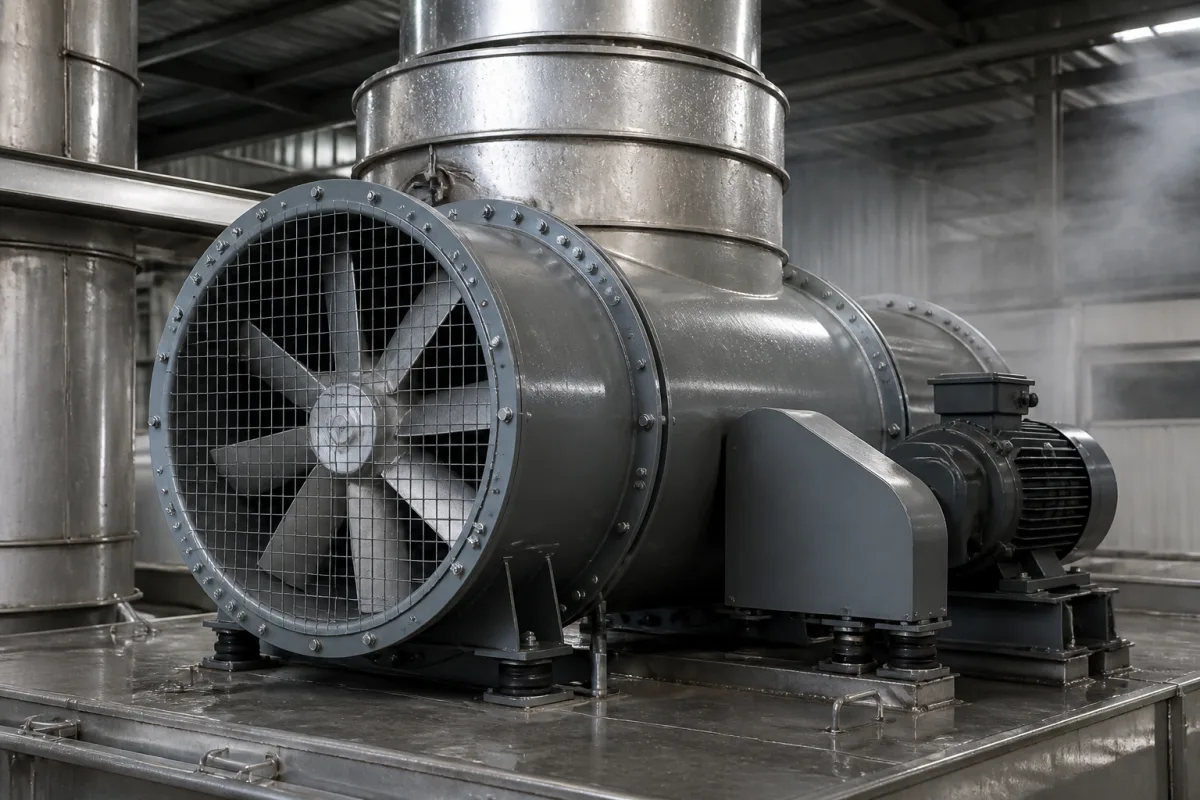
Belt-driven tube axial exhaust fan (in-line axial fan with the motor and belts outside the airstream, for spray booth and fume exhaust)
Duct-mounted axial exhaust fans · Arrangement 9 belt drive with the motor outside the airstream, spark-resistant aluminium propellers, spray booth exhaust rules, tube axial versus vane axial pressure range
A belt-driven tube axial exhaust fan is a cylindrical steel housing with an axial propeller inside, bolted into a duct or onto a roof curb. The motor is mounted on the outside of the tube and turns the propeller shaft through V-belts that pass through an enclosed belt tube, so neither the motor nor the belts sit in the exhaust air. That layout is why the type is chosen for paint spray booth and fume exhaust, where the air carries flammable vapour or overspray. The buying questions are the airflow at the design static pressure, the propeller material and pitch, whether a vane section is needed for higher pressure, and the drive and balance details.
Belt-driven tube axial and vane axial exhaust fans for in-line duct or roof upblast mounting, with motor and V-belt drive outside the airstream, as used for paint spray booth and fume exhaust. General centrifugal fans, their fan laws and field troubleshooting are covered on the Centrifugal fan page. Burner combustion air blowers, wastewater aeration blowers and fibreglass-reinforced plastic centrifugal fume exhausters are covered on their own pages (Combustion air blower for industrial furnace burners; Air blower for wastewater aeration and low-pressure process air; Exhaust fan for corrosive chemical fumes), and complete hood, duct, filter and stack systems on the Industrial exhaust system page. Small appliance blowers for range hoods and heaters are outside this page.
CNFX editorial research · Sources checked October 12, 2026 · 4 sources
What OSHA 1910.107 asks of a spray booth exhaust fan, its motor and its belts
OSHA's spray finishing standard, 29 CFR 1910.107, sets rules that bear directly on the fan. The rotating element must be nonferrous or nonsparking, or the casing must be made of or lined with such material, with enough clearance between rotor and casing to avoid a fire by friction. Motors driving exhaust fans must not be placed inside booths or ducts, and belts must not enter the duct or booth unless belt and pulley there are thoroughly enclosed. The shaft is preferably to have bearings outside the duct and booth. [1]
The same section sets the air the fan has to move in a dry spray booth: an average velocity over the open face of the booth of not less than 100 linear feet per minute, or not less than 60 ft/min for electrostatic spraying, with a gauge, alarm or pressure device to show the velocity is maintained. Where more than one fan serves a booth, the fans must be interconnected so that one cannot run without the others. [1]
Editorial calculation: a booth with an open face 12 ft wide and 8 ft high has 96 ft²; at 100 ft/min it needs at least 9,600 cfm (about 16,300 m³/h), and at 60 ft/min for electrostatic spraying 5,760 cfm. Filters, ducts and any roof cap add the static pressure the fan must overcome at that flow.
Aerovent's BTABD, a belt-driven tube axial fan made for paint spray booth exhaust, answers these points with a spark-resistant die-cast aluminium propeller and hub, a motor located out of the airstream, cast-iron sheaves with non-static conducting belts isolated from the airstream, and OSHA belt guards as standard. [2] Greenheck lists paint booth exhaust among the uses of its TBI-CA belt-drive tube axial fan, with spark-resistant construction and motor and drives out of the airstream as standard features. [4]
Give the fan supplier the booth face area and the required face velocity, the filter type and its clean and loaded pressure drop, the duct run and discharge (in-line or roof upblast), the solvent or powder being sprayed, and the motor enclosure your electrical classification calls for.
02
Arrangement 9 belt drive: motor on the tube, belts in a belt tube, bearings purged by inlet air
Aerovent's installation instructions describe the belt-driven tube axial as a duct fan built to become part of the duct, at its entrance, middle or discharge. The motor is outside the airstream; the belt drive and bearings are enclosed in a tube and cover on the suction side of the impeller. For normal and high-temperature air the bearing cover is left open at the impeller end, so air is drawn through the belt tube and bearing enclosure as a purge that carries contaminants away and cools drive and bearings. For wet air heavy with corrosive chemicals, the bearing housing can be fully enclosed with a seal around the shaft. [3]
The BTABD specification calls this Arrangement 9, V-belt driven: a NEMA foot-mounted TEFC or ODP motor on a base plate of at least 3/16 in steel welded to the casing, a motor base adjusted with two jack-bolts to tension the belts, and a variable-pitch drive sheave on motors up to 5 hp so the fan speed can be trimmed during booth balancing; larger motors get a fixed sheave. Access to the fan sheave is through a cover plate on the inner cylinder. Bearings are non-relubricable sealed ball bearings in a cast aluminium monoblock, specified for an L-10 life of at least 60,000 hours. [2]
Greenheck's TBI-CA instead uses grease-lubricated cast-iron pillow block bearings selected for an L10 life over 80,000 hours in horizontal service and 40,000 hours in vertical service, with the shaft sized so its first critical speed is at least 25% above the maximum operating speed. [4] Editorial note: sealed-for-life bearings remove the need for grease lines into the tube; greased pillow blocks can be relubricated but need a lube path from outside the duct, which is the arrangement 1910.107 prefers for bearings. [1]
Aerovent's BTABD casing gauge steps with size: 12-gauge hot-rolled steel through 20 in diameter, 10-gauge from 24 to 28 in, and 7-gauge above 30 in, with inlet and outlet flanges rolled from the casing sheet. [2]
Ask for the arrangement number, motor frame and enclosure, sheave type (variable or fixed pitch), belt type, bearing type and rated L10 life, and whether the bearing enclosure is open (air-purged) or sealed for corrosive wet air.
03
Tube axial or vane axial: pressure range, adjustable propeller pitch and the roof upblast allowance
A spray booth tube axial and a medium-pressure axial fan from the same family differ mainly in how much pressure they are built to develop. The two catalogues below state these limits for belt-driven, cast-aluminium-propeller models; the pressure column is what decides whether a booth with loaded filters and a long duct can be served.
Greenheck gives a correction for roof upblast mounting: the extra static pressure is a size factor K times the flow squared. Its worked example takes a size 36 fan at 25,000 cfm against 2 in wg: with K = 4.78×10⁻¹⁰ the upblast adds 0.299 in wg, so the fan is selected at 25,000 cfm against 2.299 in wg. [4] Editorial calculation: with the size 24 factor (4.16×10⁻⁹), the same 25,000 cfm would add about 2.6 in wg, which is why the upblast loss is checked size by size rather than as a fixed allowance.
Aerovent's installation notes add that the rating tables assume the fan sits in a duct of the same size; a tapered discharge regains part of the velocity pressure as static pressure, and converging inlet and discharge sections lower duct velocities, either of which can let the fan be selected at a lower pressure at a higher installation cost. [3]
Overspray on the propeller, balance limits and flexible duct connections
Aerovent notes that deposits build up evenly on an axial impeller and do no harm until they break away in crust-like pieces; the impeller can then be thrown out of balance and the vibration can be serious. Fans exhausting process air should be cleaned as required, by solvent or scraping, taking care not to cut through any protective coating. [3]
The BTABD propeller is balanced to ANSI/AMCA 204-05, category BV-3, grade G6.3, and belt-driven units are trim-balanced in the casing to peak vibration of 0.15 in/s rigidly mounted or 0.20 in/s flexibly mounted, with test-room readings recorded in three planes and available on request. [2] Editorial calculation: 0.15 in/s is about 3.8 mm/s and 0.20 in/s about 5.1 mm/s, values that can be used as the acceptance reading after cleaning or re-pitching the blades.
Flexible connections between the fan and the duct reduce vibration passed to the duct and lower noise, and Aerovent states that vibration isolators under the fan are also needed for noise dampening. [3]
Ask for the factory balance record in the three planes, the propeller coating if any, the cleaning access (inner cylinder cover, bolt-on vane section) and the isolator and flexible connector arrangement.
05
Data for a belt-driven tube axial exhaust fan quotation
Paste it into your enquiry below or into an email to a maker, then replace every bracket.
Duty: [airflow cfm or m³/h; static pressure at that flow; air temperature]
Application: [spray booth face area and face velocity; filter loading; solvent or powder; corrosive vapour]
Mounting: [in-line horizontal base or ceiling hung; vertical up or down; roof upblast with windband]
Fan: [propeller diameter; blade material and pitch; tube axial or vane axial section]
Drive: [arrangement; motor kW or hp, frame and enclosure; sheave type; belt guard]
Bearings: [sealed or greased; L10 life; open or sealed bearing enclosure]
Tests and documents: [AMCA 210/300 ratings; balance grade and vibration record; finish]
Explore company information and manufacturing capabilities, then discuss the scope of your project with a relevant supplier.
Share this page
Compiled and source-reviewed by the CNFX editorial team.
Each manufacturer above links to the page on that company's own website where the product is listed, with the date we checked it. How we source and review
· Page last updated 13 October 2026
Buyer questions
Why are spray booth exhaust fans belt driven with the motor outside?
OSHA 1910.107 forbids motors driving exhaust fans inside booths or ducts and requires belts entering the duct to be thoroughly enclosed; belt-driven tube axial fans place the motor on the outside of the tube and run the belts through an enclosed belt tube. [1][3]
What airflow does a spray booth exhaust fan need?
OSHA requires an average of at least 100 ft/min over the open face of a dry spray booth, or 60 ft/min for electrostatic spraying; multiply by the face area to get the minimum flow. [1]
How much pressure can a belt-driven tube axial fan develop?
Aerovent's spray booth model BTABD is rated to 1.25 in wg; Greenheck's TBI-CA medium-pressure axial fan is listed up to 3.5 in wg, with a vane section on Level 5. [2][4]
What happens when overspray builds up on the propeller?
Aerovent says deposits do no harm until they break away in pieces, which can throw the impeller out of balance and cause serious vibration, so process exhaust fans are cleaned as required. [3]
Sources and what still needs a direct check
Sources checked 2026-10-12. Aerovent (a Twin City Fan Companies brand) and Greenheck are fan makers describing their own belt-driven axial models; their ratings are catalogue statements. OSHA 29 CFR 1910.107 is the US federal rule for spray finishing.