Stainless screw feeders that have to come apart for cleaning
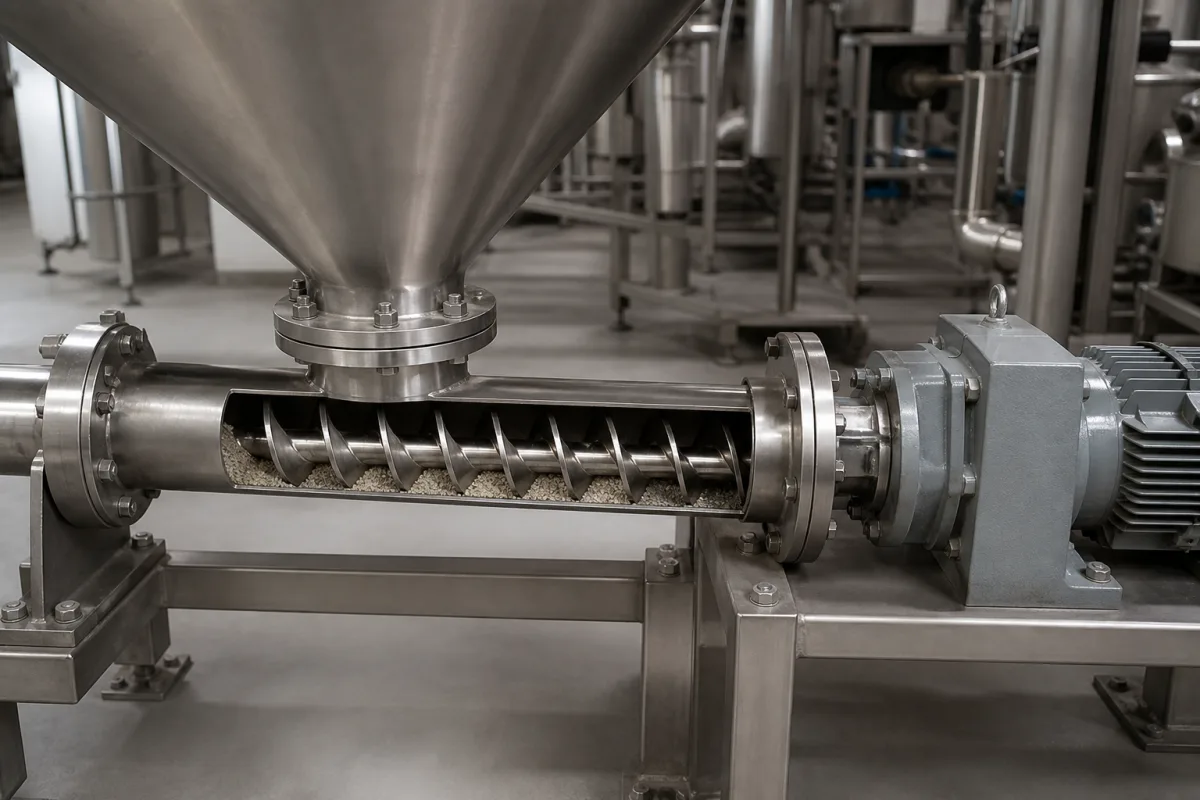
The illustrated feeder is a polished stainless tube under a conical hopper, cut away to show the screw carrying granules toward a flanged outlet, with the gearmotor bolted to the far end. In food, dairy and pharmaceutical plants the questions about such a feeder are less about conveying capacity than about hygiene: where the bearings sit, what seals them, and how quickly the screw and its housing can be taken apart, cleaned and put back. Four makers' published descriptions answer those questions differently.
Covers sanitary and hygienic screw feeders for powders and granules in food, dairy, nutrition and pharmaceutical processing: bearing and seal arrangement, product-contact materials and finish, disassembly for cleaning and changeover, flighting for non-free-flowing powders, and published dosing ranges. Screw feeder design for even hopper drawdown, pitch and start-up torque is on the Screw feeder page (826); screw conveyor sizing on 5999; loss-in-weight feeder control on 1418; vibrated cone hoppers over screw feeders on 3466; hygienic bag-tip ingredient hoppers above the feeder on 825. Feed screws of pin mixers and briquetting machines share the name and are outside this page.
CNFX editorial research · Sources checked October 13, 2026 · 4 sources
Keeping powder out of the bearings and lubricant out of the powder
The drive end is where a screw feeder meets oil, grease and moving seals. The three makers that describe it put the bearings outside the product and use air to keep powder from reaching them.
The purge air does its work only while it is supplied: a feeder whose seals depend on purge air needs that air on whenever powder is in the hopper, including standstill (editorial reading).
Tetra Pak also states that all product-contact parts are stainless steel with no hollow bodies, and Gericke specifies 316L polished to Ra < 0.8 µm in product-contact areas.
Maker and model
Bearings and seals
Other drive-end detail
PPS VSF / VSFO
Shaft bearings fully outboard of the product area, protected by air-purged shaft lip seals
AC gearmotor coupled directly to the screw shaft; optional variable-frequency drive
Tetra Pak Powder Feeder DN061
Pressurized air keeps powder out of the bearing unit
Sanitary gap between motor and bearing unit so lubricant cannot reach the product; swivelling hinge for motor removal
Gericke Feedos S
Hygienic seals
Tri-clamps instead of screwed joints to connect upstream and downstream equipment
02
How far the feeder comes apart, and how fast
Every maker here claims easy cleaning; what differs is which parts come out and whether tools are needed.
Trantec adds a changeover method rather than a design feature: a duplicate set of components, cleaned and stored in advance, swapped in for a complete product changeover in under ten minutes.
Trantec's argument for removing the body too is that a feeder body left in place restricts access to all areas and crevices; whether that matters depends on whether the line changes between allergen or potency classes (editorial note).
Maker and model
What comes apart
Stated time or method
PPS VSF / VSFO
Screw and tube completely demountable
Quickly demountable; inlet and outlet by bolted flange, sanitary ferrule or BFM fitting
Gericke Feedos S
Feeding tool and feeding chamber
Connections removed without tools for inspection, cleaning and maintenance
Trantec QR Tec
Entire machine including the feeder body
Dismantled without tools in under three minutes; parts can be dishwasher cleaned or autoclaved
Tetra Pak DN061
Motor swings away on a hinge
Maintenance and cleaning access
Times are the makers' own statements from product announcements, not independent tests.
03
Screw, size and dosing range
Hygienic construction does not change the metering job. PPS and Tetra Pak publish the screw and flow figures behind theirs.
PPS explains the overflight: powders that pack or interlock build up on the shaft or in the trough and cut capacity and consistency, and the open space between auger and overflighting lets them move freely and keeps the metering flights filled.
The DN061's stated flow spans a ratio of 24:1 (Editorial calculation, 1,700 ÷ 70 = 24.3); millimetre and metre values for PPS are converted from inches (Editorial calculation).
Item
PPS VSF / VSFO
Tetra Pak DN061
Screw diameter
4 to 10 in (102 to 254 mm)
—
Screw length
Up to 60 in (1.52 m)
—
Flighting
Any flight configuration; VSFO adds overflighting for non-free-flowing powders
Screw pitch regulates flow; a blade prevents powder vaulting in the hopper or bag-tipping unit
Flow and accuracy
Medium to high capacity
70 to 1,700 L/h depending on product and process; accuracy down to ±15 g
Control
Volumetric or loss-in-weight
Synchronous direct-coupled gearmotor under PID control; gain-in-weight or loss-in-weight processes
Standard named
Meets 3-A Sanitary Standard 81-00
Meets sanitary design standards (not named)
04
What to give a sanitary screw feeder supplier
Paste it into your enquiry below or into an email to a maker, then replace every bracket.
Give the powder or granule, its bulk density and flow behaviour, required feed rate range and accuracy, volumetric or gravimetric control, hopper or bag-tipping arrangement above, cleaning method (dry, wet, dishwasher, autoclave) and frequency, changeover frequency and allergen or potency classes, and the hygiene standard you work to. Ask for bearing position and seal type, purge-air requirement, product-contact material and finish, which parts come out and with what tools, teardown and reassembly time, flighting options, and test results on your material.
Explore company information and manufacturing capabilities, then discuss the scope of your project with a relevant supplier.
Share this page
Compiled and source-reviewed by the CNFX editorial team.
Each manufacturer above links to the page on that company's own website where the product is listed, with the date we checked it. How we source and review
· Page last updated 13 October 2026
Buyer questions
Where should the bearings be on a sanitary screw feeder?
PPS puts the shaft bearings fully outboard of the product area behind air-purged lip seals; Tetra Pak uses pressurized air to keep powder out of the bearing unit and a sanitary gap to keep lubricant from the product. [1][2]
How quickly can a hygienic screw feeder be dismantled?
Trantec states its QR Tec feeder comes apart without tools in under three minutes, body included; Gericke's Feedos S connections are removed without tools. [4][3]
What helps a screw feeder handle sticky powders?
PPS adds overflighting on its VSFO model so powders that pack or interlock do not build up on the shaft or trough. [1]
Sources and what still needs a direct check
Sources checked 2026-10-13. A sanitary screw feeder brochure from PPS, Tetra Pak's DN061 powder feeder page, and product announcements for Gericke's Feedos S and Trantec's QR Tec feeders.