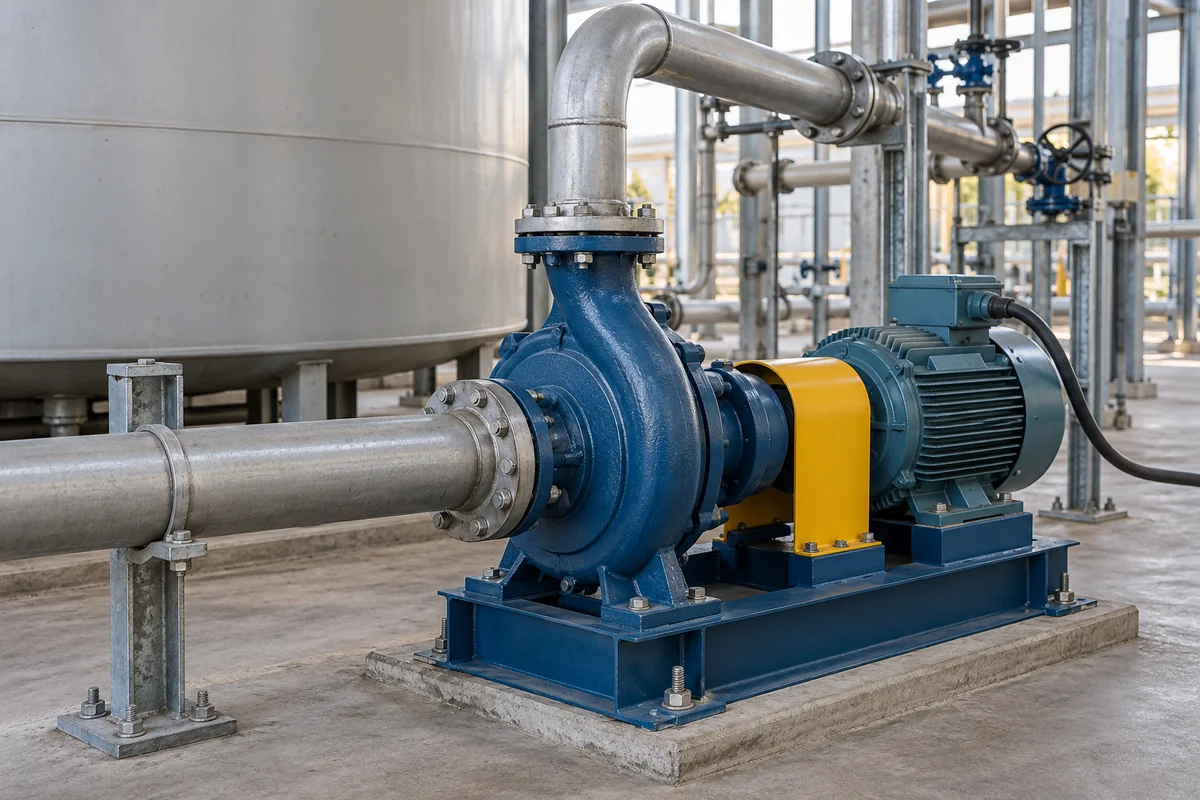
ASME B73.1 (ANSI) end-suction chemical process pump: the 60 Hz design limits, sizes and baseplate envelope that set it apart from ISO pumps
The ASME B73.1 (ANSI) chemical process pump · how its technical limits differ from ISO 5199, 27 sizes in 17 designations with a baseplate envelope, and the high-capacity models built beyond the standard's size limits
ASME B73.1, "Specification for Horizontal End Suction Centrifugal Pumps for Chemical Process", is the North American counterpart of the ISO 2858 / ISO 5199 pair. The pumps look alike — end suction, centreline discharge, back pull-out, frame-mounted on a baseplate — but the two standards set different technical limits, fit different numbers of sizes and treat baseplates differently. A plant specified to ANSI dimensions needs an ANSI pump to drop onto its foundations and pipework, and the B73.1 limits on shaft deflection, run-out, critical speed and NPSH margin are what a buyer can hold the supplier to.
Horizontal single-stage end-suction centrifugal pumps built to ASME B73.1 for chemical and general process duty, supplied bare or as long-coupled sets on B73.1 baseplates, including high-capacity models built with B73.1 design features beyond its size range. Pumps built to ISO 2858 dimensions and the ISO 5199 Class II specification are covered on the Process pump for chemical plants page — the difference is the standard the pump is dimensioned and specified to. Hydraulic selection and NPSH for centrifugal pumps are covered on the Industrial pumps page; cooling-water loop pumps on the Cooling-water circulation pump for industrial cooling loops page; glycol loop pumps on the Glycol coolant pump for closed-loop chiller and dry-cooler skids page; and the cast casing alone on the Volute casing for centrifugal pumps page. Small fuel-transfer, gear and diaphragm pumps are outside this page.
CNFX editorial research · Sources checked October 12, 2026 · 3 sources
ASME B73.1 against ISO 5199: shaft deflection, run-out, critical speed and NPSH margin
Wilfley's 2014 comparison traces B73.1 to chemical pump standard work begun in 1955, ANSI B73.1 in 1974 and a current edition first published in 2012, and notes a split by electrical frequency — B73.1 for 60 Hz and ISO 5199 for 50 Hz — while saying either standard can be applied at either frequency. [1] Its technical summary sets the two side by side; the rows below are those where the ASME figure differs from the ISO one.
Both standards share a minimum bearing L10 life of 17,500 hours, a hydrotest at 150% of MAWP for 10 minutes, a 3 mm minimum corrosion allowance and clockwise rotation. [1] Wilfley adds that because L10 life depends on speed, a 4-pole pump designed for 17,500 hours at 60 Hz would theoretically give 62,650 hours at 4-pole 50 Hz speed. [1]
Editorial calculation: 0.13 mm is about 0.005 in and 0.05 mm about 0.002 in, so the ISO 5199 deflection limit in Wilfley's table is roughly 2.6 times tighter than the B73.1 one; a buyer who wants the tighter figure on an ANSI pump has to write it into the order.
Driver 110–137% of rated input; 5% future head; no circlips; no lip seals [1]
Editorial note: Wilfley states its summary is not an exhaustive review of the two standards; check the current edition of ASME B73.1 for any limit written into a purchase specification.
02
27 sizes in 17 designations, Class 150 or 300 flanges, and pumps built beyond the B73.1 size limits
Wilfley counts 27 pump sizes in B73.1 fitted into 17 size designations, against 34 sizes and 34 dimensional variants in ISO 2858, five of them optional. [1] B73.1 also carries dimensional envelopes for baseplates within the same specification, where the ISO side uses a separate document, ISO 3661. [1] Flanges are ASME B16.5 Class 150 or 300; B73.1 requires at least Class 150 for ductile iron and alloy steels, 280 psig (19.3 bar) at ambient, against PN16 (16 bar, 232 psig) in ISO 5199, and Wilfley attributes the thicker casing walls and higher-rated flanges of B73.1 pumps to their 60 Hz design conditions. [1]
Editorial calculation: the Group 4 discharge pressure of 19 bar is about the Class 150 ambient minimum of 19.3 bar Wilfley quotes, while the Mark 3's 27 bar sits above it. [3][1] Pumps built beyond the B73.1 size range keep its design features but have no B73.1 dimensional counterpart to swap with.
Flowserve Durco series
Standard stated
Flows, heads, pressure, temperature
Sizes
Mark 3 (sealed, metallic)
ASME B73.1
4540 m³/h (20,000 gpm); 215 m (700 ft); 27 bar (400 psi); −75 to 370 °C [2]
ASME B73.1 design features, flows well beyond ASME size limits
3861 m³/h (17,000 gpm); 125 m (410 ft); 19 bar (275 psi) discharge; −73 to 204 °C, ductile iron −29 to 204 °C [3]
13 sizes on two bearing frames, e.g. 41K8x4-19 to 42K16x14-22 [3]
03
Back pull-out, external impeller setting and seal chambers on an ANSI pump
Wilfley describes the construction both standards share as end suction, centreline (self-venting) discharge, back pull-out and frame-mounted. [1] On Flowserve's Durco Mark 3, the reverse vane impeller is set through an external adjustment mechanism, seal chamber pressures are re-established after every impeller setting, and the shaft and bearing design is meant to minimise shaft deflection. [2]
For the Group 4 models Flowserve lists an external micrometer impeller adjustment that sets clearance in 20 seconds, SealSentry seal chambers with flow modifiers, a sealed bearing housing with labyrinth bearing isolators, a two-piece power end with self-contained bearing housing, and hydraulic, NPSH and vibration testing to Hydraulic Institute standards with CE/ATEX conformance. [3] Flowserve offers the Mark 3 in mechanically sealed, dynamically sealed, sealless magnetic-drive, low-flow, self-priming and recessed-impeller configurations. [2]
04
Data for an ASME B73.1 process pump enquiry
Paste it into your enquiry below or into an email to a maker, then replace every bracket.
Standard: [ASME B73.1 edition; size designation if replacing an installed pump; B73.1 baseplate or other]
Duty: [liquid; flow; head; temperature; NPSH available; 60 Hz or 50 Hz drive]
Limits: [any figure tighter than B73.1 — shaft deflection, vibration, NPSH margin]
Flanges and materials: [Class 150 or 300; casing and impeller material]
Shaft seal: [mechanical seal arrangement; seal chamber; or sealless]
Supply: [bare pump or set with motor, coupling and guard; testing to HI standards]
Explore company information and manufacturing capabilities, then discuss the scope of your project with a relevant supplier.
Share this page
Compiled and source-reviewed by the CNFX editorial team.
Each manufacturer above links to the page on that company's own website where the product is listed, with the date we checked it. How we source and review
· Page last updated 13 October 2026
Buyer questions
How does ASME B73.1 differ from ISO 5199?
Wilfley's comparison lists 0.13 mm shaft deflection against 0.05 mm, a 20% critical-speed margin against 10%, and NPSH margin above 0.9 m against 0.5 m; both require 17,500 h bearing L10 life. [1]
How many sizes does B73.1 have?
27 sizes in 17 size designations, against 34 sizes in ISO 2858, and B73.1 includes baseplate envelopes. [1]
What flange rating does an ANSI process pump have?
ASME B16.5 Class 150 or 300; Class 150 is the minimum for ductile iron and alloy steels, 280 psig (19.3 bar) at ambient. [1]
Are there ANSI-style pumps larger than the standard covers?
Yes: Flowserve's Durco Mark 3 Group 4 keeps B73.1 design features for flows to 3861 m³/h, which Flowserve describes as well beyond ASME size limits. [3]
Sources and what still needs a direct check
Sources checked 2026-10-12. The ASME B73.1 and ISO 5199 limits, sizes, flanges and bearing-life note come from A.R. Wilfley and Sons' March 2014 comparison; ratings, sizes and design features from Flowserve's Durco Mark 3 and Mark 3 Group 4 product pages.