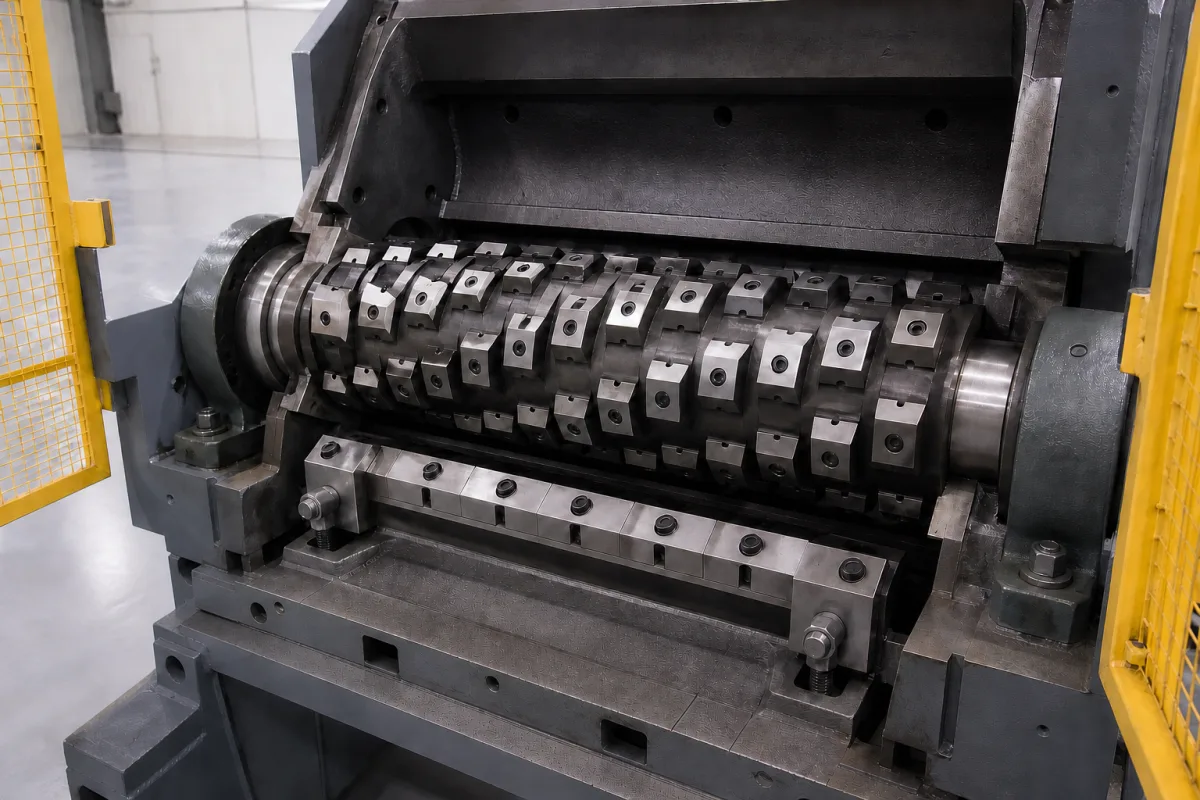
Granulator knife sets · Rotor knives that cut against fixed bed knives in plastic and scrap granulators, set to a cutting clearance, bolted to a specified torque and resharpened, with a sizing screen under the rotor setting the regrind size
A granulator's knife assembly is the set of rotating knives on the rotor and fixed bed knives in the cutting chamber that shear plastic or other scrap into regrind; a perforated screen under the rotor holds pieces in the chamber until they are small enough to pass. The knives wear and are resharpened or replaced. Ask three things first: which granulator model and rotor the knives fit, what material and hardness suit the scrap, and what clearance, torque and resharpening allowance the maker specifies.
Rotor knives, bed (fixed) knives and their clamping parts for plastic and scrap granulators and similar rotary size-reduction machines. Complete granulators and shredders, strand pelletizer rotors and bed knives (see polymer pelletizing strand cutter), crusher wear parts for rock (see jaw crusher and impact crusher), and packaging-machine rotary knives are outside this page except where compared.
CNFX editorial research · Sources checked October 11, 2026 · 4 sources
A Cumberland granulator patent (US5775608A) describes granulators that cut plastic scrap into small pieces for recycling: a rotor carries cutting blades on its perimeter, each edge running parallel to the rotor axis, either full-length or in segments that may be staggered around the rotor; each blade cuts against one or more stationary bed knives located to give a proper clearance with each cutting edge; and a sizing screen beneath the rotor lets fragments out only when small enough to pass its holes, so screen hole size controls the particle size. [1]
Conair's CR-series manual describes the rotor's knives grinding material against fixed knives in the cutter housing, with both changeable, and a screen under the rotor with a standard hole size of 5 mm; its CR 66 to CR 617 models list 2 × 1 or 2 × 2 rotating knives and 3 × 2 to 3 × 6 fixed knives, 1.5 to 4 kW motors at 190 to 290 rpm, sound levels of 80–82 dBA and weights of 160 to 235 kg. [2]
Editorial calculation: across the CR range, the fixed knife count rises from 6 (3 × 2) to 18 (3 × 6) between the smallest and largest models. [2]
Give the supplier the granulator make, model and serial number, rotor type (open, staggered, segmented), number and position of rotor and bed knives, knife drawings or samples, material processed and contaminants, required material and hardness, coatings, screen hole size, and quantity of sets.
02
Set clearance, torque and resharpening
The Cumberland patent notes that rotor and bed knife edges periodically need resharpening, which means removing the blades, reinstalling them and carefully resetting the cutting clearance to the bed knife; its design mounts the bed knife adjustably with bolts through enlarged holes into a clamping bar so the clearance to each rotor edge can be set. [1]
Conair's procedure fits each new rotating knife free of grease, pushed to the bottom of its seat with the outer knives tight against the ring, and tightens the fixing screws to 38 N·m; fixed knives are pushed against factory-set stop screws under retaining rulers and tightened to 38 N·m; damaged screws must be replaced, and the rotor is turned by hand to check that all knives move freely. It also says the screen should be replaced when its holes wear drop-shaped. [2]
03
Knife makers, and what to ask them before they cut steel
Anhui Yafei lists rotor and stator crusher blades for the recycling industry, and granulator knives for plastic, copper, aluminium and rubber.
Ask any supplier for the machine models they cover, knife drawings and tolerances, steel grade and heat treatment with hardness, flatness and straightness, bolt-hole positions, resharpening allowance, coatings, matched sets for balance, and lead time.
04
Write the regrinding rules into the knife order
Herbold Meckesheim's information sheet on granulator blades gives regrinding conditions a buyer can pass to whoever resharpens the knives. It says the cutting angle is tailored to the material and the granulator model range and may never be altered. For all-steel blades it recommends ceramically or bakelite-bonded grinding discs of grain size 36 - 40 and hardness G - J, and grinding at a circumferential speed of 22 - 25 m/min and a cutting speed of about 1400 1/min. [3] Because the high chromium alloy makes all-steel blades bad heat conductors, it calls for a continuous jet of coolant onto the stone and warns that drop cooling is ineffective; burnt edges may only break out after the second or third regrind. [3]
Herbold states that rotor blades must be ground down to an identical weight to avoid rotor imbalance, that grinding can stop when the ground surface shows an even silvery shine and the back of the blade a fine burr, and that grinding off more shortens blade life. [3] It lists the signs that blades are blunt as higher drive motor power, lower throughput, an unclean cut and edges sticking together or darkening, and advises buying a set of spare blades with the machine and tightening blade bolts with a torque wrench, naming one with a 300 - 750 Nm measuring range. [3]
Editorial note: ask the knife supplier to state the edge angle, the weight tolerance within a rotor set and the minimum blade width after regrinding, and to confirm that its own regrinding service follows the machine maker's cutting angle, since Herbold says that angle may never be altered. [3]
The knife steel should be named by a standard number, not a trade label. BÖHLER Edelstahl describes its K110 as a 12% ledeburitic chromium steel corresponding to material number 1.2379 (X153CrMoV12, AISI D2, UNS ~T30402) under EN ISO 4957, lists industrial and machine knives among its applications, and gives an average composition of 1.55% C, 0.30% Si, 0.30% Mn, 11.30% Cr, 0.75% Mo and 0.75% V. It notes a pronounced secondary hardness maximum on tempering, which allows advanced coatings to be applied. [4]
Editorial calculation: in that composition chromium is 11.30 ÷ (1.55 + 0.30 + 0.30 + 11.30 + 0.75 + 0.75) ≈ 76% of the listed alloying elements by mass, and the carbon content is about 5 times that of a 0.3% C steel (a comparison value assumed here). If a supplier quotes "D2" or "1.2379", ask for the heat analysis against these values and the hardness after tempering on the certificate. [4]
05
Rotor knives, bed knives, clamps, stop screws and screen
In Conair's procedure the fixed knives go back against factory-set stop screws, and both knife types are tightened to 38 N·m. [2]
Steel, hardness and blade dimensions the knife maker has to confirm
Only the steel grade and rotor speed carry published values here; dimensions, weight and balance have to come from your knife drawings or samples. [4][2]
Field
What it means and published values
Ask the supplier for
Blade Material
E.g. 1.2379 / X153CrMoV12 / AISI D2 (EN ISO 4957), 1.55% C and 11.30% Cr average in one maker's grade. [4]
Steel grade.
Blade Hardness (HRC)
Not stated in the reviewed sources; the hardness of a 1.2379 knife depends on its tempering. [4]
Hardness.
Blade Length (mm)
Not stated in the reviewed sources. Blades may run full rotor length or in segments. [1]
Length.
Blade Width (mm)
Not stated in the reviewed sources.
Width; resharpening allowance.
Blade Thickness (mm)
Not stated in the reviewed sources.
Thickness.
Cutting Speed (m/s)
Not stated in the reviewed sources. Rotor speeds of 190–290 rpm in one range. [2]
Explore company information and manufacturing capabilities, then discuss the scope of your project with a relevant supplier.
Share this page
Compiled and source-reviewed by the CNFX editorial team.
Each manufacturer above links to the page on that company's own website where the product is listed, with the date we checked it. How we source and review
· Page last updated 13 October 2026
Buyer questions
What sets the regrind size in a granulator?
The sizing screen under the rotor; Conair's standard hole size is 5 mm. [1][2]
How tight should granulator knife screws be?
Conair's CR-series manual specifies 38 N·m for rotating and fixed knife screws. [2]
Why must the bed knife be adjustable?
After resharpening, the cutting clearance to each rotor edge has to be reset. [1]
How should granulator knives be reground?
Herbold Meckesheim's blade sheet says keep the original cutting angle, use grain 36 - 40 discs with continuous coolant, and grind rotor blades to identical weight to avoid imbalance. [3]
What steel are granulator knives made from?
One option is the 12% chromium cold work steel 1.2379 (X153CrMoV12, AISI D2); BÖHLER lists its K110 version for industrial and machine knives at 1.55% C and 11.30% Cr average. [4]
Sources and what still needs a direct check
Sources checked 2026-10-11. Cumberland held a granulator patent; Conair and Herbold Meckesheim make granulators; BÖHLER Edelstahl makes tool steel used for machine knives.