Industry-Verified Manufacturing Data (2026)

Gripper / End-Effector

Based on aggregated insights from multiple verified factory profiles within the CNFX directory, the standard Gripper / End-Effector used in the Machinery and Equipment Manufacturing sector typically supports operational capacities ranging from standard industrial configurations to heavy-duty production requirements.

Technical Definition & Core Assembly

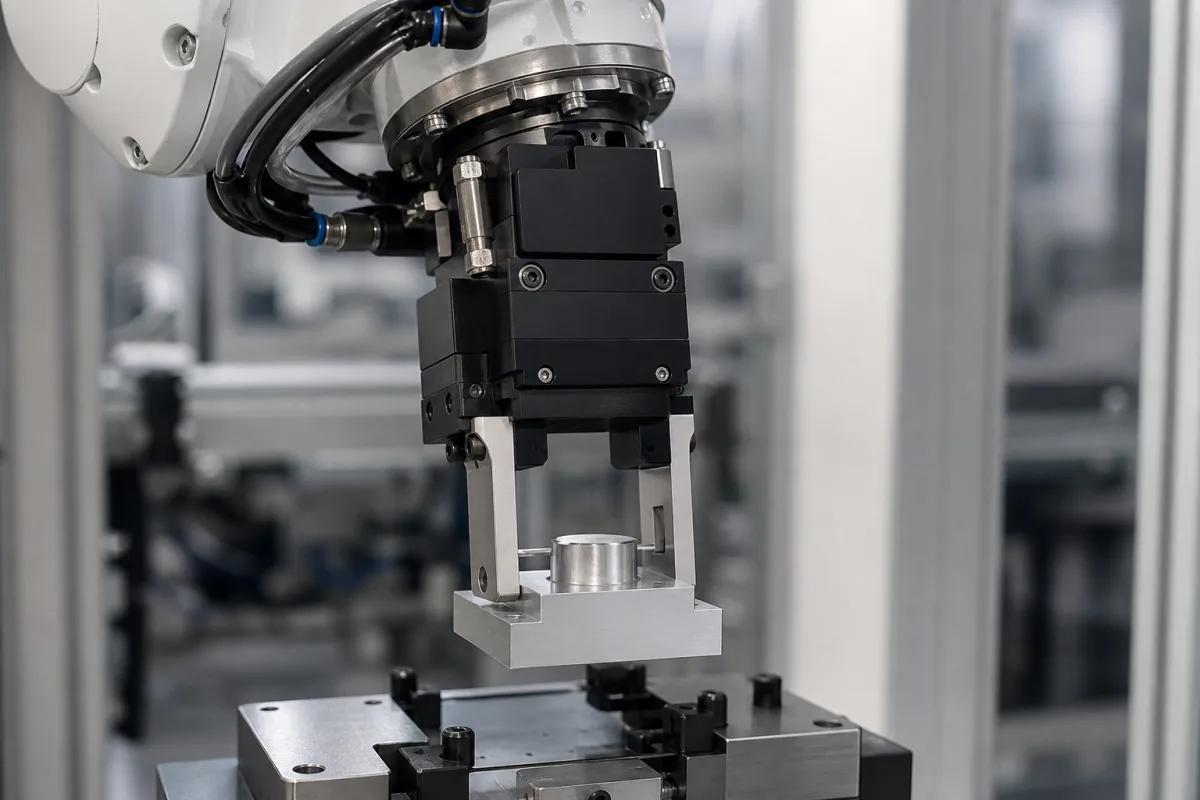
A canonical Gripper / End-Effector is characterized by the integration of Gripper Body/Housing and Gripper Jaws/Fingers. In industrial production environments, manufacturers listed on CNFX commonly emphasize Aluminum alloy construction to support stable, high-cycle operation across diverse manufacturing scenarios.

A mechanical device attached to the end of a robotic arm or automated system that interacts with objects for gripping, holding, or manipulating during transfer operations.
Product Specifications

Technical details and manufacturing context for Gripper / End-Effector

Definition
The gripper/end-effector is a critical component of an Automated Transfer System that enables the system to physically interact with workpieces, materials, or products. It serves as the interface between the automated machinery and the items being transferred, providing the necessary gripping force, precision, and adaptability to handle various shapes, sizes, and materials during loading, unloading, positioning, and transfer operations within manufacturing or material handling environments.
Working Principle
The gripper operates by converting mechanical, pneumatic, hydraulic, or electrical energy into controlled gripping force. Common mechanisms include parallel jaw grippers that close symmetrically, angular grippers that rotate fingers, vacuum grippers that use suction, and magnetic grippers that use electromagnetic force. The end-effector receives signals from the control system to open, close, or adjust its gripping position based on the transfer requirements.
Common Materials
Aluminum alloy, Stainless steel, Engineering plastics, Rubber/polyurethane
Technical Parameters
  • Maximum opening width between gripping surfaces (mm) Customizable
Components / BOM
  • Gripper Body/Housing
    Main structural frame that houses internal mechanisms and provides mounting interface to robotic arm
    Material: Aluminum alloy or steel
  • Gripper Jaws/Fingers
    Contact surfaces that directly engage with the workpiece, often customizable with different profiles or pads
    Material: Steel, aluminum, or polyurethane
  • Actuation Mechanism
    System that converts energy into mechanical motion to open/close gripper jaws (piston, gear, motor, etc.)
    Material: Steel, brass, engineering plastics
  • Sensors
    Detect grip status, position, or presence of workpiece (optional component)
    Material: Electronic components, plastic housing
Engineering Reasoning
0.5-2.5 MPa gripping force, 0-150°C ambient temperature, 0-85% relative humidity
Gripping force drops below 0.3 MPa at 160°C ambient temperature or 95% relative humidity
Design Rationale: Thermal expansion mismatch between aluminum alloy fingers and steel actuator components exceeding 0.15 mm differential at 160°C, causing binding; moisture-induced corrosion reducing friction coefficient below 0.25 at 95% RH
Risk Mitigation (FMEA)
Trigger Pneumatic pressure surge exceeding 1.0 MPa from regulator failure
Mode: Diaphragm rupture in pneumatic actuator at 1.2 MPa internal pressure
Strategy: Install 0.8 MPa pressure relief valve with 0.05 MPa hysteresis in pneumatic supply line
Trigger Electromagnetic interference from 50 kV/m field strength near arc welding stations
Mode: Hall effect sensor saturation causing position feedback loss at 75 mT magnetic flux density
Strategy: Mu-metal shielding with 40 dB attenuation at 100 kHz-1 MHz frequency range around sensor circuitry

Industry Taxonomies & Aliases

Commonly used trade names and technical identifiers for Gripper / End-Effector.

Applied To / Applications

This component is essential for the following industrial systems and equipment:

Industrial Ecosystem & Supply Chain DNA

Complementary Systems
Downstream Applications
Specialized Tooling

Application Fit & Sizing Matrix

Operational Limits
pressure: 0 to 10 bar
other spec: Max grip force: 500 N, Cycle rate: 60 cycles/min
temperature: -20°C to 80°C
Media Compatibility
✓ Metal parts ✓ Plastic components ✓ Packaged goods
Unsuitable: Corrosive chemical baths
Sizing Data Required
  • Object weight (kg)
  • Object dimensions (mm)
  • Required grip force (N)

Reliability & Engineering Risk Analysis

Failure Mode & Root Cause
Wear and Tear on Gripping Surfaces
Cause: Repeated friction and impact during object handling, often exacerbated by abrasive materials or misalignment, leading to loss of grip force and precision.
Actuator or Pneumatic System Failure
Cause: Contamination (e.g., dust, moisture) in pneumatic lines, seal degradation, or electrical faults in servo motors, resulting in slow response, incomplete closure, or total loss of function.
Maintenance Indicators
  • Audible hissing or irregular pneumatic noises indicating air leaks or pressure loss.
  • Visible misalignment, wobbling, or inconsistent gripping force during operation, often observed as dropped or poorly positioned objects.
Engineering Tips
  • Implement regular cleaning and inspection of gripping surfaces and seals, using non-abrasive methods and checking for wear patterns to prevent contamination and premature degradation.
  • Calibrate and align the gripper periodically with the robot arm and workpiece, ensuring optimal force settings and avoiding over-tightening to reduce mechanical stress and wear.

Compliance & Manufacturing Standards

Reference Standards
ISO 9409-1:2004 - Manually exchangeable gripping devices ANSI/RIA R15.06-2012 - Industrial Robots and Robot Systems Safety Requirements CE Marking - Machinery Directive 2006/42/EC
Manufacturing Precision
  • Bore diameter for mounting: +/-0.01mm
  • Parallelism of gripping surfaces: 0.05mm
Quality Inspection
  • Dimensional verification with CMM (Coordinate Measuring Machine)
  • Load cycle fatigue testing to verify operational lifespan

Factories Producing Gripper / End-Effector

Verified manufacturers with capability to produce this product in China

✓ 98% Supplier Capability Match Found

S Sourcing Manager from Singapore Feb 17, 2026
★★★★★
"The Gripper / End-Effector we sourced perfectly fits our Machinery and Equipment Manufacturing production line requirements."
Technical Specifications Verified
P Procurement Specialist from Germany Feb 14, 2026
★★★★☆
"Found 12+ suppliers for Gripper / End-Effector on CNFX, but this spec remains the most cost-effective. (Delivery took slightly longer than expected, but technical support was excellent.)"
Technical Specifications Verified
T Technical Director from Brazil Feb 11, 2026
★★★★★
"The technical documentation for this Gripper / End-Effector is very thorough, especially regarding technical reliability."
Technical Specifications Verified
Verification Protocol

“Feedback is collected from verified sourcing managers during RFQ (Request for Quote) and factory evaluation processes on CNFX. These reports represent historical performance data and technical audit summaries from our B2B manufacturing network.”

6 sourcing managers are analyzing this specification now. Last inquiry for Gripper / End-Effector from Germany (1h ago).

Supply Chain Compatible Machinery & Devices

Hydraulic Press

Industrial machine using hydraulic pressure to compress, form, or assemble materials

Explore Specs →
Heavy-Duty CNC Plasma Cutting Machine

Industrial machine for precision metal cutting using plasma arc technology

Explore Specs →
Automated Assembly Line System

Integrated production system for sequential component assembly operations

Explore Specs →
Automated Powder Coating System

Integrated industrial system for applying dry powder coatings to metal substrates.

Explore Specs →

Frequently Asked Questions

What materials are used in your gripper construction?

Our grippers are constructed from durable aluminum alloy, stainless steel components, engineering plastics, and rubber/polyurethane gripping surfaces for optimal performance and longevity.

What types of actuation mechanisms are available?

We offer pneumatic, electric, and hydraulic actuation mechanisms to suit different industrial applications and force requirements in machinery manufacturing environments.

Can these grippers be integrated with existing robotic systems?

Yes, our grippers feature standardized mounting interfaces and sensor compatibility for seamless integration with most industrial robotic arms and automated systems.

Can I contact factories directly on CNFX?

CNFX is an open directory, not a transaction platform. Each factory profile provides direct contact information and production details to help you initiate direct inquiries with Chinese suppliers.

Get Quote for Gripper / End-Effector

Request technical pricing, lead times, or customized specifications for Gripper / End-Effector directly from verified manufacturing units.

Your business information is encrypted and only shared with verified Gripper / End-Effector suppliers.

Thank you! Your message has been sent. We'll respond within 1–3 business days.

Need to Manufacture Gripper / End-Effector?

Connect with verified factories specializing in this product category

Add Your Factory Contact Us
Previous Product
Grinding Plate
Next Product
Gripper / Tool Clamp