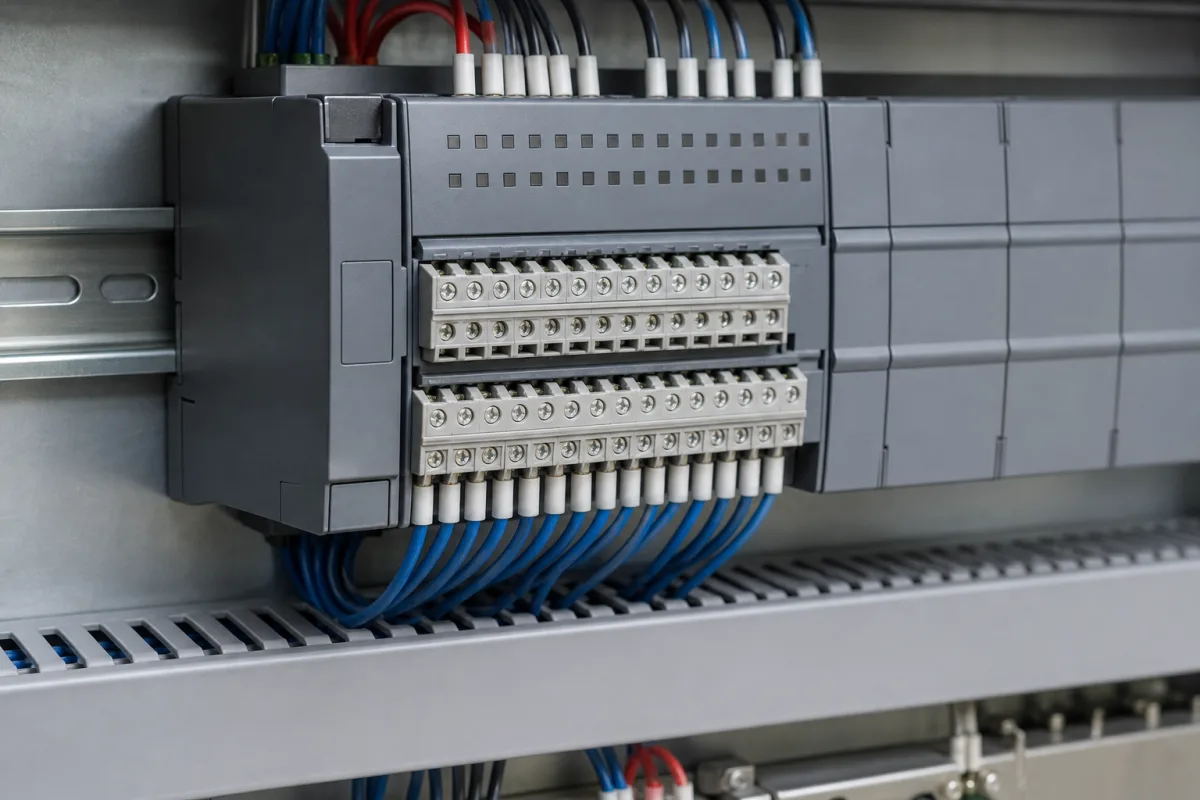
Digital input module (24 V DC discrete input card for PLC and remote I/O)
24 V DC digital input modules · IEC 61131-2 Type 1, 2 and 3 thresholds, input filter time, sinking or sourcing COM groups, isolation and heat per channel
A digital input module is the card or terminal that turns 24 V DC on/off signals from push-buttons, limit switches and proximity sensors into bits for the controller. Two modules with the same channel count can disagree on whether a sensor is on: the switching thresholds, the minimum current the input draws, and the filter that delays each change differ from module to module. Settle three things before ordering: which IEC 61131-2 input type the module meets, what input filter or response time it applies, and whether its inputs sink or source current through how many isolated COM terminals.
Discrete (digital) input modules and terminals for 24 V DC signals, used as local expansion of a PLC or inside a remote I/O station: input type and thresholds, filter time, sinking and sourcing COM groups, field-side isolation and heat per channel. CPU selection, expansion counting and 24 V budgeting for a whole controller are covered on the Programmable logic controller page; bus couplers and remote I/O stations as a system are covered on the PLC controller with fieldbus remote I/O page. Slim coupling relays and solid-state interface modules are covered on the Interface module for PLC and DCS I/O page, and safety-rated inputs on the Safety programmable controller page; assembled PLC cabinets, EtherCAT master controllers and redundant modular PLCs have their own pages. Analog input and output modules are outside this page.
CNFX editorial research · Sources checked October 12, 2026 · 4 sources
IEC 61131-2 Type 1, 2 or 3: where the module decides a sensor is on
Beckhoff specifies its EL1008 8-channel terminal to EN 61131-2 Type 1/3, with a nominal 24 V DC (−15%/+20%) supply. It reads −3 to +5 V as signal 0 and 11 to 30 V as signal 1, and draws a typical 3 mA per input, all stated against Type 3. [1]
Texas Instruments, which sells the ISO1211 and ISO1212 isolated receivers for PLC digital input modules, gives the maximum ON threshold each type requires as 15 V for Type 1 and 11 V for Type 3. Its recommended sense resistor of 562 Ω gives a typical current limit of 2.25 mA for Type 1 and Type 3 inputs, and 200 Ω gives a typical 6 mA for Type 2. [3] A sensor or contact that cannot supply the higher current a Type 2 input draws is a mismatch even when the voltage is right.
Not every 24 V card is stated against a type. AutomationDirect's P3-16ND3 lists its own levels instead: ON above 10 V DC, OFF below 3 V DC, a minimum ON current of 4 mA and a maximum OFF current of 2 mA, for a 12–24 V DC (±10%) operating range. [4] Editorial note: the maximum OFF current is the current a sensor may still pass in its off state without the input reading 1, so compare it with the off-state leakage in the datasheet of any two-wire sensor you connect.
Give the supplier the sensor types (contact, 2-wire or 3-wire PNP/NPN), their off-state leakage and output current, the supply voltage at the cabinet, and the IEC 61131-2 type you need, or ask for the module's ON/OFF voltage and current limits.
02
Input filter: 3 ms for bouncing contacts, 10 µs for fast pulses
Beckhoff sells the same 8-channel, Type 1/3 input in two filter versions. The EL1008 applies a typical 3 ms filter so that bouncing mechanical switches do not toggle the input; the EL1018 has a typical 10 µs filter for fast signals. Both draw a typical 90 mA from the E-bus. [1][2]
Editorial calculation: 3 ms ÷ 10 µs = 300, so the EL1008 holds back a change about 300 times longer than the EL1018 before passing it on. A pulse shorter than the filter can be lost, which matters for encoder tracks, flow-meter pulses and short sensor flashes rather than for push-buttons. [1][2]
AutomationDirect gives a response time rather than a filter value for the P3-16ND3: 1 ms typical and 2 ms maximum from OFF to ON and from ON to OFF. [4] At the component level, TI's ISO121x receivers pass a minimum pulse width of 150 ns at up to 4 Mbps, so in a module built on them the slower filter, when there is one, is set by the module design. [3]
03
Sinking or sourcing inputs, points per COM terminal and field isolation
The P3-16ND3 takes sinking or sourcing field devices on 16 inputs arranged as 4 isolated COM groups of 4 points each, wired through a 20-position removable terminal block sold separately. [4]
COM grouping decides how freely field circuits can be mixed: on the P3-16ND3 each group of four can be wired as sinking or sourcing on its own COM terminal. [4] Beckhoff states 500 V electrical isolation between the E-bus and the field potential for the EL1008. [1] TI's receivers are UL 1577 recognised for 2,500 VRMS insulation, are configurable as sinking or sourcing inputs, take their field-side power from the input pins so that no separate 24 V field supply is needed, and tolerate ±60 V with reverse polarity protection. [3]
TI also shows a single-channel ISO1211 per input where channel-to-channel isolation on the field side is required, against the dual-channel ISO1212 for dense multichannel modules. [3] Ask whether isolation is stated per module, per COM group or per channel.
04
Heat from input current in a 16-channel card
Every energised input converts its input current into heat inside the card, so the current figure in the datasheet sets how warm a dense module runs.
Editorial calculation: the figures above multiply the stated typical current by a 24 V input and assume all 16 inputs are on; they are field-side input power only and leave out backplane current. TI shows an 8-channel board with ISO1212 against a traditional design without current limit to illustrate lower board temperatures. [3] Ask the supplier for the module's power dissipation with all inputs on at your highest supply voltage and cabinet temperature; AutomationDirect lists 0 to 60 °C operation for the P3-16ND3 and Beckhoff −25 to +60 °C for the EL1008. [4][1]
Input design
Published input current
Editorial calculation: 16 inputs on at 24 V
AutomationDirect P3-16ND3
Typical 11 mA at 24 V DC; maximum 12.5 mA at 60 °C, 26.4 V DC [4]
Paste it into your enquiry below or into an email to a maker, then replace every bracket.
Inputs: [number; 24 V DC or other]
Field devices: [contacts; 2-wire or 3-wire PNP/NPN sensors; off-state leakage]
Input type: [IEC 61131-2 Type 1, 2 or 3, or ON/OFF limits]
Timing: [shortest pulse to catch; filter or response time]
Wiring: [sinking or sourcing; points per COM terminal; terminal block type]
Isolation: [per module, group or channel; voltage]
System: [controller or bus coupler it plugs into]
Environment: [cabinet temperature; approvals]
2 companies list this product among what they make. Company figures are quoted from each
company's own website; every card states where the relationship came from.
EDATEC
Manufacturing site to be confirmed for the order
Lists EtherCAT digital input modules with 8 or 16 optocoupler-isolated channels for PNP or NPN signals, a configurable 1–10 ms debounce time (3 ms default) and 500 V AC isolation.
Explore company information and manufacturing capabilities, then discuss the scope of your project with a relevant supplier.
Share this page
Compiled and source-reviewed by the CNFX editorial team.
Each manufacturer above links to the page on that company's own website where the product is listed, with the date we checked it. How we source and review
· Page last updated 13 October 2026
Buyer questions
What voltage counts as ON for a Type 3 digital input?
Beckhoff's EL1008 reads 11–30 V as signal 1 and −3 to +5 V as signal 0 under EN 61131-2 Type 3; TI gives 11 V as the maximum ON threshold for Type 3 and 15 V for Type 1. [1][3]
Why does a digital input module have an input filter?
Beckhoff's EL1008 uses a typical 3 ms filter so bouncing mechanical switches do not toggle the input; its EL1018 uses 10 µs for fast signals. [1][2]
How much current does a 24 V digital input draw?
It depends on the design: AutomationDirect lists a typical 11 mA at 24 V for the P3-16ND3, Beckhoff a typical 3 mA for the EL1008, and TI a 2.25 mA typical limit for its Type 1/3 setting. [4][1][3]
Sources and what still needs a direct check
Sources checked 2026-10-12. Beckhoff and AutomationDirect publish data for their own input modules; Texas Instruments publishes data for the isolated receiver chips used inside such modules, including how they meet IEC 61131-2 types. The standard itself governs the type definitions.