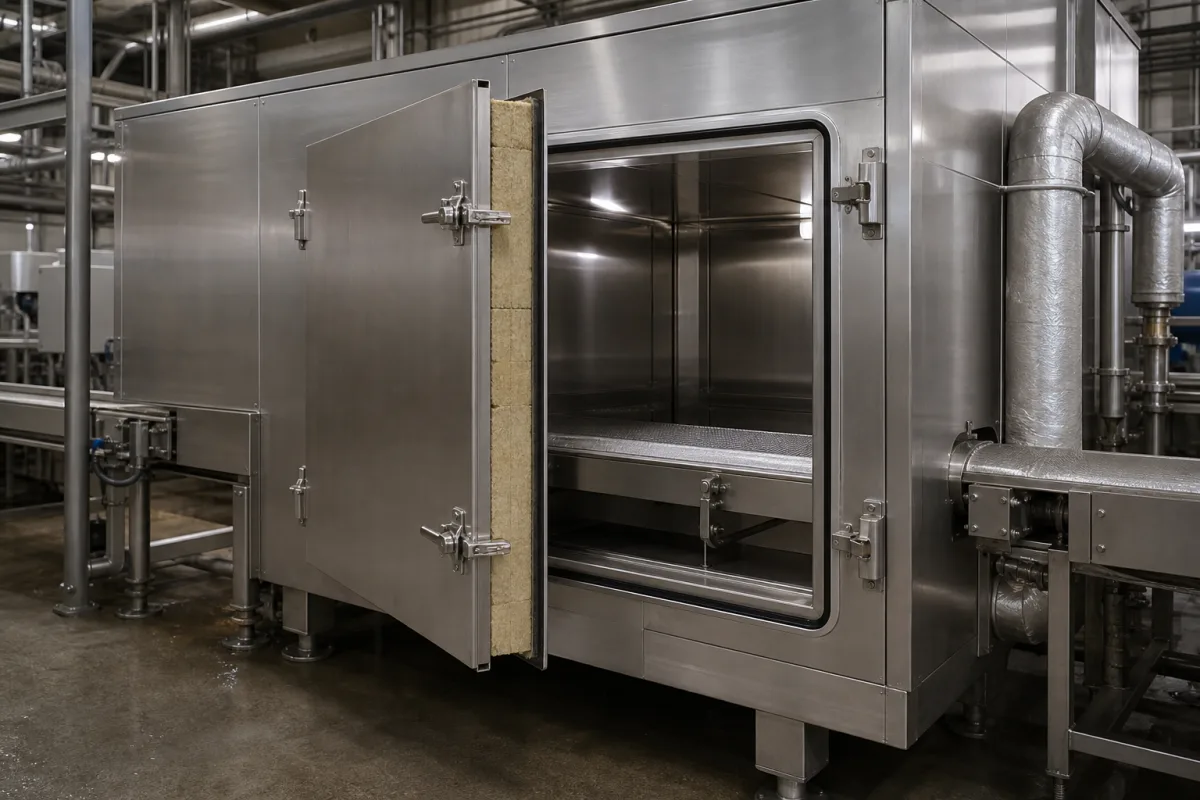
Insulated enclosure for spiral freezers and food-process holding sections: welded stainless housing, floor tray and doors
The housing round a spiral freezer or process holding section · welded or caulked joints, seam-welded floor tray and drains, heated door frames, PIR thickness against temperature
In a spiral freezer, spiral cooler or chilled holding section, the conveyor, evaporator and fans sit inside an insulated housing that the machine builder supplies as part of the equipment. That housing has to hold the cold, keep wash-down water and product debris out of the insulation, and be cleaned with the rest of the machine. Settle three things before comparing offers: how the panel joints are closed (welded or caulked), how the floor drains, and how the doors are kept free of ice.
Insulated housings supplied as part of food-process freezing, cooling and holding equipment, such as spiral freezer and cooler enclosures with their floor tray, drains, access doors and penetrations. Self-supporting sandwich panels sold as building products, with their core and fire ratings, are covered on the Insulated sandwich panels page. Walk-in cold rooms, refrigeration plant and the freezer conveyor are outside this page except where compared.
CNFX editorial research · Sources checked October 12, 2026 · 4 sources
Fully welded or groove-and-tongue caulked: closing the housing and draining the floor
The joint method decides whether wash water can reach the foam core; the floor decides where that water goes.
Square describes the enclosure of its spiral freezers as designed for insulation and waterproofing, with a choice between fully welded construction and groove-and-tongue caulking. Its panels are continuous PIR made in-house on a Hennecke foaming line, 50 to 250 mm thick depending on operating temperature and ambient conditions, with thermal conductivity ≤ 0.022 W/m·K, density 38–42 kg/m³, a cam-lock joint with a thermal break, and stainless steel skins on both sides; a fully welded stainless interior is an option. The floor is a modular, fully welded stainless floor, sloped to four drains at the corners. [1]
Heinen lines the wall and ceiling panels of its spiral freezer enclosure with stainless steel and forms the floor as a fully seam-welded stainless steel tray with defined drains; it also offers a fully welded insulating enclosure as an option. [2] ICS builds its modular packaged spiral freezer from its own insulated panels with a 2 mm stainless steel plate on each side and a high-density foam core, welded inside and outside, and states that the self-supporting framework removes the need for a special concrete floor or floor heating; final welds join the modules on site. [3]
Editorial note: a caulked housing relies on sealant along every joint for its hygiene and vapour tightness, so ask how the joints are inspected and resealed; a welded housing moves that question to the welds and to how penetrations for drives, pipes and sensors are closed. ICS places all drives outside the housing for hygiene and maintenance. [3]
Tell the builder the operating temperature, room ambient and humidity, cleaning chemicals and method (manual, belt washer or CIP), whether a welded interior is required, the floor arrangement (tray on frame or on a heated slab), drain positions, door count and size, and every pipe, duct and cable penetration.
02
Doors, frame heating and how much insulation a freezing enclosure needs
Doors and their frames are where the cold housing meets warm room air, so builders heat the frames to stop ice and condensation.
Heinen gives access to the inside of its enclosure through an insulated stainless steel door with a contact switch and electric frame heating. [2] Square uses air shrouds at the infeed and outfeed openings, which it says cut cold loss by about 30%. [1]
Spiral freezer enclosures are process equipment, but US federal rules for walk-in freezers give a published reference for insulation and door heating: walls, ceiling and doors need at least R-25 for coolers and R-32 for freezers, freezer floors at least R-28, and where an anti-sweat heater has no controls, door rail, glass and frame heaters on a freezer may draw no more than 7.1 W per square foot of door opening. [4]
Editorial calculation: R-32 (ft²·°F·h/Btu) × 0.1761 ≈ RSI 5.64 m²·K/W, and R-28 ≈ RSI 4.93. With Square's ≤ 0.022 W/m·K, a core of about 0.022 × 5.64 ≈ 0.124 m (124 mm) reaches RSI 5.64, ignoring skins, joints and surface films. 7.1 W/ft² × 10.764 ≈ 76 W/m², so a 0.9 × 2.0 m door opening (1.8 m²) would allow about 138 W of uncontrolled frame heating under that rule.
03
Cleaning and defrost features that depend on the housing
These figures are each maker's own claims for its machine; they show what to ask for rather than guarantees for another housing.
Ask where cleaning water and defrost water leave the housing, whether drains are trapped and heated at freezing temperatures, and whether the floor tray is inspected for cracks at welds after commissioning.
Feature
Published detail
Source
Floor
Sloped, fully welded stainless floor; four corner drains
Data to send for an insulated freezer or holding enclosure
Paste it into your enquiry below or into an email to a maker, then replace every bracket.
Process: [freezing, cooling or holding; air temperature; room ambient and humidity]
Housing: [inside dimensions; welded or caulked; skin material and thickness]
Insulation: [core; thickness; thermal conductivity]
Floor: [tray or panel; slope; drain number and position; on frame or slab]
Doors: [number; size; frame heating; contact switch]
Cleaning: [manual, belt washer or CIP; chemicals]
Penetrations: [drives; refrigerant pipes; ducts; sensors]
1 company lists this product among what they make. Company figures are quoted from each
company's own website; every card states where the relationship came from.
Square Technology Group Co. Ltd.
Manufacturing site to be confirmed for the order
Lists the insulated enclosure of its spiral freezers: PIR panels 50–250 mm thick with stainless skins, fully welded or caulked, and a sloped welded stainless floor with four corner drains.
Explore company information and manufacturing capabilities, then discuss the scope of your project with a relevant supplier.
Share this page
Compiled and source-reviewed by the CNFX editorial team.
Each manufacturer above links to the page on that company's own website where the product is listed, with the date we checked it. How we source and review
· Page last updated 13 October 2026
Buyer questions
How thick are the walls of a spiral freezer enclosure?
Square lists PIR panels from 50 to 250 mm, chosen by operating temperature and ambient conditions, with thermal conductivity of 0.022 W/m·K or less. [1]
Why are freezer enclosure door frames heated?
To keep the door seal free of ice and condensation; Heinen fits its insulated stainless door with electric frame heating and a contact switch. US walk-in freezer rules cap uncontrolled frame heater power at 7.1 W per square foot of door opening. [2][4]
Does a freezer enclosure need floor heating?
It depends on the base; ICS says its self-supporting welded modules need no special concrete floor and no floor heating. [3]
Sources and what still needs a direct check
Sources checked 2026-10-12. Square, Heinen and ICS are freezer builders describing their own enclosures; the US Department of Energy rule applies to walk-in coolers and freezers and is used here only as a reference level.