Industry-Verified Manufacturing Data (2026)

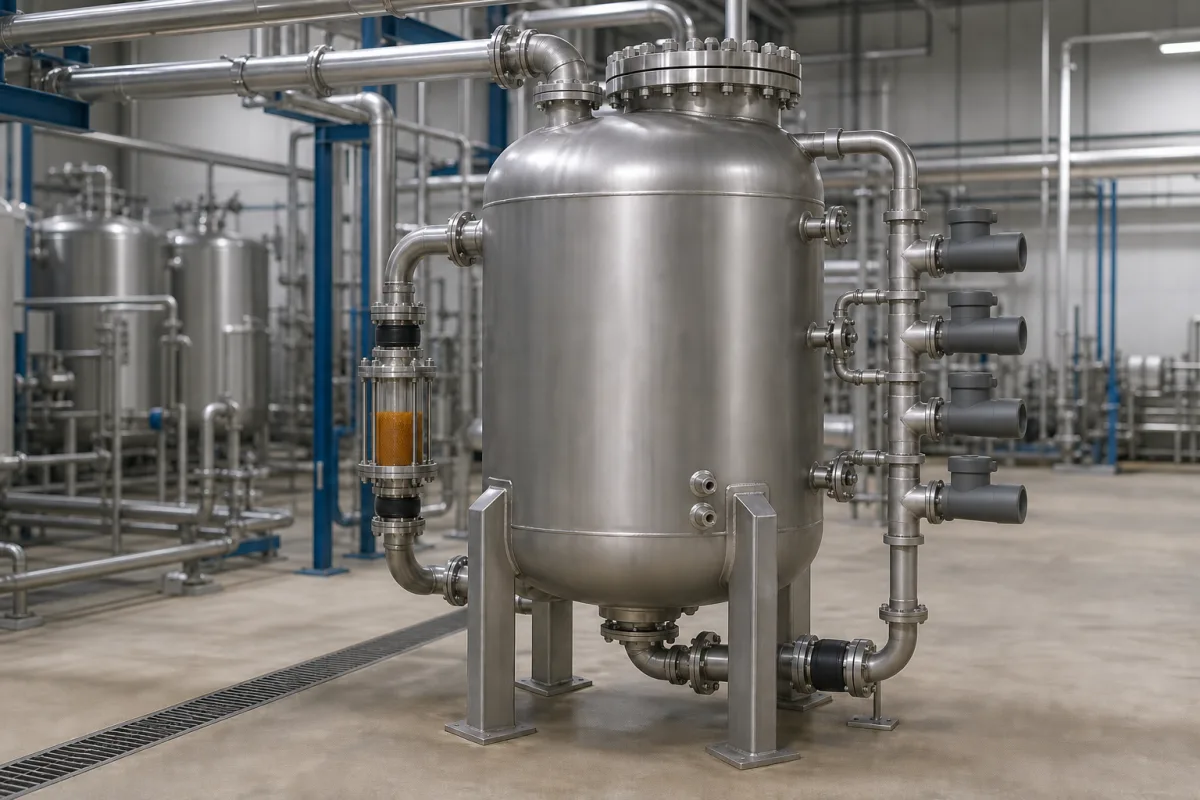
Ion Exchange Vessel

Based on aggregated insights from multiple verified factory profiles within the CNFX directory, the standard Ion Exchange Vessel used in the Machinery and Equipment Manufacturing sector typically supports operational capacities ranging from standard industrial configurations to heavy-duty production requirements.

Technical Definition & Core Assembly

A canonical Ion Exchange Vessel is characterized by the integration of Vessel Shell and Upper Distributor/Collector. In industrial production environments, manufacturers listed on CNFX commonly emphasize Fiberglass Reinforced Plastic (FRP) construction to support stable, high-cycle operation across diverse manufacturing scenarios.

A pressure vessel containing ion exchange resin for removing dissolved ions from water.
Product Specifications

Technical details and manufacturing context for Ion Exchange Vessel

Definition
A cylindrical pressure vessel that houses ion exchange resin media as part of a water treatment module. It facilitates the removal of specific dissolved ionic contaminants (cations or anions) from water through reversible ion exchange reactions between the resin and the solution, enabling water softening, demineralization, or specific ion removal.
Working Principle
Water flows through a bed of ion exchange resin beads inside the vessel. Target ions in the water (e.g., calcium, magnesium, nitrate) are exchanged for less problematic ions (e.g., sodium, hydrogen, hydroxide) held on the resin's functional groups. The process continues until the resin's exchange capacity is exhausted, after which it requires regeneration with a concentrated brine or acid/caustic solution.
Common Materials
Fiberglass Reinforced Plastic (FRP), Stainless Steel (e.g., 304, 316L), Carbon Steel (lined)
Technical Parameters
  • Vessel diameter and height/tangent-to-tangent length. (mm) Customizable
Components / BOM
  • Vessel Shell
    Provides the pressure-retaining structure for the resin bed and process fluid.
    Material: FRP, Stainless Steel, or Lined Carbon Steel
  • Upper Distributor/Collector
    Distributes incoming water evenly across the resin bed surface during service and collects backwash water.
    Material: PVC, ABS, Stainless Steel
  • Lower Distributor/Collector
    Collects treated water evenly from the bottom of the resin bed during service and distributes regeneration/rinse solutions.
    Material: PVC, ABS, Stainless Steel
  • Resin Retention Screen
    Prevents ion exchange resin beads from escaping the vessel with the effluent.
    Material: Stainless Steel, Plastic
  • Manway
    Provides access for resin loading, inspection, and maintenance.
    Material: Matching vessel material
Engineering Reasoning
0.5-10 bar at 5-40°C
15 bar internal pressure at 60°C causing resin bed fluidization and vessel wall stress exceeding 250 MPa yield strength
Design Rationale: Resin osmotic swelling pressure exceeding vessel mechanical limits due to ionic concentration gradients across resin beads, combined with thermal expansion mismatch between stainless steel (17.3 μm/m·K) and polypropylene resin beads (150 μm/m·K)
Risk Mitigation (FMEA)
Trigger Chlorine breakthrough exceeding 0.1 ppm oxidizing resin crosslinks
Mode: Resin bead fragmentation creating 50+ μm fines causing bed compaction
Strategy: Upstream activated carbon filtration with 5 μm pre-filter maintaining chlorine <0.01 ppm
Trigger Calcium sulfate scaling at Langelier Saturation Index >0.5
Mode: Resin fouling reducing exchange capacity by 70% within 48 hours
Strategy: Antiscalant injection at 2-5 ppm maintaining LSI <-0.3 with pH control at 6.8-7.2

Industry Taxonomies & Aliases

Commonly used trade names and technical identifiers for Ion Exchange Vessel.

Applied To / Applications

This component is essential for the following industrial systems and equipment:

Industrial Ecosystem & Supply Chain DNA

Complementary Systems
Downstream Applications
Specialized Tooling

Application Fit & Sizing Matrix

Operational Limits
pressure: Up to 150 psi (10.3 bar) operating, 225 psi (15.5 bar) design
flow rate: 2-20 gpm/ft³ (0.27-2.7 m³/h/m³) resin bed
temperature: 5°C to 50°C (41°F to 122°F)
slurry concentration: Not applicable (fixed bed operation)
Media Compatibility
✓ Demineralized water production ✓ Boiler feedwater treatment ✓ Process water purification
Unsuitable: High organic content wastewater (fouling risk)
Sizing Data Required
  • Required flow rate (gpm or m³/h)
  • Total dissolved solids (TDS) concentration (ppm)
  • Required treated water quality (conductivity/resistivity)

Reliability & Engineering Risk Analysis

Failure Mode & Root Cause
Resin degradation
Cause: Chemical attack from incompatible process fluids, high temperatures exceeding resin thermal limits, or chlorine/oxidant exposure breaking polymer chains
Vessel wall corrosion/erosion
Cause: Galvanic corrosion at dissimilar metal interfaces, pitting from chloride ions in brackish water, or erosion from high-velocity resin movement during backwash cycles
Maintenance Indicators
  • Visible resin leakage at vessel connections or through cracked laterals
  • Abnormal pressure drop across vessel (>15-20% increase from clean state) indicating fouling or channeling
Engineering Tips
  • Implement regular resin analysis (annual) to monitor bead integrity, exchange capacity, and fouling levels - replace at 80% capacity loss
  • Install sacrificial anode protection on vessel internals and maintain proper backwash flow rates (typically 4-6 gpm/ft²) to prevent resin compaction and mechanical damage

Compliance & Manufacturing Standards

Reference Standards
ISO 9001:2015 - Quality management systems ASME BPVC Section VIII - Pressure vessel construction DIN 28018 - Vessels for process plants
Manufacturing Precision
  • Bore diameter: +/-0.05mm
  • Surface finish: Ra 0.8μm maximum
Quality Inspection
  • Hydrostatic pressure test
  • Visual and dimensional inspection

Factories Producing Ion Exchange Vessel

Verified manufacturers with capability to produce this product in China

✓ 92% Supplier Capability Match Found

P Procurement Specialist from United States Jan 03, 2026
★★★★★
"As a professional in the Machinery and Equipment Manufacturing sector, I confirm this Ion Exchange Vessel meets all ISO standards."
Technical Specifications Verified
T Technical Director from United Arab Emirates Dec 31, 2025
★★★★★
"Standard OEM quality for Machinery and Equipment Manufacturing applications. The Ion Exchange Vessel arrived with full certification."
Technical Specifications Verified
P Project Engineer from Australia Dec 28, 2025
★★★★★
"Great transparency on the Ion Exchange Vessel components. Essential for our Machinery and Equipment Manufacturing supply chain."
Technical Specifications Verified
Verification Protocol

“Feedback is collected from verified sourcing managers during RFQ (Request for Quote) and factory evaluation processes on CNFX. These reports represent historical performance data and technical audit summaries from our B2B manufacturing network.”

8 sourcing managers are analyzing this specification now. Last inquiry for Ion Exchange Vessel from Turkey (1h ago).

Supply Chain Compatible Machinery & Devices

Hydraulic Press

Industrial machine using hydraulic pressure to compress, form, or assemble materials

Explore Specs →
Heavy-Duty CNC Plasma Cutting Machine

Industrial machine for precision metal cutting using plasma arc technology

Explore Specs →
Automated Assembly Line System

Integrated production system for sequential component assembly operations

Explore Specs →
Automated Powder Coating System

Integrated industrial system for applying dry powder coatings to metal substrates.

Explore Specs →

Frequently Asked Questions

What materials are available for ion exchange vessels in industrial applications?

Our ion exchange vessels are constructed from Fiberglass Reinforced Plastic (FRP) for corrosion resistance, stainless steel (304 or 316L) for durability, or carbon steel with protective lining for cost-effective solutions in various industrial environments.

How does the resin retention system work in your ion exchange vessels?

Our vessels feature precision-engineered resin retention screens and upper/lower distributor-collector systems that ensure uniform flow distribution, prevent resin loss, and maximize ion exchange efficiency throughout the water treatment process.

What maintenance access features are included in your ion exchange vessel design?

Each vessel includes a full-size manway for easy resin replacement and internal inspection, along with strategically placed access points for distributor maintenance, ensuring minimal downtime during service operations.

Can I contact factories directly on CNFX?

CNFX is an open directory, not a transaction platform. Each factory profile provides direct contact information and production details to help you initiate direct inquiries with Chinese suppliers.

Get Quote for Ion Exchange Vessel

Request technical pricing, lead times, or customized specifications for Ion Exchange Vessel directly from verified manufacturing units.

Your business information is encrypted and only shared with verified Ion Exchange Vessel suppliers.

Thank you! Your message has been sent. We'll respond within 1–3 business days.

Need to Manufacture Ion Exchange Vessel?

Connect with verified factories specializing in this product category

Add Your Factory Contact Us
Previous Product
Ion Exchange Resin Bed
Next Product
IR Drying/Curing Tunnel