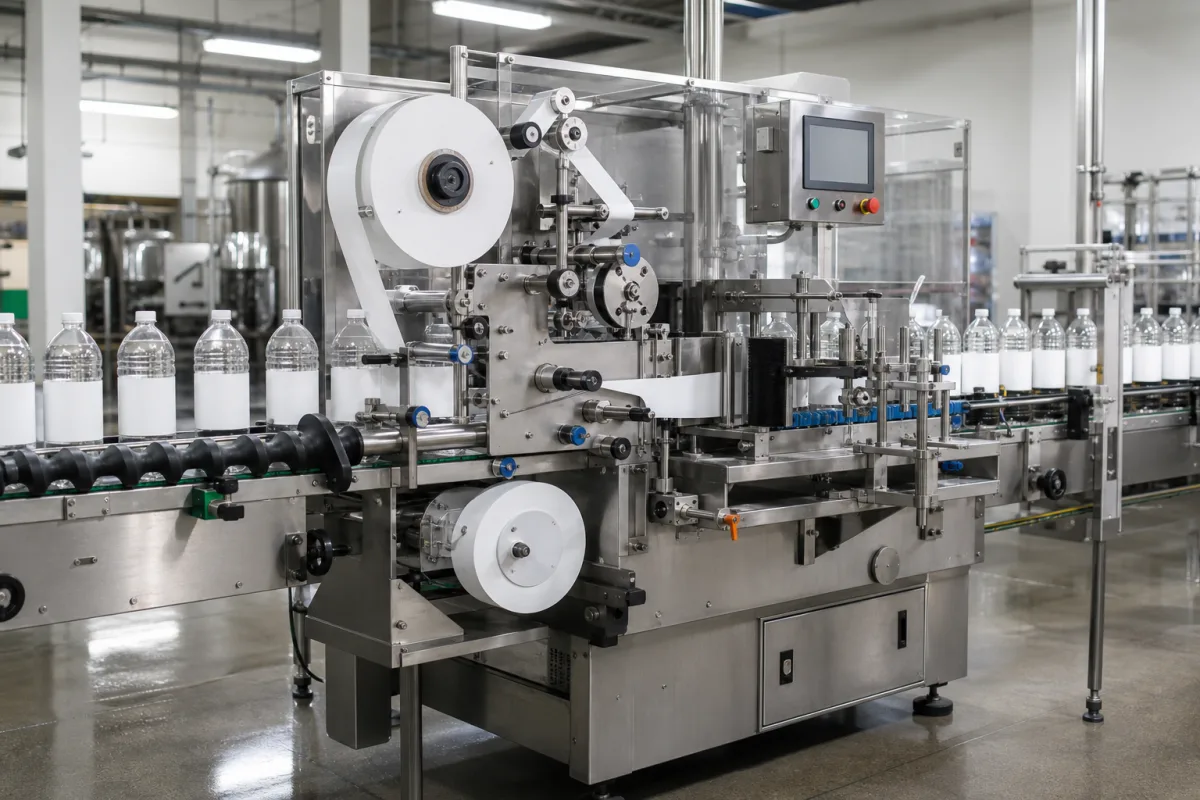
Labeling unit (roll-fed hot-melt wrap-around labeller: label web cut from the reel, glued on a vacuum drum and wrapped round PET bottles)
Roll-fed wrap-around labelling units for PET bottles · label reels and splicing, cutting drum and fixed blade, vacuum transfer drum, hot-melt glue roller, no-bottle-no-glue control, carousel and bottle plates
A labeling unit here is the roll-fed station of a wrap-around labeller: the printed film runs off a reel, a cutting drum cuts each label to length, a vacuum drum carries it past a hot-melt glue roller and presses its leading edge onto the bottle, and the bottle turns on the carousel to draw the rest of the label round itself. Ask three things first: what label film and length the unit must cut, how reel changes and missing bottles are handled without stopping or gluing the drum, and what bottle shapes and speeds the carousel must take.
Roll-fed (reel-fed) wrap-around labelling units and labellers that apply cut plastic film labels with hot-melt glue to cylindrical and shaped bottles. Self-adhesive (pressure-sensitive) labelling systems and applicators are covered on the Labeling systems for packaging lines page; electric peel-and-present label dispensers on the Automatic label dispenser page; shrink-sleeve and cold-glue labellers and label printers are outside this page.
CNFX editorial research · Sources checked October 12, 2026 · 3 sources
From reel to cut label: splicing, web tension and the cutting blade
SIPA describes its XLABL as a "roll-fed labeller, designed to apply plastic wrap-around labels with hot-melt glue to cylindrical and shaped PET bottles, full or empty". Its dual reel system is servo-controlled for active unwinding with web aligner and mark reading, splices reels automatically "for continuous operation without any machine stop", and has an electronically controlled film tensioner. The traction and cutting roller uses a straight fixed blade of sintered hard metal rated for "up to 200 million cuts", replaced with a single screw and no adjustment, and a servo "Pull-Back" function and label-length self-learning. [1]
A Stackpole patent on wrap-around labelling explains why roll-fed labels are used: labels "supplied in roll form" are advanced and cut to the correct length, at low label cost and with good print quality; its vacuum drum is built from replaceable segments so the machine can change from one label length to another. [3]
Editorial calculation: 200 million cuts at an assumed 30,000 bottles per hour is 200,000,000 ÷ 30,000 ≈ 6,670 running hours per blade. A wrap-around label for a bottle of 65 mm diameter needs at least π × 65 ≈ 204 mm plus the overlap the glue seam needs; both the speed and the bottle size are assumed examples. [1]
Give the labeller maker the bottle drawings (diameter, label panel height, shape), label film type and thickness, label length and overlap, reel diameter and core, print register marks, glue type, line speed range, full or empty bottles, and the reel change and splice requirements.
02
Vacuum drum, hot-melt glue roller and what happens when a bottle is missing
In SIPA's unit a vacuum transfer drum moves each label "from the cutting cylinder to the glue roller and then to the bottle"; the drum has a removable vacuum plate for cleaning and is light for quick changeover. The glue station is built for uniform glue application with low consumption and "to prevent issues like fumes or carbonization", with an external insulated tank for glue blocks and an electrically heated glue pipe for faster start-up. On the carousel, self-centring bottle plates and cap-pressing heads hold the bottle, and the heads can pressurise empty bottles. [1]
A KHS patent on the vacuum drum explains that the label's glued leading edge sticks to the container, which is then rotated to draw off the rest of the label, and that gaps in the container flow mean the drum must not glue a label for a container that is not there; its drum has vacuum holders that switch between a gluing position and a rest position "in which the vacuum holders avoid an application of glue". [2] The Stackpole patent instead deforms the drum surface selectively to bring only parts of the label into contact with the glue roll. [3]
03
Reel stands, cutting drum, vacuum drum, glue station and carousel
Explore company information and manufacturing capabilities, then discuss the scope of your project with a relevant supplier.
Share this page
Compiled and source-reviewed by the CNFX editorial team.
Each manufacturer above links to the page on that company's own website where the product is listed, with the date we checked it. How we source and review
· Page last updated 13 October 2026
Buyer questions
How is a roll-fed labelling unit different from a self-adhesive labeller?
It cuts plain film labels from a reel and glues them with hot melt; self-adhesive labellers that peel labels from a liner are on the Labeling systems for packaging lines page. [1][3]
How long does the cutting blade last?
SIPA rates its sintered hard metal fixed blade for up to 200 million cuts. [1]
What stops glue going onto the drum when a bottle is missing?
A KHS patent switches the drum's vacuum holders to a rest position that avoids glue when there is a gap in the container flow. [2]
Can the unit run without stopping for reel changes?
SIPA's dual reel system splices automatically for continuous operation. [1]
Sources and what still needs a direct check
Sources checked 2026-10-12. SIPA publishes its XLABL roll-fed labeller; KHS and Stackpole patents describe vacuum drums for wrap-around labelling.