Industry-Verified Manufacturing Data (2026)

Linear Motion System

Based on aggregated insights from multiple verified factory profiles within the CNFX directory, the standard Linear Motion System used in the Machinery and Equipment Manufacturing sector typically supports operational capacities ranging from standard industrial configurations to heavy-duty production requirements.

Technical Definition & Core Assembly

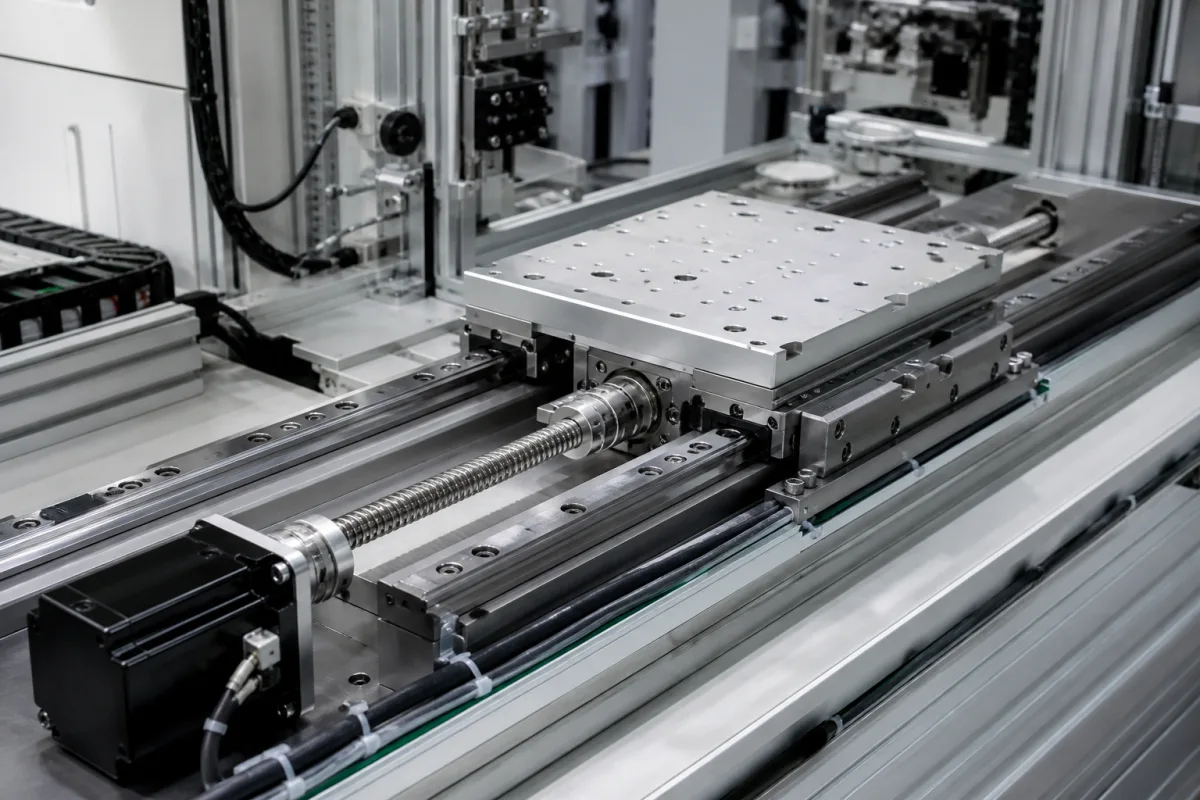
A canonical Linear Motion System is characterized by the integration of Linear Rail and Carriage (Slider Block). In industrial production environments, manufacturers listed on CNFX commonly emphasize Hardened Steel construction to support stable, high-cycle operation across diverse manufacturing scenarios.

A mechanical system designed to provide controlled linear movement along a single axis within an industrial setup.
Product Specifications

Technical details and manufacturing context for Linear Motion System

Definition
A Linear Motion System is a precision mechanical component within an Industrial System that facilitates controlled, repeatable movement along a straight path. It is fundamental for positioning, transferring, or actuating loads in applications requiring high accuracy, smooth operation, and minimal friction, such as in automation, machining, assembly, and material handling equipment.
Working Principle
The system physically functions by converting rotational motion (typically from a motor) into precise linear motion. This is commonly achieved through mechanisms like a ball screw or lead screw, where a rotating screw drives a nut along its length, or via a linear motor that directly produces linear force. The moving carriage or platform is guided along a rigid rail or shaft using recirculating ball bearings or linear guides to minimize friction and maintain alignment, ensuring smooth and accurate travel.
Common Materials
Hardened Steel, Aluminum Alloy
Technical Parameters
  • Travel length or stroke of the Linear Motion System (mm) Standard Spec
Components / BOM
  • Linear Rail
    Provides a rigid, precision-ground track for guiding the carriage
    Material: Hardened Steel
  • Carriage (Slider Block)
    The moving element that travels along the rail, often with recirculating ball bearings
    Material: Hardened Steel or Aluminum Alloy
  • Drive Mechanism (e.g., Ball Screw)
    Converts rotational motion from a motor into linear motion to propel the carriage
    Material: Hardened Steel
  • End Supports
    Mounting blocks that secure and align the rail ends to the machine structure
    Material: Aluminum Alloy or Cast Iron
  • Wiper Seals Optional
    Protect the rail and carriage from contaminants like dust and debris
    Material: Synthetic Rubber or Polyurethane
Engineering Reasoning
0.1-100 m/s linear velocity, 0.01-100 kN axial load
Exceeds 120 m/s velocity or 110 kN axial load, or operates above 150°C for >1000 hours
Design Rationale: Bearing fatigue failure due to Hertzian contact stress exceeding 2.1 GPa, or polymer component degradation via Arrhenius thermal aging at >150°C
Risk Mitigation (FMEA)
Trigger Contamination ingress (ISO 4406 Class 21/19/16 particles >4 μm)
Mode: Ball screw/linear guide abrasive wear increasing backlash >50 μm
Strategy: IP67-rated sealing with labyrinth seals and positive-pressure purge system
Trigger Resonant vibration at 85-120 Hz matching system natural frequency
Mode: Positioning error accumulation exceeding ±0.05 mm via structural resonance
Strategy: Stiffness-tuned mounting at 200 N/μm with active vibration damping using piezoelectric actuators

Industry Taxonomies & Aliases

Commonly used trade names and technical identifiers for Linear Motion System.

Applied To / Applications

This component is essential for the following industrial systems and equipment:

Industrial Ecosystem & Supply Chain DNA

Complementary Systems
Downstream Applications
Specialized Tooling

Application Fit & Sizing Matrix

Operational Limits
pressure: 0 to 10 bar
speed range: 0.01 to 2 m/s
temperature: -20°C to 80°C
load capacity: Up to 5000 N
Media Compatibility
✓ Clean air environments ✓ Lubricated mechanical systems ✓ Dry particulate-free atmospheres
Unsuitable: High-concentration abrasive slurry environments
Sizing Data Required
  • Maximum load requirement (N)
  • Required travel length (mm)
  • Desired positioning accuracy (mm)

Reliability & Engineering Risk Analysis

Failure Mode & Root Cause
Wear and Contamination
Cause: Abrasive particles (dust, debris) entering the system, inadequate lubrication, or misalignment causing accelerated wear on components like rails, bearings, and seals.
Fatigue and Overload Failure
Cause: Excessive or cyclic loading beyond design limits, improper installation (e.g., preload issues), or material defects leading to cracks, deformation, or catastrophic failure in components such as ball screws or linear guides.
Maintenance Indicators
  • Unusual grinding, squeaking, or knocking noises during operation
  • Visible misalignment, excessive vibration, or irregular motion patterns
Engineering Tips
  • Implement a proactive lubrication schedule using manufacturer-recommended lubricants and ensure proper sealing to prevent contamination ingress.
  • Conduct regular alignment checks and load monitoring to ensure operations stay within design specifications, and use vibration analysis for early fault detection.

Compliance & Manufacturing Standards

Reference Standards
ISO 10791-1:2015 (Geometric accuracy of linear motion systems) ANSI/B11.19-2019 (Safety requirements for machine tools and linear motion components) DIN 645-1 (Linear ball bearings and shafts - Dimensions and tolerances)
Manufacturing Precision
  • Parallelism of guide rails: ≤0.02mm per 1000mm
  • Surface roughness of sliding surfaces: Ra ≤0.8μm
Quality Inspection
  • Laser interferometer geometric accuracy verification
  • Hardness testing of bearing surfaces (Rockwell C scale)

Factories Producing Linear Motion System

Verified manufacturers with capability to produce this product in China

✓ 94% Supplier Capability Match Found

S Sourcing Manager from United Arab Emirates Jan 08, 2026
★★★★★
"Great transparency on the Linear Motion System components. Essential for our Machinery and Equipment Manufacturing supply chain."
Technical Specifications Verified
P Procurement Specialist from Australia Jan 05, 2026
★★★★☆
"The Linear Motion System we sourced perfectly fits our Machinery and Equipment Manufacturing production line requirements. (Delivery took slightly longer than expected, but technical support was excellent.)"
Technical Specifications Verified
T Technical Director from Singapore Jan 02, 2026
★★★★★
"Found 32+ suppliers for Linear Motion System on CNFX, but this spec remains the most cost-effective."
Technical Specifications Verified
Verification Protocol

“Feedback is collected from verified sourcing managers during RFQ (Request for Quote) and factory evaluation processes on CNFX. These reports represent historical performance data and technical audit summaries from our B2B manufacturing network.”

15 sourcing managers are analyzing this specification now. Last inquiry for Linear Motion System from Germany (20m ago).

Supply Chain Commonly Integrated Components

Drive Motor

Electric motor that provides rotational power to drive the blending mechanism in pharmaceutical powder blending equipment

Explore Specs →
Vision System

An optical inspection subsystem that uses cameras, lighting, and image processing to detect defects in pharmaceutical vials.

Explore Specs →
Coating Pan

A rotating vessel used to apply uniform coating layers to pharmaceutical tablets through controlled spraying and drying processes.

Explore Specs →
Spray System

A precision fluid delivery subsystem that atomizes and applies coating solutions onto pharmaceutical tablets within an automated coating system.

Explore Specs →

Frequently Asked Questions

What are the main advantages of using hardened steel in linear motion systems?

Hardened steel provides superior wear resistance, high load capacity, and extended service life in demanding industrial environments, reducing maintenance frequency and downtime.

How does the ball screw drive mechanism improve linear motion performance?

Ball screw drives offer high precision positioning, efficient power transmission with minimal backlash, and smooth operation for accurate repeatable movement in machinery applications.

What maintenance is required for linear motion systems with wiper seals?

Wiper seals protect internal components from contaminants; regular inspection and cleaning of seals, along with proper lubrication of rails and carriages, ensure optimal performance and longevity.

Can I contact factories directly on CNFX?

CNFX is an open directory, not a transaction platform. Each factory profile provides direct contact information and production details to help you initiate direct inquiries with Chinese suppliers.

Get Quote for Linear Motion System

Request technical pricing, lead times, or customized specifications for Linear Motion System directly from verified manufacturing units.

Your business information is encrypted and only shared with verified Linear Motion System suppliers.

Thank you! Your message has been sent. We'll respond within 1–3 business days.

Need to Manufacture Linear Motion System?

Connect with verified factories specializing in this product category

Add Your Factory Contact Us
Previous Product
Linear Guideways & Ball Screws
Next Product
Linear Motor / Servo Motor