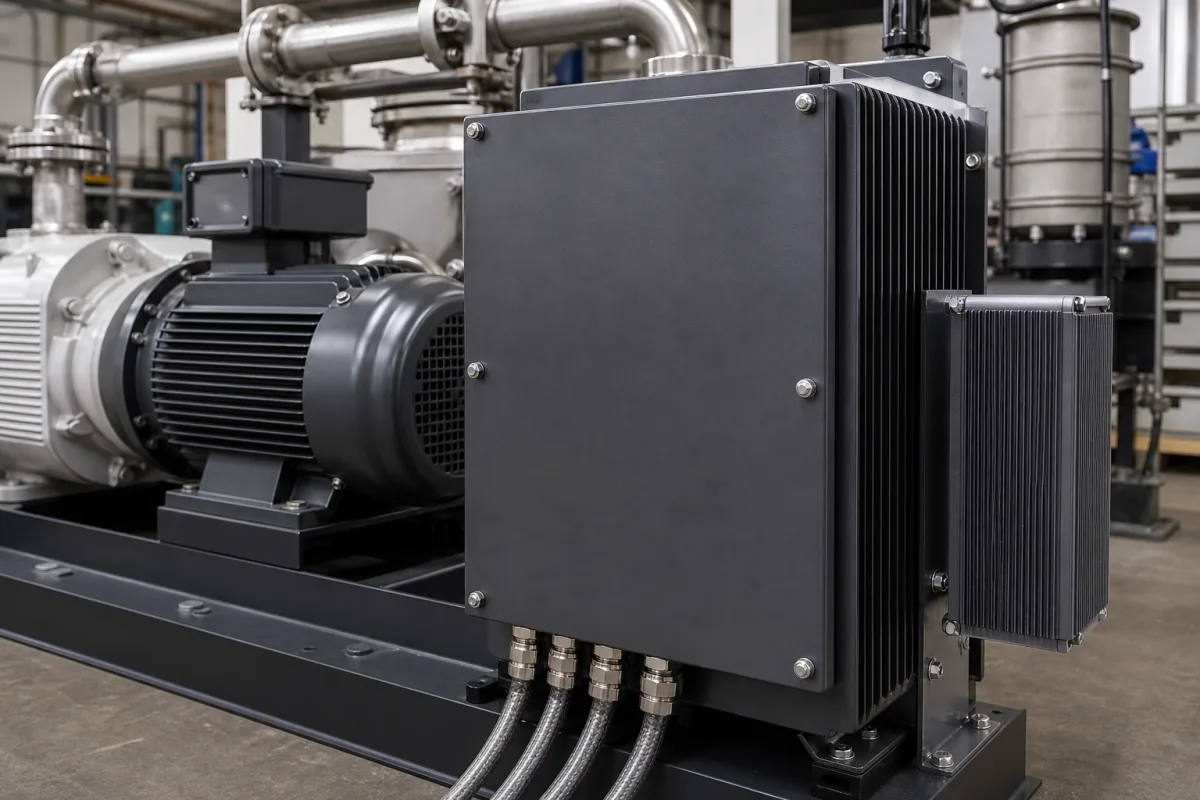
On a vacuum pump skid the motor drive is not just a soft starter with a speed knob. Its job is to hold the process at a set pressure: run faster when the leak or gas load rises, slower when it falls, and never so slow, or on a liquid ring pump so fast, that the pump itself is harmed. The illustration shows the drive mounted on the pump base beside the motor; this page covers what it is controlling.
Covers motor drives fitted to industrial vacuum pumps (oil-sealed and dry rotary vane, screw, claw and liquid ring) and the control they perform: pressure setpoint control, permissible frequency range, behaviour in central systems with more than one pump, and the anti-cavitation speed limit on liquid ring pumps. General low-voltage AC drive selection is on Variable frequency drive; panel installation, harmonics and derating are on Variable frequency drive (VFD) in the control panel; conveyor speed controllers are on Conveyor motor speed controller. Choosing the pump type and sizing pumping speed are on Vacuum pump, and complete skid packages with separators and boosters on Packaged vacuum pump system. Motor driver chips, servo and stepper drives are outside this page.
CNFX editorial research · Sources checked October 12, 2026 · 3 sources
Atlas Copco's vacuum energy-efficiency page sets out what a drive changes on a vacuum pump.
A fixed-speed pump runs flat out whatever the process needs. With a variable speed drive the pump adapts to the current demand from the process. Atlas Copco names setpoint control as possibly the largest single source of savings: the factory manager or process engineer defines the operating pressure precisely and can change it after the system is installed, so the pump stops pulling a deeper vacuum than the process uses.
In a central vacuum system with more than one pump, a fixed-speed machine started to cover a demand spike keeps running when demand drops again; Atlas Copco says a minimum run of about 10 minutes is needed to prevent mechanical damage. A variable-speed pump follows the fluctuation instead of cycling on and off.
On its GVS VSD+ rotary vane pumps the drive sits on top of the pump and provides the setpoint control directly, the same close-coupled arrangement as the drive on the pump base in the illustration. For its GHS VSD+ screw pumps Atlas Copco claims energy savings of potentially 50% or more, footnoted as applying in a good share of applications against traditional fixed-speed technology and measured with its own Vbox energy audit tool.
The 50% figure is a manufacturer claim on its own measurement method. Ask for a logged pressure and power profile of your process, or a site audit, before relying on any saving figure.
02
The frequency window a pump allows
A drive can produce a far wider frequency range than a pump will tolerate; the pump maker sets the window.
Becker sells this oil-free vane pump with its own VARIAIR frequency inverter and states an operating range of 30 to 60 Hz. For a displacement pump, flow scales roughly with speed, so halving from 60 to 30 Hz would bring the 76 m³/h rating down to about 38 m³/h (Editorial calculation, assuming 76 m³/h is the 60 Hz value and flow is proportional to speed).
The lower limit matters as much as the upper: below it a vane pump may not keep its vanes or cooling working as designed, and a liquid ring pump may not hold its ring. A general-purpose drive left with factory frequency limits does not know any of this.
Ask the pump maker for the permitted minimum and maximum frequency, whether the 60 Hz rating is the nameplate value, and set those limits in the drive parameters.
03
Liquid ring pumps: the anti-cavitation limit
Edwards' patent US 11,619,232 B2 describes a drive control scheme for a liquid ring pump with two control processes.
In the first, the controller compares the measured inlet pressure with a target pressure defined by the facility and adjusts motor speed to close the gap. The patent states that at low thermal load the pump slows down and energy consumption falls, and that recycling the operating liquid through a separator and a heat exchanger reduces operating-liquid consumption.
The second, which the patent calls anti-cavitation control, can override the first. A temperature sensor measures the operating liquid; the controller works out the vapour pressure of the liquid (water in the example) at that temperature and adds an offset as a safety margin, between 1 and 10 mbar. If the inlet pressure comes down to that limit, the controller slows the motor so the pump draws gas out less quickly and the inlet pressure rises again, reducing the likelihood or severity of cavitation.
In other words, on a liquid ring pump the lowest pressure the drive is allowed to chase depends on how warm the sealing water is: warmer water means a higher floor. Atlas Copco's LRP VSD+ uses a second drive on the water circulation pump alongside the main one.
Input
Measured by
Used for
Inlet pressure
Pressure sensor on the suction line
Speed against the target pressure
Operating liquid temperature
Temperature sensor
Vapour pressure of the liquid
Offset (1–10 mbar)
Set in the controller
Margin above vapour pressure
Ask whether the drive or pump controller has an anti-cavitation limit tied to sealing-liquid temperature, how the offset is set, and what alarm is raised when the setpoint cannot be reached without crossing it.
04
What to give a vacuum pump supplier about the drive
Paste it into your enquiry below or into an email to a maker, then replace every bracket.
State the pump type and size, the process pressure setpoint and its range, how demand varies over a shift, whether the pump works alone or in a central system with others, supply voltage and frequency, and where the drive will be mounted (on the pump, on the skid, or in a panel) with ambient temperature and ingress protection needed. Ask for the permitted frequency range, the flow at minimum and maximum speed, the control mode (setpoint or external speed reference), sealing-liquid temperature limits and anti-cavitation logic for liquid ring pumps, and a measured power curve against pressure.
10 companies list this product among what they make. Company figures are quoted from each
company's own website; every card states where the relationship came from.
Explore company information and manufacturing capabilities, then discuss the scope of your project with a relevant supplier.
Share this page
Compiled and source-reviewed by the CNFX editorial team.
Each manufacturer above links to the page on that company's own website where the product is listed, with the date we checked it. How we source and review
· Page last updated 13 October 2026
Buyer questions
What does a variable speed drive control on a vacuum pump?
It adapts pump speed to process demand and, with setpoint control, holds a defined operating pressure that can be changed after installation, according to Atlas Copco. [1]
Can a vacuum pump run at any frequency the drive allows?
No. Becker states 30 to 60 Hz for its VARIAIR KVT 3.80/0-400; set the drive's limits to the pump maker's window. [2]
Why must a liquid ring pump drive limit how low the pressure goes?
Edwards' patent limits speed so inlet pressure stays above the vapour pressure of the operating liquid at its measured temperature plus a 1–10 mbar offset, to avoid cavitation. [3]
Why not just switch extra fixed-speed pumps on and off?
Atlas Copco notes that a fixed-speed pump started for a spike keeps running when demand falls, with a minimum run of about 10 minutes to avoid mechanical damage. [1]
Sources and what still needs a direct check
Sources checked 2026-10-12. A vacuum pump maker's application page, a second pump maker's specification and a third maker's patent on liquid ring pump control.