CNC Motion System
View system integration details
This page explains how Motor Driver is classified within Machinery and Equipment Manufacturing. Technical values and manufacturer relationships are research references; confirm the current specification and supplier evidence for each order.
Electronic device that controls the operation of electric motors in CNC systems by converting control signals into power signals.
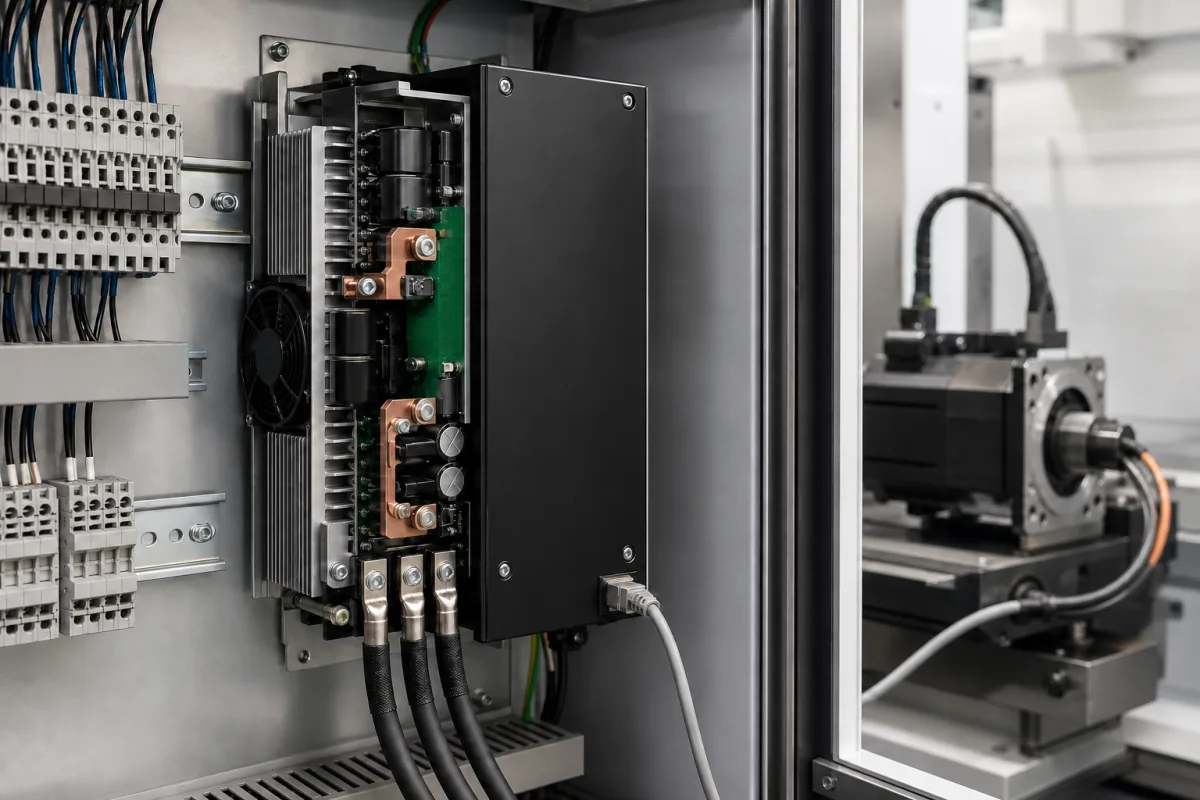
Technical details and manufacturing context for Motor Driver
| Parameter | Typical range | Notes & selection driver |
|---|---|---|
| Rated Power | 0.4–7.5 kW | Matches motor size; higher power requires larger drive. |
| Input Voltage | 220–480 V AC | Three-phase; outside range may damage drive.IEC 60038 |
| Output Current | 2–20 A | Must exceed motor rated current by 20%. |
| Control Accuracy | ±0.01 % | Typical for closed-loop vector control. |
| Speed Range | 1:1000 | Constant torque below base speed. |
| Operating Temperature | -10–50 °C | Derate above 40°C.IEC 60721-3-3 |
| Protection Rating | IP20–IP54 | IP54 for dusty/wet environments.IEC 60529 |
| Cooling Method | Natural–Forced | Forced air above 5 kW. |
| Weight | 1.5–15 kg | Depends on power and enclosure. |
| Dimensions (W×H×D) | 100×200×150–300×500×400 mm | Panel mounting; check clearance. |
Ranges are indicative industry figures for RFQ preparation, not a supplier commitment. Confirm every value and standard with the legal manufacturer before ordering.
This component is essential for the following industrial systems and equipment:
| current: | Up to 20A continuous, 40A peak (model dependent) |
| voltage: | 12-48V DC input range, 0-400V AC output range |
| humidity: | 5-95% non-condensing |
| temperature: | -10°C to +70°C operating, -40°C to +85°C storage |
Indicative industry ranges for design and RFQ preparation. Confirm the exact figures and applicable standard with the manufacturer before specifying.
Quoted from the published standard.
12 companies list this product among what they make. Company figures are quoted from each company's own website; every card states where the relationship came from.
Manufacturer listings support early research and capability understanding. They are not certification, ranking, or transaction guarantees.
A practical evidence checklist for RFQ preparation and supplier evaluation.
CNFX does not score or rank suppliers. Buyers must verify all claims and documents with the legal manufacturer before ordering.
A servo motor driver uses closed-loop control with encoder feedback to precisely adjust motor position, speed, and torque. A stepper motor driver operates in open-loop, converting step and direction pulses into phased current pulses to rotate the motor in fixed increments. Servo drivers are typically used for higher accuracy and dynamic performance, while stepper drivers are simpler and cost-effective for lower-speed applications.
Select a driver whose rated power matches the motor's power rating, and ensure the output current exceeds the motor's rated current by at least 20%. Verify that the input voltage matches your facility's three-phase supply (220-480 V AC) and that the driver's protection rating and cooling method suit the installation environment. Always confirm model-specific values with the legal manufacturer or supplier.
IP20 indicates protection against solid objects larger than 12 mm, such as fingers, but no protection against water. IP54 provides protection against dust ingress (limited) and splashing water from any direction. For dusty or wet environments, choose IP54; for clean, dry control cabinets, IP20 may suffice. Verify the actual rating with the manufacturer.
Above 40°C, the driver's ability to dissipate heat is reduced, so the output current or power must be derated to prevent overheating and damage. The operating temperature range is -10 to 50°C, but derating is necessary above 40°C. Consult the manufacturer's derating curves for specific values.
Editorial classification, named public sources where available, and source-reviewed manufacturer records.
Ask for use case, specification boundaries, supplier type, and RFQ preparation information for this product.
Compare manufacturer profiles with relevant product and process capability.