Industry-Verified Manufacturing Data (2026)

Multi-Leaf Collimator (MLC)

Based on aggregated insights from multiple verified factory profiles within the CNFX directory, the standard Multi-Leaf Collimator (MLC) used in the Machinery and Equipment Manufacturing sector typically supports operational capacities ranging from standard industrial configurations to heavy-duty production requirements.

Technical Definition & Core Assembly

A canonical Multi-Leaf Collimator (MLC) is characterized by the integration of Tungsten leaves and Leaf drive mechanism. In industrial production environments, manufacturers listed on CNFX commonly emphasize Tungsten construction to support stable, high-cycle operation across diverse manufacturing scenarios.

A device used in radiotherapy to shape radiation beams to match tumor contours.

Product Specifications

Technical details and manufacturing context for Multi-Leaf Collimator (MLC)

Definition
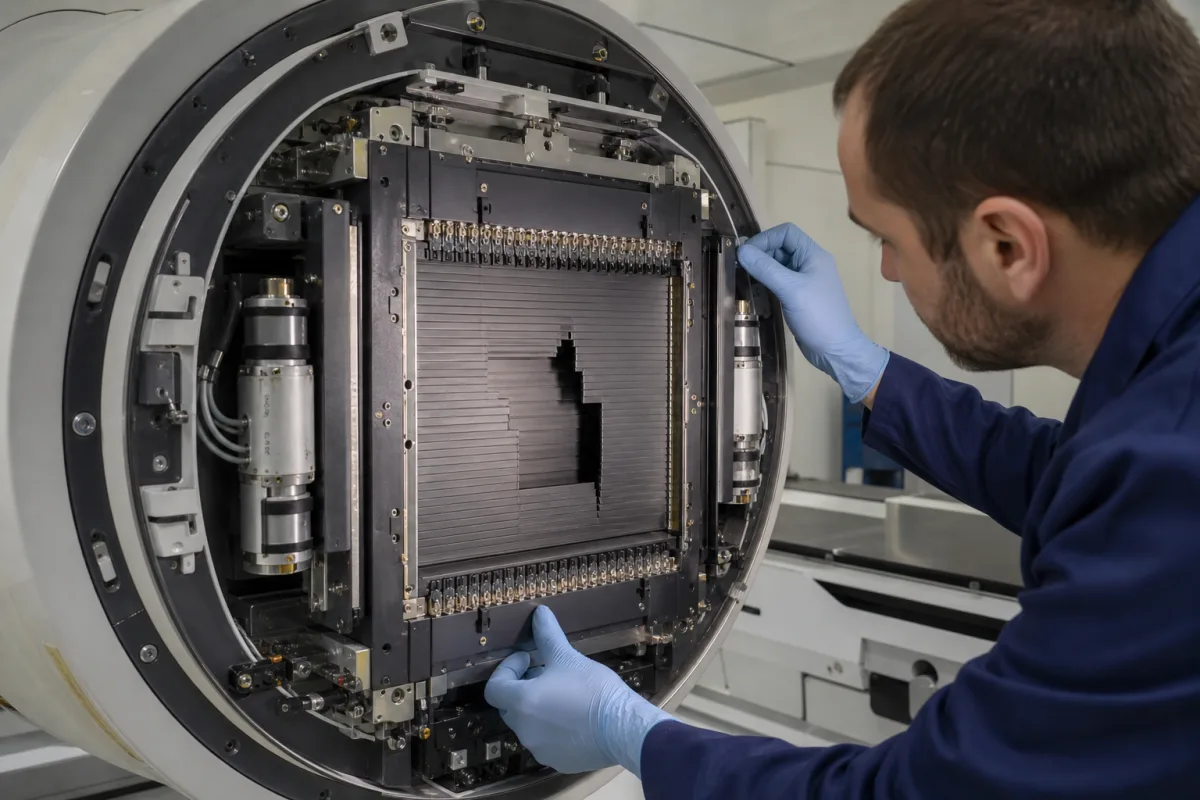
A critical component of the Integrated Radiotherapy Treatment Planning and Delivery System, the Multi-Leaf Collimator consists of multiple thin tungsten leaves that can be individually positioned to create custom apertures. It dynamically shapes the radiation beam during treatment to precisely conform to the three-dimensional shape of the tumor while minimizing exposure to surrounding healthy tissues.
Working Principle
Individual tungsten leaves are moved by computer-controlled motors into specific positions based on treatment planning data. These leaves block portions of the radiation beam, creating a shaped aperture that matches the tumor's projection from the beam's eye view. The leaves can move during treatment delivery to adapt to tumor motion or create intensity-modulated fields.
Common Materials
Tungsten, Steel alloys, Copper
Technical Parameters
  • Leaf width at isocenter determines the resolution of beam shaping (mm) Customizable
Components / BOM
  • Tungsten leaves
    Primary radiation blocking elements that shape the beam
    Material: Tungsten alloy
  • Leaf drive mechanism
    Motorized system that positions individual leaves
    Material: Steel, copper
  • Position sensors
    Monitor and verify leaf positions during treatment
    Material: Electronic components
  • Control electronics
    Process treatment planning data and control leaf movements
    Material: Circuit boards, semiconductors
Engineering Reasoning
Leaf positioning accuracy: ±0.5 mm at isocenter, leaf speed: 0.5-3.0 cm/s, maximum leaf travel: 20 cm
Leaf positioning error exceeding ±1.0 mm at isocenter, leaf motor torque dropping below 0.8 N·m, leaf position sensor resolution degradation beyond 0.1 mm
Design Rationale: Backlash accumulation in worm gear transmission exceeding 0.2 mm, permanent magnet DC motor demagnetization at temperatures above 80°C, optical encoder glass scale contamination reducing light transmission below 60%
Risk Mitigation (FMEA)
Trigger Worm gear tooth wear exceeding 50 μm clearance due to insufficient lubrication
Mode: Leaf positioning hysteresis error of 1.2 mm at isocenter
Strategy: Integrated oil-impregnated bronze worm gear bushings with automatic lubrication system maintaining 0.1 mm oil film thickness
Trigger Hall effect sensor magnetic field drift of 15 mT due to thermal expansion mismatch
Mode: Leaf position feedback error of 0.8 mm at 40°C operating temperature
Strategy: Temperature-compensated Hall sensor array with InSb semiconductor elements and Pt100 RTD thermal compensation circuit

Industry Taxonomies & Aliases

Commonly used trade names and technical identifiers for Multi-Leaf Collimator (MLC).

Applied To / Applications

This component is essential for the following industrial systems and equipment:

Industrial Ecosystem & Supply Chain DNA

Complementary Systems
Downstream Applications
Specialized Tooling

Application Fit & Sizing Matrix

Operational Limits
pressure: Atmospheric (sealed system, no external pressure rating required)
other spec: Radiation field size: 40x40 cm max, Leaf width: 5-10 mm, Leaf positioning accuracy: ±1 mm, Max leaf speed: 3 cm/s
temperature: 15°C to 35°C (operating), 0°C to 50°C (storage)
Media Compatibility
✓ Medical-grade radiation beams (photons/electrons) ✓ Sterile clinical environments ✓ Precision motion control systems
Unsuitable: High-vibration industrial environments or areas with conductive dust/particulates
Sizing Data Required
  • Maximum radiation field dimensions required (cm)
  • Tumor contour complexity (minimum leaf width needed)
  • Treatment delivery speed requirements (leaf positioning speed)

Reliability & Engineering Risk Analysis

Failure Mode & Root Cause
Leaf Positioning Inaccuracy
Cause: Wear in drive mechanisms (e.g., motors, gears, lead screws), thermal expansion, or calibration drift from repeated high-precision movements and radiation exposure.
Leaf Motor Failure
Cause: Overheating due to high duty cycles, electrical faults from power surges, or mechanical binding leading to excessive current draw and burnout.
Maintenance Indicators
  • Audible grinding or clicking noises during leaf movement, indicating mechanical wear or obstruction.
  • Visual misalignment or gaps between leaves in the closed position, detected during routine quality assurance tests.
Engineering Tips
  • Implement predictive maintenance using vibration analysis and thermal imaging on drive components to detect early wear before failure.
  • Establish strict environmental controls (temperature, humidity) and regular calibration schedules to minimize thermal and positional drift.

Compliance & Manufacturing Standards

Reference Standards
ISO 9001:2015 - Quality management systems IEC 60601-2-1 - Medical electrical equipment - Part 2-1: Particular requirements for the basic safety and essential performance of electron accelerators in the range 1 MeV to 50 MeV CE marking - Medical Devices Regulation (MDR) 2017/745
Manufacturing Precision
  • Leaf positioning accuracy: +/- 0.5 mm
  • Leaf end flatness: 0.1 mm
Quality Inspection
  • Radiation leakage test
  • Leaf positional accuracy verification via film dosimetry

Factories Producing Multi-Leaf Collimator (MLC)

Verified manufacturers with capability to produce this product in China

✓ 92% Supplier Capability Match Found

P Procurement Specialist from United States Feb 08, 2026
★★★★★
"The Multi-Leaf Collimator (MLC) we sourced perfectly fits our Machinery and Equipment Manufacturing production line requirements."
Technical Specifications Verified
T Technical Director from United Arab Emirates Feb 05, 2026
★★★★★
"Found 21+ suppliers for Multi-Leaf Collimator (MLC) on CNFX, but this spec remains the most cost-effective."
Technical Specifications Verified
P Project Engineer from Australia Feb 02, 2026
★★★★★
"The technical documentation for this Multi-Leaf Collimator (MLC) is very thorough, especially regarding technical reliability."
Technical Specifications Verified
Verification Protocol

“Feedback is collected from verified sourcing managers during RFQ (Request for Quote) and factory evaluation processes on CNFX. These reports represent historical performance data and technical audit summaries from our B2B manufacturing network.”

19 sourcing managers are analyzing this specification now. Last inquiry for Multi-Leaf Collimator (MLC) from USA (36m ago).

Supply Chain Compatible Machinery & Devices

Hydraulic Press

Industrial machine using hydraulic pressure to compress, form, or assemble materials

Explore Specs →
Heavy-Duty CNC Plasma Cutting Machine

Industrial machine for precision metal cutting using plasma arc technology

Explore Specs →
Automated Assembly Line System

Integrated production system for sequential component assembly operations

Explore Specs →
Automated Powder Coating System

Integrated industrial system for applying dry powder coatings to metal substrates.

Explore Specs →

Frequently Asked Questions

What materials are used in Multi-Leaf Collimator construction?

Our MLCs are built with durable tungsten leaves for radiation shielding, steel alloys for structural integrity, and copper components for thermal and electrical conductivity in the drive mechanism.

How does the Multi-Leaf Collimator improve radiotherapy treatment?

The MLC dynamically shapes radiation beams to precisely match tumor contours, minimizing exposure to healthy tissue and enhancing treatment accuracy through automated leaf positioning controlled by advanced electronics.

What maintenance is required for the Multi-Leaf Collimator system?

Regular calibration of position sensors, inspection of tungsten leaves for wear, and software updates for control electronics ensure optimal performance. The steel alloy construction provides long-term durability with minimal maintenance.

Can I contact factories directly on CNFX?

CNFX is an open directory, not a transaction platform. Each factory profile provides direct contact information and production details to help you initiate direct inquiries with Chinese suppliers.

Get Quote for Multi-Leaf Collimator (MLC)

Request technical pricing, lead times, or customized specifications for Multi-Leaf Collimator (MLC) directly from verified manufacturing units.

Your business information is encrypted and only shared with verified Multi-Leaf Collimator (MLC) suppliers.

Thank you! Your message has been sent. We'll respond within 1–3 business days.

Need to Manufacture Multi-Leaf Collimator (MLC)?

Connect with verified factories specializing in this product category

Add Your Factory Contact Us
Previous Product
Multi-Leaf Collimator
Next Product
Multi-Media Filter