PLC Control System
View system integration details
This page explains how Output Module is classified within Machinery and Equipment Manufacturing. Technical values and manufacturer relationships are research references; confirm the current specification and supplier evidence for each order.
A PLC component that converts control signals into physical outputs to drive external devices.
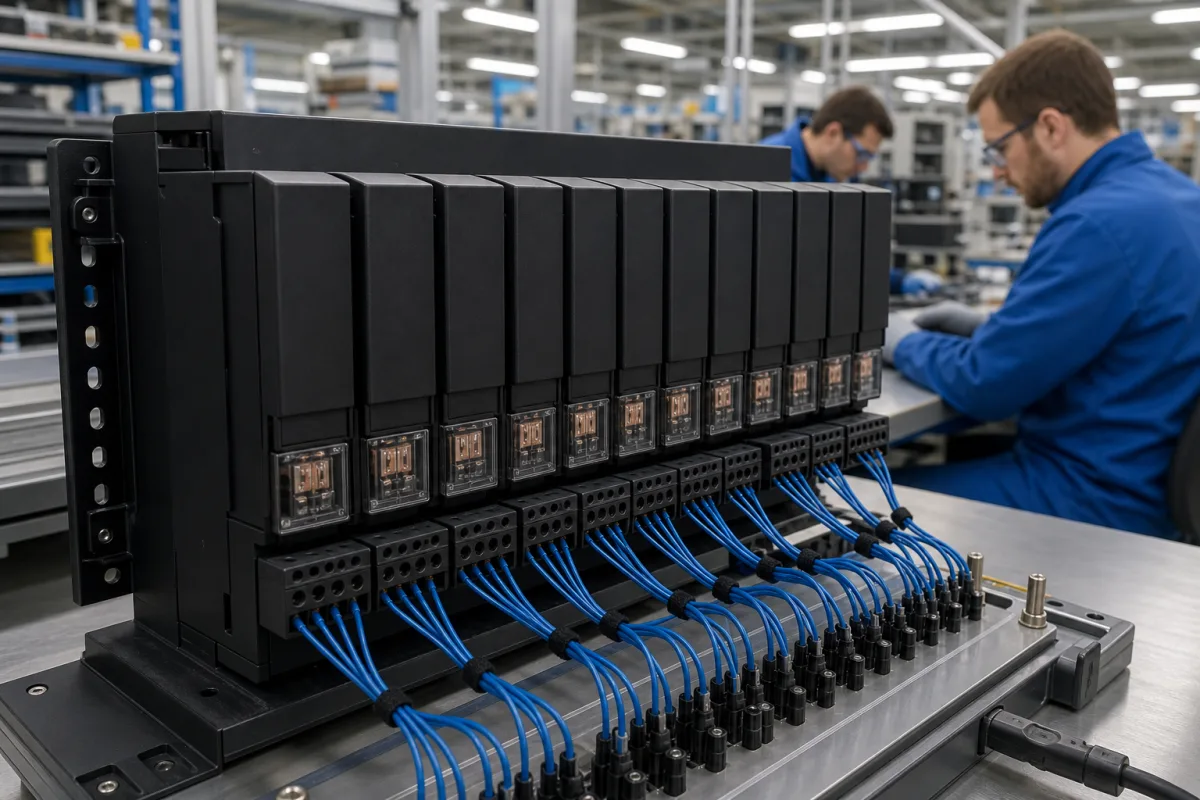
Technical details and manufacturing context for Output Module
| Parameter | Typical range | Notes & selection driver |
|---|---|---|
| Number of Channels | 8–32 | Select based on number of field devices to control. |
| Output Type | Relay, Transistor, Triac | Relay for AC/DC, transistor for high-speed DC, triac for AC. |
| Output Voltage Range | 24–230 V AC/DC | Must match load supply voltage. |
| Output Current per Channel | 0.5–2 A | Ensure sufficient current for connected loads. |
| Switching Frequency | 0.1–100 Hz | Higher frequency for transistor outputs; relay limited. |
| Response Time | 0.1–10 ms | Critical for high-speed control loops. |
| Isolation Voltage | 1500–2500 V AC | Protects PLC from field transients.IEC 61131-2 |
| Power Supply Voltage | 24 ±10% V DC | Typical PLC I/O power supply. |
| Power Consumption | 2–10 W | Affects heat dissipation and power budget. |
| Operating Temperature | -40–85 °C | Extended range for industrial environments.IEC 61131-2 |
| Storage Temperature | -40–85 °C | Non-operating condition. |
| Humidity Range | 5–95 % RH | Non-condensing.IEC 60068-2-78 |
| Protection Rating | IP20–IP65 | IP20 for cabinet, IP65 for field mounting.IEC 60529 |
| Weight | 100–500 g | Affects mounting and handling. |
Ranges are indicative industry figures for RFQ preparation, not a supplier commitment. Confirm every value and standard with the legal manufacturer before ordering.
This component is essential for the following industrial systems and equipment:
| pressure: | 0 to 1 bar (atmospheric) |
| other spec: | Output current: 0.5A to 2A per channel, Voltage range: 24V DC ±10%, Isolation: 1500V AC |
| temperature: | -20°C to +70°C |
Indicative industry ranges for design and RFQ preparation. Confirm the exact figures and applicable standard with the manufacturer before specifying.
Quoted from the published standard.
5 companies list this product among what they make. Company figures are quoted from each company's own website; every card states where the relationship came from.
Manufacturer listings support early research and capability understanding. They are not certification, ranking, or transaction guarantees.
A practical evidence checklist for RFQ preparation and supplier evaluation.
CNFX does not score or rank suppliers. Buyers must verify all claims and documents with the legal manufacturer before ordering.
Common output types are relay, transistor, and triac. Relay outputs are suitable for both AC and DC loads and provide isolation, but have slower switching speeds. Transistor outputs are for high-speed DC switching, while triac outputs are for AC loads. The choice depends on the load type and switching frequency requirements.
The number of channels should match the number of field devices you need to control. Typical modules offer 8 to 32 channels. Consider future expansion and the physical space in your control cabinet. Ensure the module's current per channel and total power consumption are within your system's capacity.
Isolation voltage protects the PLC from electrical transients and noise from the field side. It is the maximum voltage that can be applied between the input and output circuits without breakdown. Typical values range from 1500 to 2500 V AC, as per IEC 61131-2. Always verify that the module's isolation rating meets your application's requirements.
It depends on the output type. Relay outputs can handle both AC and DC loads, but the voltage and current ratings must be within the module's specifications. Transistor outputs are typically for DC loads only, while triac outputs are for AC loads. Always check the output voltage range and current per channel to ensure compatibility.
Editorial classification, named public sources where available, and source-reviewed manufacturer records.
Ask for use case, specification boundaries, supplier type, and RFQ preparation information for this product.
Compare manufacturer profiles with relevant product and process capability.