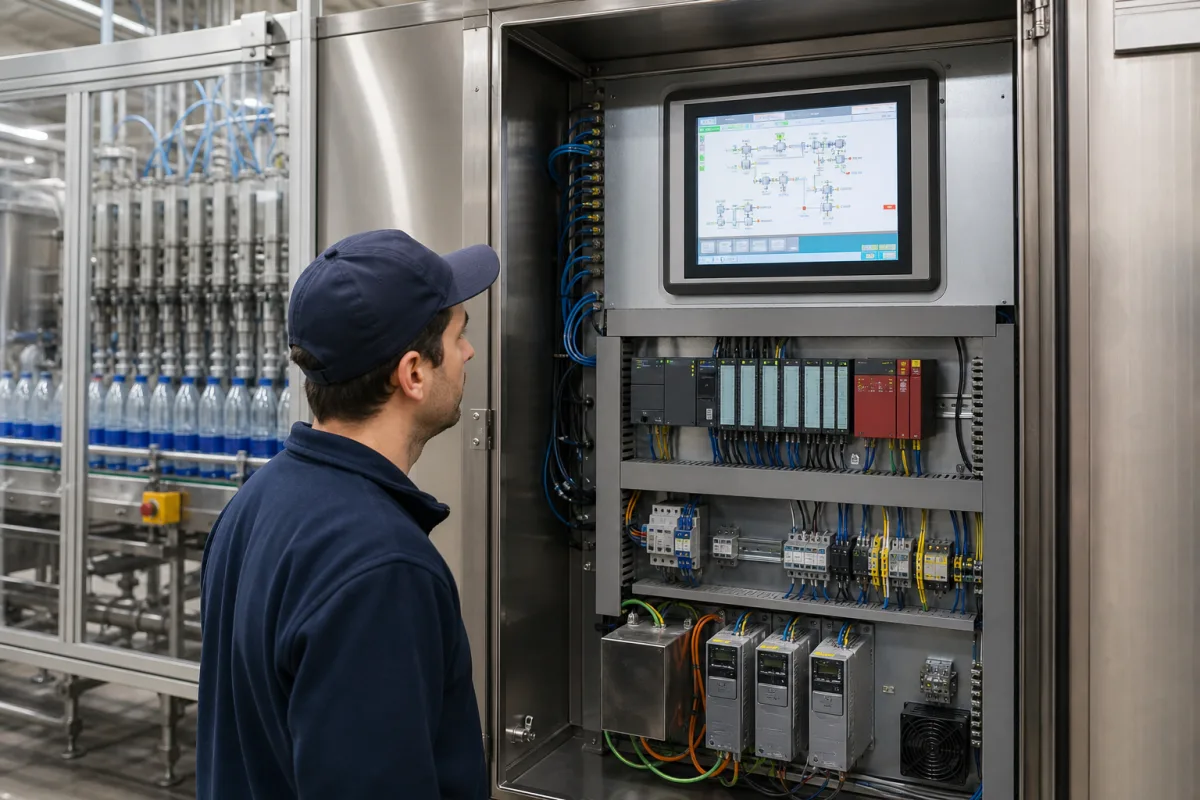
PLC/HMI control panel for washdown beverage lines: hygienic stainless cabinet, HMI with built-in PLC or networked to each machine, and PackML states
The whole control panel that stands beside a washdown beverage line · stainless hygienic-design cabinet for the PLC, the choice between one HMI + PLC unit and a screen that talks to each machine, and PackML machine states
On a beverage line the PLC and its touch screen do not live in a dry control room: they hang beside the filler, the rinser or the container-purging unit and are hosed down with the machine. What makes this panel different from a cabinet in an electrical room is therefore its outside: a housing with no ledges or gaps for product to collect on, seals and cable entries that survive high-pressure water, an operator panel rated for direct jets, and screens that report machine state in a form the line's other machines also use.
PLC and HMI control panels built for the wet, cleaned zone of beverage and liquid-food lines: the stainless hygienic-design enclosure and its seals and glands, the washdown-rated operator panel (HMI alone or HMI with built-in PLC), and the machine-state model the HMI displays. This page is about the complete panel as one hygienic unit — cabinet, PLC and screen together; the washdown operator terminal on its own (ingress ratings, bezels, M12 exits, yoke mounting) is covered on the Stainless steel washdown HMI for food and beverage lines page, dry-area machine control cabinets with their heat balance on the Control system cabinet page, and standard panel-mount touch and text panels on the Human-machine interface (HMI) page. PLC hardware selection, CPU and I/O counting and 24 V budgeting are covered on the Programmable logic controller page; PLC systems bought as an engineered project with I/O lists and acceptance tests on the PLC control system as an engineered delivery page; sealed machine-mounted controllers on the Control module page; fieldbus remote I/O, EtherCAT master PLCs, redundant PLCs and safety PLCs on their own pages.
CNFX editorial research · Sources checked October 12, 2026 · 3 sources
Stainless housing next to the filler: 1.4301 body, 30° roof, radii over 3 mm and blue silicone seals
Rittal's Hygienic Design catalogue (edition XWW00109EN2511) describes what a control enclosure needs when it sits in an open food or beverage process. Its compact enclosures and covers are stainless steel 1.4301 (AISI 304) with a grain-400 brushed finish, internal radii over 3 mm at folds, and no openings at all as delivered — holes are cut only where a gland or panel will go. [1]
The same catalogue states the brushed finish two ways: the overview page gives a surface roughness of < 8 μm, while the page on compact enclosures and terminal boxes gives a peak-to-valley height Ra < 0.8 μm. [1] The tenfold gap may be a printing error, but a panel builder quoting a hygienic cabinet should state which figure it guarantees and how it was measured.
Rittal also names its testing bodies — the German BGN and the technical committee for food and consumables — and states that its hygiene range meets DIN EN 1672-2 (2009-07) and carries cULus listing for terminal boxes and compact enclosures. [1] Inside, however, the mounting plate is zinc-plated sheet steel, not stainless. [1]
Feet adjustable 122–175 mm, compensating floor slopes up to 10° [1]
Lets the floor and wall behind the cabinet be cleaned.
Ask the panel builder for: enclosure make and material grade, roof and side slopes, the guaranteed surface roughness and measuring method, seal material and its FDA reference, the IP rating with the standard it was tested to, and whether wall spacers or feet are included.
02
Cable entries, viewing windows and condensation in a hosed-down panel
A hygienic cabinet is only as cleanable as the holes cut into it. Rittal's HD cable gland seals directly at the cable entry, has no external thread, keeps minimum radii on its hexagon and finishes flush between cap nut and enclosure, with protection up to IP 69; conventional glands are criticised for an entry in front of the seal and a gap from the O-ring on the enclosure surface. [1]
A viewing window lets an operator read a display or switches that are not themselves washdown-rated, keeping them behind a sealed frame. [1] Editorial note: if the HMI must be touched during production, a window does not help; the panel itself then needs a jet rating, as in the next section.
Hosing a warm cabinet with cold water pulls humid air in through any pressure difference. Rittal's approach pairs a thermal component that lowers the dew point inside with a stainless pressure-relief stopper with an integral sealing membrane, for enclosures exposed to changing temperatures. [1]
One unit or two: an HMI with built-in PLC, or a washdown screen talking to each machine's PLC
KEB America's C6 stainless HMI shows what a washdown operator panel is built from: an IP69K-certified front in 316L stainless steel, intended for equipment sanitised with high-pressure water or steam. KEB sells it either as a standalone HMI or as an HMI + PLC combo. [2]
Editorial note: the HMI + PLC combination suits a single machine such as a container purging or capping unit, where one panel can hold both the logic and the screens. On a line where the filler, rinser and capper each have their own PLC, a standalone HMI with the right protocol driver for each is the other route; the 40-plus drivers KEB lists are what make that route possible. [2]
Editorial note: 316L at the front of the panel and 1.4301 (304) on the cabinet body, as in the two examples on this page, are different grades; specify each separately rather than writing "stainless" once for the whole panel. [2][1]
Ask for: the IP rating of the front and the standard it was certified to, the front and bezel material grade, whether the PLC runtime is in the panel or in a separate controller, the protocol to each machine on the line, and how programs and recipes are backed up.
04
What the screen reports: the PackML state model with up to 17 states
Beverage and packaging lines combine machines from different builders, and PackML gives their HMIs a shared vocabulary. Schneider Electric's PackML library documentation, based on ANSI/ISA TR88.00.02-2015, says each operation mode can be made up of up to 17 states — Aborted, Aborting, Clearing, Complete, Completing, Execute, Held, Holding, Idle, Resetting, Starting, Stopped, Stopping, Suspended, Suspending, Un-Holding and Un-Suspending — and that a machine's state model must contain these states or a subset of them. [3]
The state model is defined by choosing which of the 17 states exist for an operation mode; Schneider's library then creates the transitions between them, and leaves the machine builder responsible for implementing the state flow and mode changes. [3] Schneider's newer library help cites the base state model of the 2022 edition of TR88.00.02, while the library overview cites the 2015 edition. [3]
Editorial note: for a PLC/HMI panel on one machine in a line, write into the order which PackML edition applies and which states the machine actually uses, so the screens on the filler and those on neighbouring machines show the same state names for the same conditions.
Term
Definition quoted by Schneider from ANSI/ISA TR88.00.02-2015
Wait state
A state showing the machine has reached a defined set of conditions and is holding that status until it moves to an acting state [3]
Acting state
A state representing processing activity: single or repeated execution of steps in a logical order, for a finite time or until a condition is reached [3]
Transition
Triggered either by a state transition command or by the State Complete (SC) condition [3]
Details a panel builder needs for a washdown PLC/HMI panel
Paste it into your enquiry below or into an email to a maker, then replace every bracket.
Location: [beside filler / rinser / purging unit; distance from spray; cleaning chemicals and water temperature]
Enclosure: [material grade; roof slope; surface roughness and how measured; seal material; IP rating and test standard]
Entries: [hygienic cable glands; number and sizes; viewing window size if any]
Operator panel: [screen size; front material; IP rating; HMI only or HMI + PLC]
Communication: [protocol to each machine; remote access]
Machine states: [PackML edition; states used; tags reported]
Climate: [condensation prevention; pressure relief]
Explore company information and manufacturing capabilities, then discuss the scope of your project with a relevant supplier.
Share this page
Compiled and source-reviewed by the CNFX editorial team.
Each manufacturer above links to the page on that company's own website where the product is listed, with the date we checked it. How we source and review
· Page last updated 13 October 2026
Buyer questions
What material is a hygienic PLC enclosure made of?
Rittal's hygienic-design compact enclosures use stainless steel 1.4301 (AISI 304) with a grain-400 brushed finish, a 30° roof and blue FDA-compliant silicone seals; the internal mounting plate is zinc-plated steel. [1]
Can an HMI be hosed down?
Only if it is rated for it. KEB's C6 HMI, for example, has an IP69K-certified 316L stainless front for high-pressure water or steam cleaning. [2]
Do I need a separate PLC behind a washdown HMI?
Not always: KEB offers its C6 either as a standalone HMI or as an HMI + PLC combo, and the standalone version supports more than 40 communication drivers to reach other PLCs. [2]
How many PackML states are there?
Schneider's PackML documentation, based on ANSI/ISA TR88.00.02-2015, lists up to 17 states per operation mode; a machine uses all of them or a subset. [3]
Sources and what still needs a direct check
Sources checked 2026-10-12. Enclosure, seal, gland, window and condensation details come from Rittal's Hygienic Design technical system catalogue; the washdown operator panel from KEB America's announcement of its C6 IP69K stainless HMI; the machine-state model from Schneider Electric's PackML library documentation, which quotes ANSI/ISA TR88.00.02.