Industry-Verified Manufacturing Data (2026)

Power Supply/Inverter

Based on aggregated insights from multiple verified factory profiles within the CNFX directory, the standard Power Supply/Inverter used in the Machinery and Equipment Manufacturing sector typically supports operational capacities ranging from standard industrial configurations to heavy-duty production requirements.

Technical Definition & Core Assembly

A canonical Power Supply/Inverter is characterized by the integration of Rectifier Module and DC Link Capacitors. In industrial production environments, manufacturers listed on CNFX commonly emphasize Silicon steel laminations construction to support stable, high-cycle operation across diverse manufacturing scenarios.

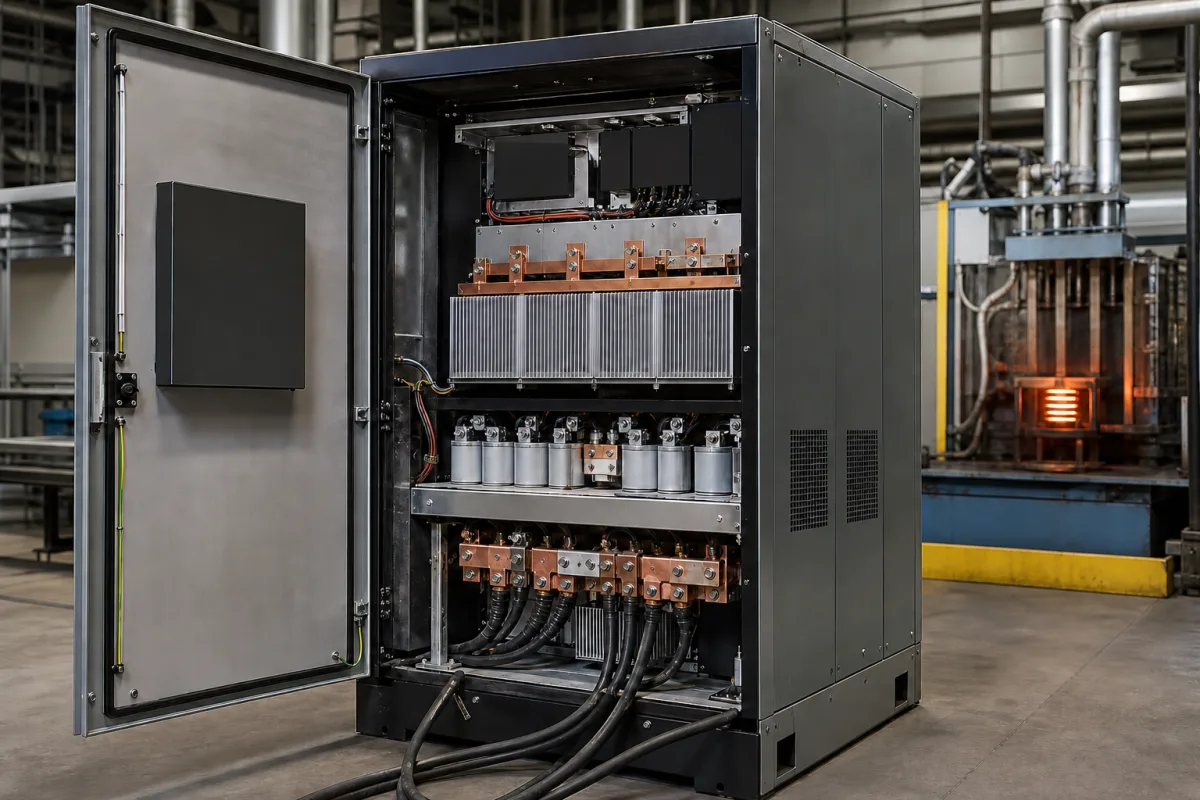
Electrical component that converts input power to controlled high-frequency AC output for induction heating
Product Specifications

Technical details and manufacturing context for Power Supply/Inverter

Definition
A critical subsystem within an Induction Heating Station that takes standard AC mains power, converts it to DC, then inverts it to high-frequency AC (typically 1-400 kHz) to drive the induction coil, enabling precise control of heating power, frequency, and timing for metal processing applications.
Working Principle
The power supply/inverter operates by first rectifying incoming AC power to DC, then using solid-state switching devices (IGBTs or MOSFETs) to convert the DC back to high-frequency AC through pulse-width modulation (PWM) techniques. This high-frequency AC is delivered to the induction coil, creating an alternating electromagnetic field that induces eddy currents in conductive workpieces, generating heat through resistance.
Common Materials
Silicon steel laminations, Copper windings, Aluminum heat sinks, Ceramic capacitors, Epoxy resin insulation
Technical Parameters
  • Output power rating determines heating capacity (kW) Customizable
Components / BOM
  • Rectifier Module
    Converts incoming AC power to DC
    Material: Silicon diodes, copper busbars
  • DC Link Capacitors
    Filters and stores DC power, stabilizes voltage
    Material: Aluminum electrolytic or film capacitors
  • Inverter Bridge
    Switches DC to high-frequency AC using IGBTs/MOSFETs
    Material: Silicon semiconductors, copper traces
  • Control Board
    Manages switching timing, protection, and user interface
    Material: FR4 PCB, electronic components
  • Output Transformer
    Matches impedance between inverter and induction coil
    Material: Ferrite core, copper windings
Engineering Reasoning
Input: 380-480V AC, 50-60Hz, 3-phase; Output: 1-10kHz, 0-1000A, 10-500kW
IGBT junction temperature exceeds 150°C, DC bus voltage exceeds 800V, output current exceeds 120% rated for >10ms
Design Rationale: Thermal runaway in IGBT modules due to switching losses exceeding heat dissipation capacity, causing semiconductor lattice breakdown at 150°C
Risk Mitigation (FMEA)
Trigger DC bus capacitor ESR increases to 0.1Ω due to electrolyte evaporation at 85°C ambient
Mode: DC bus voltage ripple exceeds 5%, causing IGBT overcurrent protection tripping
Strategy: Implement capacitor health monitoring with ESR measurement and forced air cooling maintaining <65°C ambient
Trigger Gate driver power supply voltage drops below 15V during 100μs switching transient
Mode: IGBT shoot-through current exceeds 2000A, causing bond wire fusing at 600°C
Strategy: Dual-redundant isolated gate driver supplies with 25V rating and 50μs holdup time

Industry Taxonomies & Aliases

Commonly used trade names and technical identifiers for Power Supply/Inverter.

Applied To / Applications

This component is essential for the following industrial systems and equipment:

Industrial Ecosystem & Supply Chain DNA

Complementary Systems
Downstream Applications
Specialized Tooling

Application Fit & Sizing Matrix

Operational Limits
pressure: N/A (electrical component, no pressure rating)
other spec: Input voltage: 380-480V AC 3-phase ±10%, output frequency: 1-50 kHz adjustable, efficiency: >92% at full load
temperature: Ambient operating range: -10°C to +40°C, cooling required above 40°C
Media Compatibility
✓ Industrial water cooling systems ✓ Clean dry air environments ✓ Non-corrosive industrial atmospheres
Unsuitable: Wet, humid, or corrosive environments without proper IP-rated enclosures
Sizing Data Required
  • Required output power (kW)
  • Desired output frequency range (kHz)
  • Available input voltage and phase configuration

Reliability & Engineering Risk Analysis

Failure Mode & Root Cause
Capacitor degradation
Cause: Electrolytic capacitor drying out due to high operating temperatures, voltage stress, or aging, leading to reduced capacitance and increased ESR, causing power instability or complete failure.
IGBT/MOSFET failure
Cause: Thermal cycling and overheating from poor heat dissipation, overcurrent conditions, or voltage spikes, resulting in short circuits or open circuits in switching components.
Maintenance Indicators
  • Audible high-pitched whining or buzzing from the inverter, indicating capacitor issues or transformer core saturation
  • Visible bulging or leaking capacitors on the PCB, or burnt/discolored components suggesting overheating
Engineering Tips
  • Implement regular thermal monitoring and ensure adequate cooling with clean air filters and proper ventilation to maintain operating temperatures within manufacturer specifications
  • Use voltage stabilizers or surge protectors on the input side and perform periodic capacitor testing/ESR measurements to detect early degradation before catastrophic failure

Compliance & Manufacturing Standards

Reference Standards
IEC 61000-6-2 (EMC immunity for industrial environments) UL 1741 (Inverter safety and grid interconnection) EN 50178 (Electronic equipment for power installations)
Manufacturing Precision
  • Output voltage regulation: +/-2% of nominal
  • Frequency stability: +/-0.5 Hz
Quality Inspection
  • Hi-pot (dielectric withstand) test
  • Thermal cycling and load testing

Factories Producing Power Supply/Inverter

Verified manufacturers with capability to produce this product in China

✓ 96% Supplier Capability Match Found

P Project Engineer from Australia Feb 26, 2026
★★★★★
"The Power Supply/Inverter we sourced perfectly fits our Machinery and Equipment Manufacturing production line requirements."
Technical Specifications Verified
S Sourcing Manager from Singapore Feb 23, 2026
★★★★★
"Found 53+ suppliers for Power Supply/Inverter on CNFX, but this spec remains the most cost-effective."
Technical Specifications Verified
P Procurement Specialist from Germany Feb 20, 2026
★★★★★
"The technical documentation for this Power Supply/Inverter is very thorough, especially regarding technical reliability."
Technical Specifications Verified
Verification Protocol

“Feedback is collected from verified sourcing managers during RFQ (Request for Quote) and factory evaluation processes on CNFX. These reports represent historical performance data and technical audit summaries from our B2B manufacturing network.”

11 sourcing managers are analyzing this specification now. Last inquiry for Power Supply/Inverter from UAE (37m ago).

Supply Chain Compatible Machinery & Devices

Hydraulic Press

Industrial machine using hydraulic pressure to compress, form, or assemble materials

Explore Specs →
Heavy-Duty CNC Plasma Cutting Machine

Industrial machine for precision metal cutting using plasma arc technology

Explore Specs →
Automated Assembly Line System

Integrated production system for sequential component assembly operations

Explore Specs →
Automated Powder Coating System

Integrated industrial system for applying dry powder coatings to metal substrates.

Explore Specs →

Frequently Asked Questions

What are the key components in this power supply/inverter for induction heating?

The BOM includes a rectifier module, DC link capacitors, inverter bridge, control board, and output transformer, with materials like silicon steel laminations and copper windings for efficient power conversion.

How does this inverter optimize induction heating in machinery manufacturing?

It converts input power to controlled high-frequency AC output, enabling precise heating for processes like metal hardening or brazing, with aluminum heat sinks and epoxy resin insulation for durability.

What materials ensure reliability in this industrial power supply?

Silicon steel laminations reduce core losses, copper windings enhance conductivity, ceramic capacitors stabilize voltage, and epoxy resin insulation protects against thermal and electrical stress in harsh environments.

Can I contact factories directly on CNFX?

CNFX is an open directory, not a transaction platform. Each factory profile provides direct contact information and production details to help you initiate direct inquiries with Chinese suppliers.

Get Quote for Power Supply/Inverter

Request technical pricing, lead times, or customized specifications for Power Supply/Inverter directly from verified manufacturing units.

Your business information is encrypted and only shared with verified Power Supply/Inverter suppliers.

Thank you! Your message has been sent. We'll respond within 1–3 business days.

Need to Manufacture Power Supply/Inverter?

Connect with verified factories specializing in this product category

Add Your Factory Contact Us
Previous Product
Power Supply Unit
Next Product
Power Unit