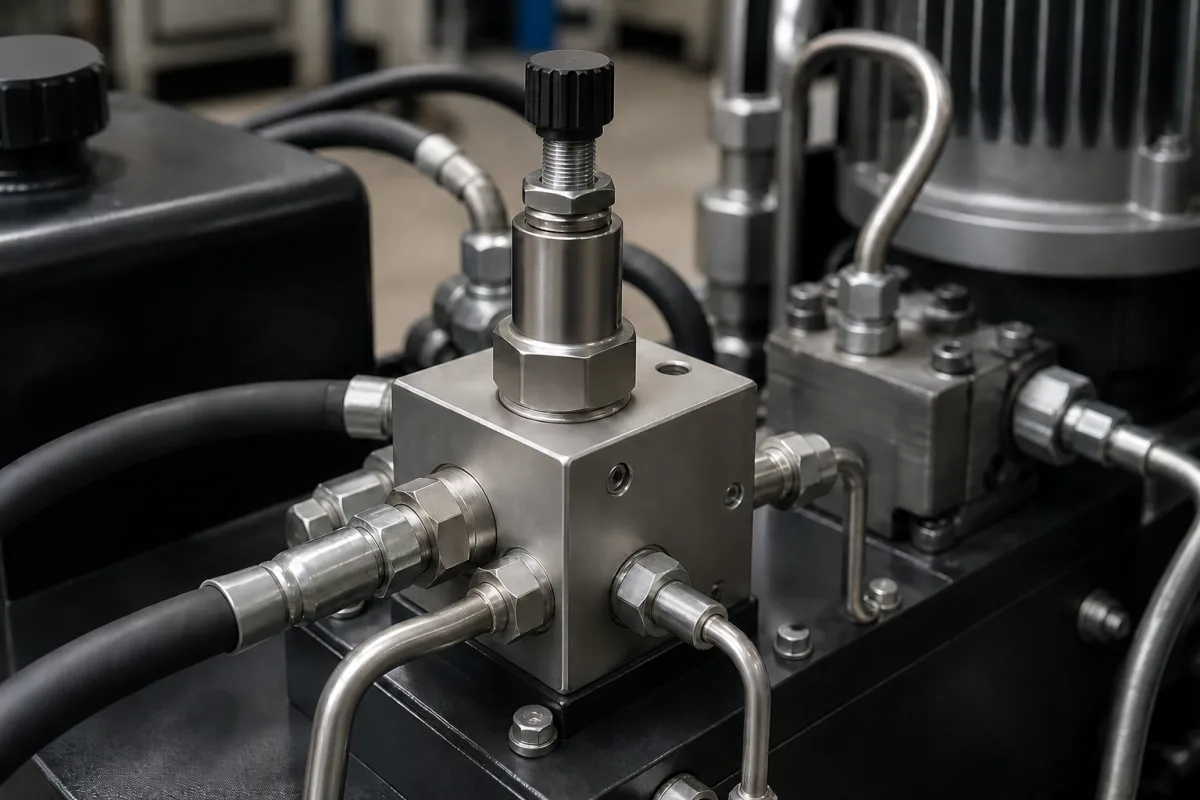
Hydraulic cartridge pressure control valve: screw-in relief and reducing/relieving cartridges for manifolds and line bodies
Screw-in hydraulic cartridges · direct-acting relief rated 241 bar and 114 L/min, reducing/relieving cartridges with drained spring chamber, VC10-2 and 3/4-16 UNF cavities, adjuster and line-body options
A hydraulic cartridge pressure control valve is a screw-in valve insert that sits in a machined cavity in a manifold block or a small line body and either caps system pressure (relief) or holds a branch at a lower pressure (reducing, or reducing/relieving). The cartridge carries the poppet or spool, spring and adjuster; the cavity and body carry the ports. Fix three things first: the valve function and its pressure and flow ratings, the spring range and adjuster style, and the cavity size, seals and body it screws into.
Screw-in (threaded) cartridge relief valves and pressure reducing and reducing/relieving cartridges for hydraulic circuits, with their cavities, adjusters, seals and line bodies. Hydraulic valve families, including sectional and subplate directional valves and counterbalance cartridges for load holding, are covered on the Hydraulic valves page. Relief and safety valves for vessels, boilers and process lines are covered on the Pressure relief valve page; self-acting reducing valves for steam, water and gas on the Pressure reducing valve page; and gas and pneumatic regulators on the Pressure regulator page. Diesel fuel-system pressure control valves are outside this page. Closed-loop electro-hydraulic pressure control for presses, built from proportional valves, transmitters and accumulators, is on the Hydraulic pressure control system for presses page.
CNFX editorial research · Sources checked October 12, 2026 · 3 sources
Direct-acting poppet relief cartridge: 241 bar, 114 L/min and crack pressure defined at 0.95 L/min
HydraForce's RV10-22 is a screw-in, direct-acting, differential-area poppet relief cartridge that blocks flow from port 2 to port 1 until pressure at port 2 lifts the poppet. It is rated 241.3 bar with 482.6 bar proof and 965.3 bar burst pressure, 113.6 L/min flow, and a maximum internal leakage of 5 drops/min up to 85% of the setting. HydraForce defines the relief pressure as the pressure present at 0.95 L/min of flow. [1]
The relief cartridge's adjusters cannot be backed out of the valve, and on the A, B and C adjuster styles positive stops keep the spring from going solid. Adjuster options include a 1/4 in hex Allen head, a 1½ in aluminium knob with lock knob, a covered hex head, lockwire holes, a factory preset non-adjustable version and a hidden factory preset. [1]
Editorial note: because the crack point is defined at a small flow, ask for the pressure-flow curve at your full pump flow, not only the setting; the pressure at full flow is what the pump and hoses see.
Give the supplier the valve function (relief, reducing, reducing/relieving), the setting and spring range, maximum flow through the cartridge, inlet and tank-port pressures, the cavity standard or the existing manifold, adjuster style and tamper protection, seal material for the fluid and temperature, and whether a line body is needed with its port threads and material.
02
Reducing/relieving cartridges: regulated port, drained spring chamber and tank back-pressure
HydraForce's PR12-36 is a pilot-operated, spool-type reducing/relieving cartridge with internal pilot and internally drained spring chamber. Flow passes from port 2 to port 1 until port 1 reaches the set pressure; the spool then throttles the inlet and also relieves port 1 to port 3. HydraForce notes that tank pressure is additive to the regulated pressure. [2]
Argo-Hytos's SP2A-A3 lets oil flow freely from P to A until pressure at A, acting on the spool against the spring, reaches the setting; the spool then throttles P to A, and if an external force on the actuator raises pressure at A further, the spool shifts on to open A to T. Its valve bush is held to the cartridge by a wire ring so that high tightening torque is not transmitted to the bush. [3]
Editorial calculation: with the PR12-36 set to 50 bar and 5 bar of back-pressure in the tank line at port 3, the regulated port would sit near 55 bar, since HydraForce states tank pressure adds to the setting; the 103.4 bar port 3 rating also limits how high that back-pressure may go. [2]
VC10-2, VC12-3 and 3/4-16 UNF cavities, installation torque and line bodies
The cartridge is only specified once its cavity is fixed. HydraForce's RV10-22 fits the VC10-2 two-way cavity and is installed at 33.9 to 36.7 N·m, 66.7 N·m maximum, with no orientation restriction; its PR12-36 uses the VC12-3 three-way cavity. [1][2] Argo-Hytos's SP2A-A3 screws into a 3/4-16 UNF-2A cavity at 30 +2 N·m, with its locknut at 15 N·m. [3]
HydraForce offers the RV10-22 without a body or in line bodies of aluminium with SAE 6 or SAE 8 ports or BSPP 1/4, 3/8 and 1/2 in ports, or ductile iron with SAE 6, SAE 8 or BSPP 1/2 in ports, and in Buna-N, fluorocarbon and other seal options. [1] Argo-Hytos specifies HL and HLP oils to DIN 51524, 10 to 500 mm²/s viscosity, contamination no worse than class 21/18/15 to ISO 4406, and NBR seals for –30 to +100 °C or FPM for –20 to +120 °C. [3]
Editorial note: cartridges from different makers can share a nominal thread size yet differ in cavity depth and seal lands; confirm the cavity drawing against the manifold before ordering a substitute cartridge.
04
Function, rating and cavity details for a cartridge pressure valve
Paste it into your enquiry below or into an email to a maker, then replace every bracket.
Function: [relief; reducing; reducing/relieving; direct or pilot operated]
Setting: [pressure; spring range; adjuster style; tamper-proof or preset]
Flow: [max flow through valve; pilot flow limit]
Ports: [inlet pressure; tank-port back-pressure]
Cavity: [standard and size, e.g. 10-2, 12-3, 3/4-16 UNF; or manifold drawing]
Body: [none or line body; material; port threads]
Fluid: [oil type; viscosity; temperature; cleanliness code; seal material]
All five makers kept here list hydraulic relief valves on their own sites, four of them also reducing valves, and Hydrath and Flag-Up also list manifold blocks built around cartridge valves.
Hydraflu Hydraulic Co.
Manufacturing site to be confirmed for the order
Lists hydraulic relief, pressure reducing and sequence valves, and cartridge valves it describes as interchangeable with HydraForce and Sun.
Explore company information and manufacturing capabilities, then discuss the scope of your project with a relevant supplier.
Share this page
Compiled and source-reviewed by the CNFX editorial team.
Each manufacturer above links to the page on that company's own website where the product is listed, with the date we checked it. How we source and review
· Page last updated 13 October 2026
Buyer questions
How is the pressure of a cartridge relief valve defined?
HydraForce defines the RV10-22's relief pressure as the pressure present at 0.95 L/min of flow; the cartridge is rated 241.3 bar and 113.6 L/min. [1]
Does tank pressure affect a reducing/relieving cartridge?
Yes for the HydraForce PR12-36, whose data states that tank pressure is additive to the regulated pressure; its port 3 is rated 103.4 bar. [2]
What pressure ranges does a small direct-operated reducing cartridge offer?
Argo-Hytos's SP2A-A3 regulates up to 63 bar, 50–160 bar or 100–210 bar at up to 20 L/min in a 3/4-16 UNF cavity. [3]
How tight should a hydraulic cartridge be screwed in?
HydraForce gives 33.9–36.7 N·m for the RV10-22 in a VC10-2 cavity; Argo-Hytos gives 30 +2 N·m for the SP2A-A3. [1][3]
Sources and what still needs a direct check
Sources checked 2026-10-12. HydraForce and Argo-Hytos are cartridge valve makers publishing ratings for their own models; values apply to the named cartridges and their stated test conditions.