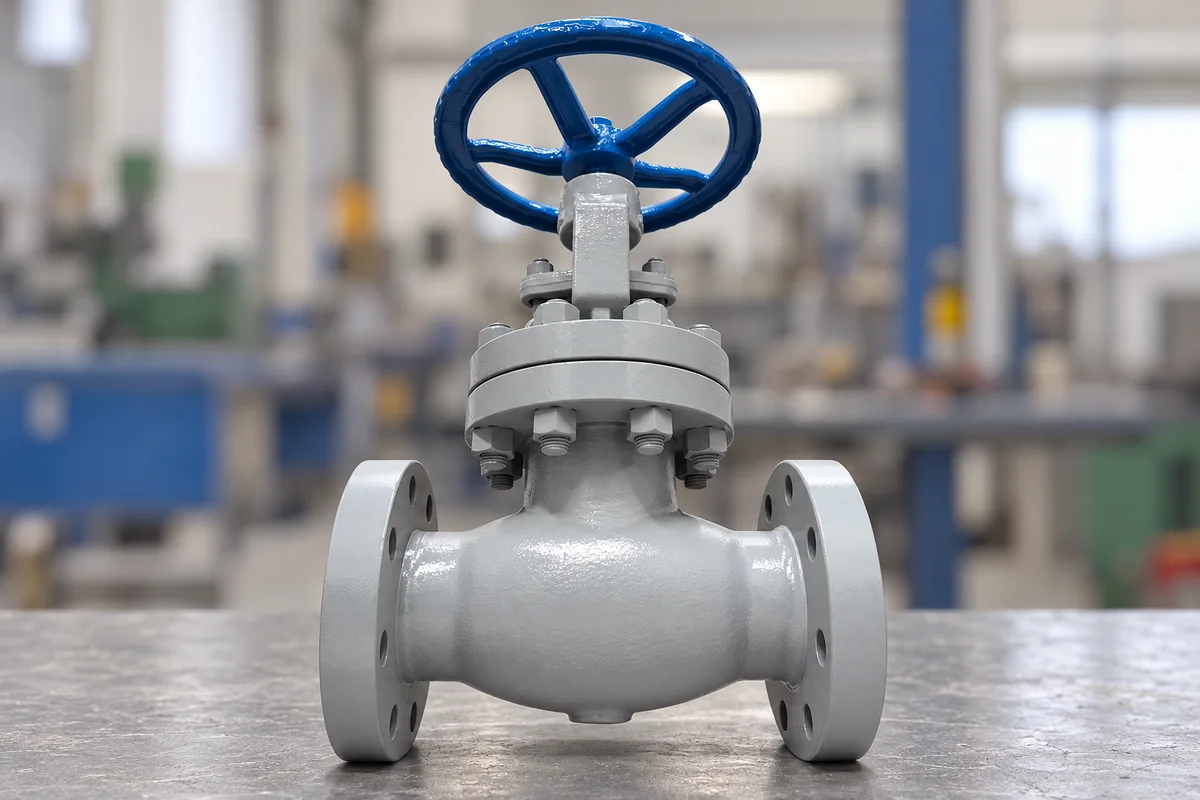
Globe valves · linear-motion valves that close by pressing a disc onto a seat, with straight, direct-flow (Y) and angle bodies, bolted, pressure-seal and bellows-seal bonnets, BS 1873 and ASME B16.34 designs, and cast steel body materials
A globe valve controls flow with a disc that moves along the stem axis onto or away from a seat. Ask three things first: what fluid, pressure class and temperature it must handle, whether it will throttle or only isolate, and which bonnet and stem seal suit the service.
Cast and forged steel, stainless and alloy globe valves for industrial, power and process piping, including bolted-bonnet, pressure-seal and bellows-seal designs. Control valves with actuators and positioners, needle valves and sanitary seat valves are outside this page except where compared.
CNFX editorial research · Sources checked October 12, 2026 · 6 sources
Baltic Valve, a valve maker and stockist, explains that a globe valve uses stem pressure to force the disc's sealing surface tightly onto the seat to cut off the medium, which makes it a forced-seal valve. The medium may flow either low-in, high-out or high-in, low-out, but only in one direction, so the valve must be installed the right way round. Globe valves come in straight-through, direct-flow and right-angle bodies. When the disc opens to 25–30% of the valve's nominal diameter, flow reaches its maximum and the valve is fully open. [1]
Editorial calculation: for a DN100 valve, 25–30% of the nominal diameter corresponds to a disc lift of about 25–30 mm.
API 623 also defines a stop-check globe valve: a non-return type in which the stem can hold the disc against the seat, but the disc is free to rise as a check valve under flow from beneath it when the stem is fully or partly open. [6]
Give the supplier the fluid and its temperature, the pressure class (PN or ASME Class) and test pressure, the size and end connection (flanged RF/RTJ, butt-weld or socket-weld), the body, trim and seat materials, the bonnet type, throttling or isolation duty, the flow direction, the operator (handwheel, gear or actuator), and the design and inspection standards.
02
Choose the bonnet and stem seal
Baltic lists three main constructions. Bolted-bonnet globe valves are offered to BS 1873 and ASME B16.34, for example ASTM A216 WCB and A352 LCC bodies from 3 to 20 in in Class 300 and 600, and DN100 PN100. Pressure-seal bonnet valves are listed in ASTM A217 WC6 and C12A, A352 LCB and WCB at Class 1500 and 2500, with butt-weld or RTJ ends. Baltic says they have a short working stroke and quick opening and closing. [1][2]
For refinery and related service, API Standard 623 (2nd edition, 2021) specifies a heavy-duty series of bolted-bonnet steel globe valves for conditions where corrosion, erosion and other service conditions call for heavy wall sections and large stem diameters. Its abstract lists the features covered: bolted bonnet, outside screw and yoke, rotating and non-rotating rising stems, rising and non-rising handwheels, conventional, Y-pattern and right-angle bodies, and stop-check designs. It also covers plug, narrow, conical, ball or guided discs, metallic seating surfaces and flanged or butt-welding ends. It covers NPS 2 to 24 (DN 50 to 600) in pressure classes 150, 300, 600, 900, 1500 and 2500. [6]
Bellows-seal globe valves use a metal bellows to seal the stem, with stem packing as a second seal if the bellows fails. Baltic says this design prevents stem leakage, and that the seat faces are hard-faced with cobalt-based alloy. It lists examples such as an ASTM A217 WC6 bellows-seal valve, DN200 PN40 with RF ends. [3]
Landee, a valve and pipe stockist, lists about 85 globe valve items alongside gate, check and butterfly valves. Neway lists cryogenic globe valves. [4][5]
Baltic's bellows-seal page also lists a DIN 3356 bellows-sealed globe valve in GS-C25, DN50 PN40 with RF ends, which shows that the same construction is sold to European as well as ASME-based standards. Its listing at the time of review counted 62 bolted-bonnet, 9 pressure-seal and 2 bellows-seal globe valves. [3]
Editorial note: name the design standard (for example API 623, ASME B16.34, BS 1873 or DIN 3356), the pressure class or PN, the body and trim materials, the end connection and the required seat and shell tests in one line of the enquiry, so that offers from different makers can be compared item by item.
03
Check the main components
This is a functional reference built from the sources cited; it is not one maker's design.
Component
Role
Fix in the order
Body
Straight, Y-pattern or right-angle; flanged or butt-welding ends. [1][6]
Pattern, end type, material.
Disc
Pressed onto the seat by the stem to shut off; plug, narrow, conical, ball or guided. [1][6]
Disc type and hard-facing.
Seat
Metallic seating surface; cobalt-alloy hard-facing on Baltic's bellows-seal valves. [6][3]
Seat material and leakage test.
Stem and yoke
Outside screw and yoke; rotating or non-rotating rising stem. [6]
Stem material and operator.
Bonnet and stem seal
Bolted, pressure-seal or bellows-seal with backup packing. [1][2][3]
Bonnet type for rating and leakage.
04
Fill the specification fields with values for your service
A globe valve quotation needs values for your line. The table explains each field, gives published values where a reviewed source states them, and says what to ask the supplier for.
Explore company information and manufacturing capabilities, then discuss the scope of your project with a relevant supplier.
Compiled and source-reviewed by the CNFX editorial team.
Published product pages show what a company offers, not tested performance. Confirm the legal seller, factory and scope for your order. How we source and review
· Page last updated 12 October 2026
The stem presses the disc onto the seat to cut off the medium; Baltic calls it a forced-seal valve. [1]
Does flow direction matter?
Yes. Baltic says the medium may flow in only one direction, so the valve must be installed the right way round. [1]
When is a bellows-seal globe valve used?
Where stem leakage must be avoided; the metal bellows seals the stem with packing as a backup. [3]
Which standard covers heavy-duty steel globe valves for refineries?
API Std 623 covers bolted-bonnet steel globe valves NPS 2 to 24 in classes 150 to 2500 with flanged or butt-welding ends. [6]
Sources and what still needs a direct check
Sources checked 2026-10-12. Baltic Valve, Landee and Neway describe their own valves; their figures are examples, not limits. The API 623 abstract is read from a standards distributor's page; the standard itself is sold by API.