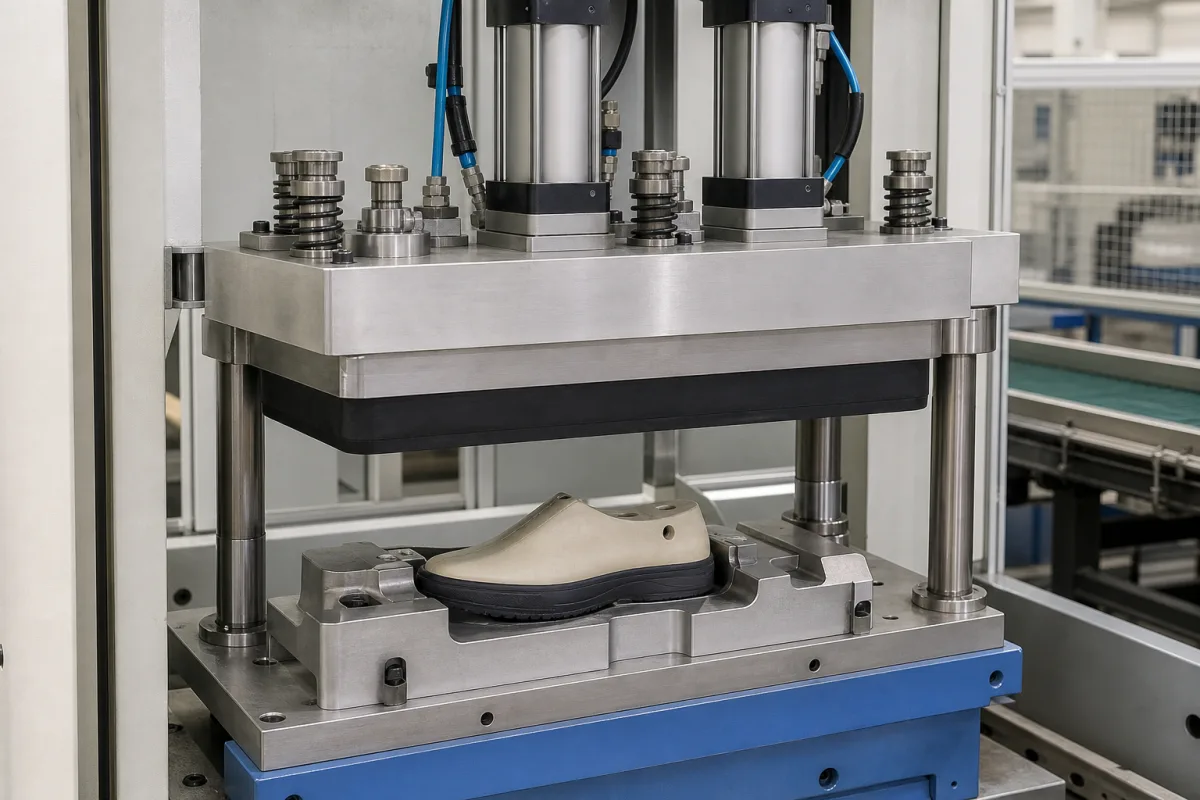
Sole attaching (cementing) press pressure assemblies · Pads, diaphragms and presser plates that bed a cemented outsole onto a lasted upper, closed by a light cylinder and loaded by a high-force stage, with toe, ball and heel pressing
A sole attaching press bonds a cemented outsole to a lasted shoe upper by pressing them together under controlled force; its pressure assembly — pads, a diaphragm or presser plates driven by cylinders — must reach every part of the sole, from toe and ball to waist and heel, without marking the shoe. Ask three things first: which shoe types, sizes and sole profiles the press must handle, how pressure is generated and distributed, and what locking and safety the closing mechanism provides.
Pressure assemblies — pads, diaphragms, presser plates, cylinders and locking — of sole attaching (cementing) presses for footwear, and the presses where compared. Lasting machines (see industrial footwear upper stretching machine), sole moulding and injection machines, and general hydraulic presses (see hydraulic press) are outside this page.
CNFX editorial research · Sources checked October 12, 2026 · 6 sources
A USM patent (US4363148A) describes a sole attaching press in which a small cylinder at low pressure moves the pressure-applying member between a retracted position and the shoe, after which a large cylinder applies the working force; it notes that earlier presses placed the lasted shoe on an inflatable pad whose compressed-air inflation exerts the attaching pressure over only a short distance, so the closing mechanism does not have to deliver full bedding pressure over its whole travel. [1]
A bonding-press patent (US4628559A) describes a fixed bed with an exchangeable receptacle plate holding the lasted upper with the sole on top, and a pressing pad made of a stable metal cowl with an expandable diaphragm sealed to its flange; a toggle-lever mechanism closes and locks the cowl so the linear drive only supplies the small opening and closing forces while the toggle carries the pressing load. [3]
Give the supplier the shoe types and size range, last and sole shapes, adhesive system and open time, required bedding pressure and dwell, number of stations and output, pressing medium (pad, diaphragm, plates), heating if needed, air and power supply, changeover of pads or receptacles, and safety standard.
02
Check sole coverage, locking and safety
A second USM patent (US4430766A) addresses cementing presses whose pressure portions are side-by-side pads over the toe, ball and waist, noting that these can leave stepped imprints on shoes with high waists; it uses a heel presser and a toe-and-ball rocker assembly that is locked in the position it takes against the shoe bottom before full bedding pressure is applied, for a more uniform pressing effect. [2]
The bonding-press patent adds a locking device that keeps the cowl closed until the internal pad pressure has dropped to zero or a low level, and a toggle design that guards against the pad dropping suddenly if a piston rod breaks or pressure is lost. [3]
03
Compare current press models: stations, pressure, bags and output
SUTEAU-ANVER, a French maker of footwear machinery, lists three sole attaching presses. Its hydraulic 600-2/600-4 has 2 or 4 stations, an adjustable pressure of 2 to 12 kg reached instantly and spread over all angles, 2 or 4 rubber bags of Ø 220 mm, regulation of hydraulic pressure and holding time, an output of up to 1,200 pairs in 8 hours, a width of 850 mm, a weight of 450 kg and a 5,500 W line power. [4] Its pneumatic 600AC has 2 stations, 2 to 6 kg adjustable pressure, two Ø 220 mm rubber bags and up to 600 pairs in 8 hours. [5] Its SA PASM for KNEIPP and GOODYEAR construction has 2 stations, microprocessor programs, membrane retraction by vacuum, membrane inflation in less than one second, a choice of standard or double-thickness membranes, an optional support for sizes 16 to 48, a net weight of 305 kg and air consumption of about 48 litres per cycle at 6 bar. [6]
Set these current machines beside the pad, diaphragm and two-stage pressing designs in the patents above, which explain why coverage and locking matter for each station. [1][2][3]
Editorial calculation: 1,200 pairs in 8 hours is 150 pairs per hour, or 2.5 pairs per minute across the press; at about 48 litres per cycle, 600 SA PASM cycles would use about 28.8 m³ of air at 6 bar.
SUTEAU-ANVER model
Stations
Pressure
Output or air use
600-2 / 600-4 (hydraulic)
2 or 4
2–12 kg adjustable; Ø 220 mm bags
Up to 1,200 pairs in 8 h; 5,500 W
600AC (pneumatic)
2
2–6 kg adjustable; Ø 220 mm bags
Up to 600 pairs in 8 h
SA PASM (pneumatic)
2
Membrane, inflation < 1 s
About 48 l air per cycle at 6 bar; 305 kg
Give the supplier your sole construction, size range, target pairs per shift and plant air pressure, and ask for the pressure range, pad or membrane size, cycle time and air or power consumption.
04
Hydraulic walled sole presses from two listed makers
Dafeng lists hydraulic walled sole attaching presses and Tushi Jingyi its JY-989 hydraulic walled sole pressing machine; ask each for the bag size, pressure range and pairs per shift that SUTEAU-ANVER publishes for its 600 series.
Ask any supplier for pressing medium and pad sizes, maximum pressure and how it is set, dwell control, number of stations and output, shoe and size range, changeover parts, heating, air consumption, power supply, safety interlocks and guarding, footprint and weight.
05
Pad or diaphragm, toe-and-ball rocker, heel presser, closing cylinder, toggle, receptacle plate and safety lock
Each row maps to one of the three patents; the receptacle plate and safety lock come only from the bonding-press patent US4628559A. [3]
Pressure, bag size, heating, cycle time, supply, power and weight for a sole press order
SUTEAU-ANVER is the only source with machine figures, and it states pressure in kg rather than MPa; the heating, temperature, flatness, roughness and IP rows have no published value.
Field
What it means and published values
Ask the supplier for
Operating Pressure (MPa)
Not stated in MPa; SUTEAU-ANVER gives its pressure range in kg (last row).
Maximum and set range.
Plate Diameter (mm)
Ø 220 mm rubber bags on the 600-2/600-4 and 600AC (SUTEAU-ANVER). [4][5]
Pad or plate size.
Plate Thickness (mm)
Not stated in the reviewed sources.
Thickness.
Surface Flatness (mm)
Not stated in the reviewed sources.
Flatness.
Surface Roughness (μm)
Not stated in the reviewed sources.
Finish.
Heating Power (W)
Not stated in the reviewed sources.
If heated.
Temperature Range (°C)
Not stated in the reviewed sources.
Range.
Temperature Accuracy (°C)
Not stated in the reviewed sources.
Accuracy.
Cycle Time (s)
Not stated in the reviewed sources.
Dwell and cycle.
Power Supply (V AC)
220/380 V three-phase, 50 Hz on the 600-2/600-4. [4]
Supply.
Power Consumption (kW)
5.5 kW line power on the 600-2/600-4 (stated as 5,500 W). [4]
Power.
IP Rating
Not stated in the reviewed sources.
IP.
Weight (kg)
450 kg (600-2/600-4); 305 kg net (SA PASM). [4][6]
Weight.
Pressure and output
Examples: 2–12 kg, up to 1,200 pairs/8 h (600-4 hydraulic); 2–6 kg, 600 pairs/8 h (600AC) (SUTEAU-ANVER). [4][5]
Pressure range and pairs per shift.
07
Send the shoe, sole and line data together
Paste it into your enquiry below or into an email to a maker, then replace every bracket.
2 companies list this product among what they make. Company figures are quoted from each
company's own website; every card states where the relationship came from.
Guangdong Dafeng Shoes Making Machine Co., Ltd.
Manufacturing site to be confirmed for the order
Its website lists hydraulic walled sole attaching presses.
Explore company information and manufacturing capabilities, then discuss the scope of your project with a relevant supplier.
Share this page
Compiled and source-reviewed by the CNFX editorial team.
Each manufacturer above links to the page on that company's own website where the product is listed, with the date we checked it. How we source and review
· Page last updated 13 October 2026
Buyer questions
Why do sole presses use a two-stage action?
USM's patent uses a small low-pressure cylinder to close and a large cylinder or inflated pad to apply bedding force over a short distance. [1]
What causes stepped marks on high-waisted shoes?
Side-by-side pads over the forepart can leave stepped imprints; a locked rocker presser evens the pressure. [2]
How is the press kept safe if pressure is lost?
A toggle mechanism and a lock keep the pad cowl closed until internal pressure has fallen. [3]
How many pairs can a sole attaching press handle?
SUTEAU-ANVER rates its hydraulic 600 series at up to 1,200 pairs in 8 hours and its pneumatic 600AC at up to 600 pairs in 8 hours. [4][5]
Sources and what still needs a direct check
Sources checked 2026-10-12. USM Corporation and an individual inventor patented the sole attaching press designs described here; SUTEAU-ANVER's product pages give stations, pressure, bag size, output, weight and power for its current models.