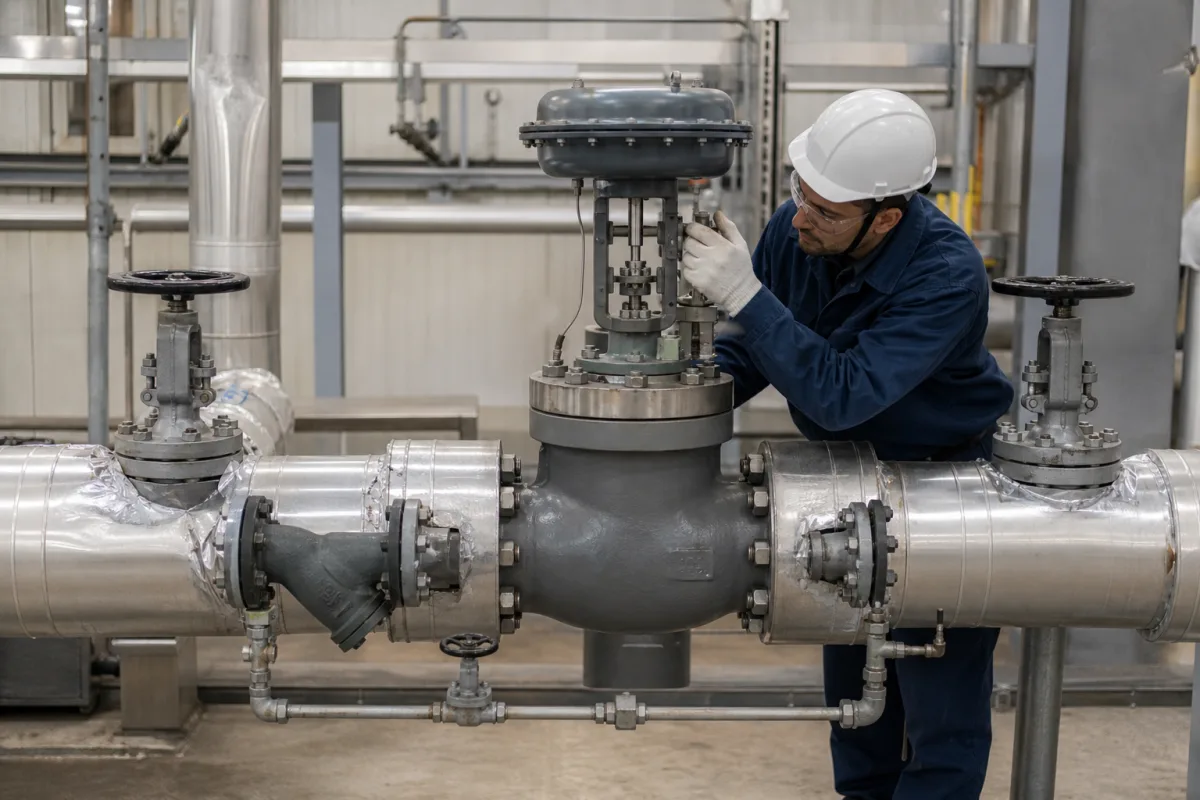
A self-acting pressure reducing valve only holds its set pressure exactly at one flow: as demand rises, downstream pressure sags. Decide how much droop the process can accept, choose direct-acting or pilot-operated design on that basis, size for flow, and protect the downstream plant with a safety valve in case the reducing valve fails open.
Self-acting direct-acting and pilot-operated pressure reducing valves for steam, gases, water, fire-protection and sanitary service. Hydraulic circuit pressure reducing valves are covered on the hydraulic valves page.
CNFX editorial research · Sources checked October 12, 2026 · 6 sources
Choose direct-acting or pilot-operated by the droop you can accept
Spirax Sarco explains that in a direct-acting valve the downstream pressure acting on a bellows or diaphragm is balanced against a spring, so downstream pressure equals the set pressure at only one load and rises as the load falls; changes in inlet pressure also shift the outlet pressure. Such valves suit simple applications with small, fairly constant flow where close control is not essential. [1]
For steam it notes that direct-acting diaphragm valves can handle pressure drops of 50:1 in small sizes and 10:1 in large sizes but have a large proportional band, so they suit reducing pressure to plant areas rather than individual items; their diaphragms need a water seal on steam. [2]
Pilot-operated valves sense downstream pressure through a sensing pipe and use a small pilot to move the main valve, giving, as Spirax Sarco states, "a very narrow proportional band, typically less than 200 kPa", and close control regardless of upstream variations. Check size and steam quality needs with the supplier for the capacity required. [1][2]
Give the supplier inlet pressure range, required outlet pressure and tolerance, minimum, normal and maximum flow, the fluid and its condition, and the maximum allowable working pressure of the downstream equipment.
02
Size for flow, not for the pipe
Spirax Sarco warns that oversizing should be avoided with reducing valves as with all control valves: a plug working close to its seat with wet steam suffers wiredrawing and erosion, and small movements of an oversized plug cause large changes in flow. [1]
It also advises that upstream and downstream pipework and fittings be sized so the only appreciable pressure drop is across the reducing valve; isolating valves the same size as the reducing valve connections cause a larger drop than larger ones. [1]
Ask the supplier for the valve's capacity at minimum and maximum flow and the outlet pressure it will hold at each, and check the downstream pipe velocity at the reduced pressure.
03
Install with strainer, separator, sensing line and safety valve
Spirax Sarco reports that "many reducing valve problems are caused by the presence of moisture or dirt", and recommends a separator and fine-mesh strainer, fitted on its side for steam, immediately before a pilot-operated valve. [1]
If the downstream pipework or plant cannot withstand the maximum possible upstream pressure, a safety or relief valve must be fitted downstream, set at or below the maximum allowable working pressure of the equipment; Spirax Sarco stresses that a safety valve is needed in case the reducing valve fails. Because direct-acting valves have a wide proportional band, care is needed if the safety valve must be set close to the working pressure. [1][2]
Large direct-acting diaphragm valves on steam are installed with the actuator below the pipe and a water seal pot protecting the diaphragm. [1]
04
Compare what suppliers offer
Suppliers linked to this page list pressure reducing valves for water, fire protection, irrigation, sanitary and industrial service. [3][4][5]
Convista lists a 1318 pressure reducing valve; Apex Fire Tech lists fire-protection pressure reducing valves; Sunthai lists sanitary pressure reducing valves for compressed air, gases and liquids in hygienic service; Chinadrip lists proportional pressure reducing valves for water lines. [3][4][5][6]
05
Trace the pressure reducing valve components
This is a functional reference built from the sources cited; it is not one maker's parts list.
Fill the specification fields with values for your line
A pressure reducing valve quotation needs line-specific values. The table explains each field, gives published values where a reviewed source states them, and says what to obtain from the supplier.
Explore company information and manufacturing capabilities, then discuss the scope of your project with a relevant supplier.
Share this page
Compiled and source-reviewed by the CNFX editorial team.
Published product pages show what a company offers, not tested performance. Confirm the legal seller, factory and scope for your order. How we source and review
· Page last updated 13 October 2026
Buyer questions
Why does downstream pressure drop as flow increases?
Spirax Sarco explains that a self-acting valve needs a change in downstream pressure to move its valve, so outlet pressure equals the set point at only one load; pilot-operated valves reduce this to a narrow proportional band. [1][2]
Do I need a safety valve after a pressure reducing valve?
Spirax Sarco states a safety or relief valve must be fitted downstream if the downstream plant cannot withstand full upstream pressure, set at or below its maximum allowable working pressure. [1]
Should a reducing valve match the pipe size?
No. Spirax Sarco warns against oversizing: an oversized valve works close to its seat, erodes with wet steam and controls poorly. [1]
Sources and what still needs a direct check
Sources checked 2026-10-12. Spirax Sarco is a steam equipment manufacturer; its learning pages describe self-acting pressure control, mainly for steam. Supplier pages describe their own offers. No valve standard was read for this page.