Industry-Verified Manufacturing Data (2026)

Processor (DSP/FPGA)

Based on aggregated insights from multiple verified factory profiles within the CNFX directory, the standard Processor (DSP/FPGA) used in the Machinery and Equipment Manufacturing sector typically supports operational capacities ranging from standard industrial configurations to heavy-duty production requirements.

Technical Definition & Core Assembly

A canonical Processor (DSP/FPGA) is characterized by the integration of Processing Core and I/O Interface. In industrial production environments, manufacturers listed on CNFX commonly emphasize Silicon (Semiconductor) construction to support stable, high-cycle operation across diverse manufacturing scenarios.

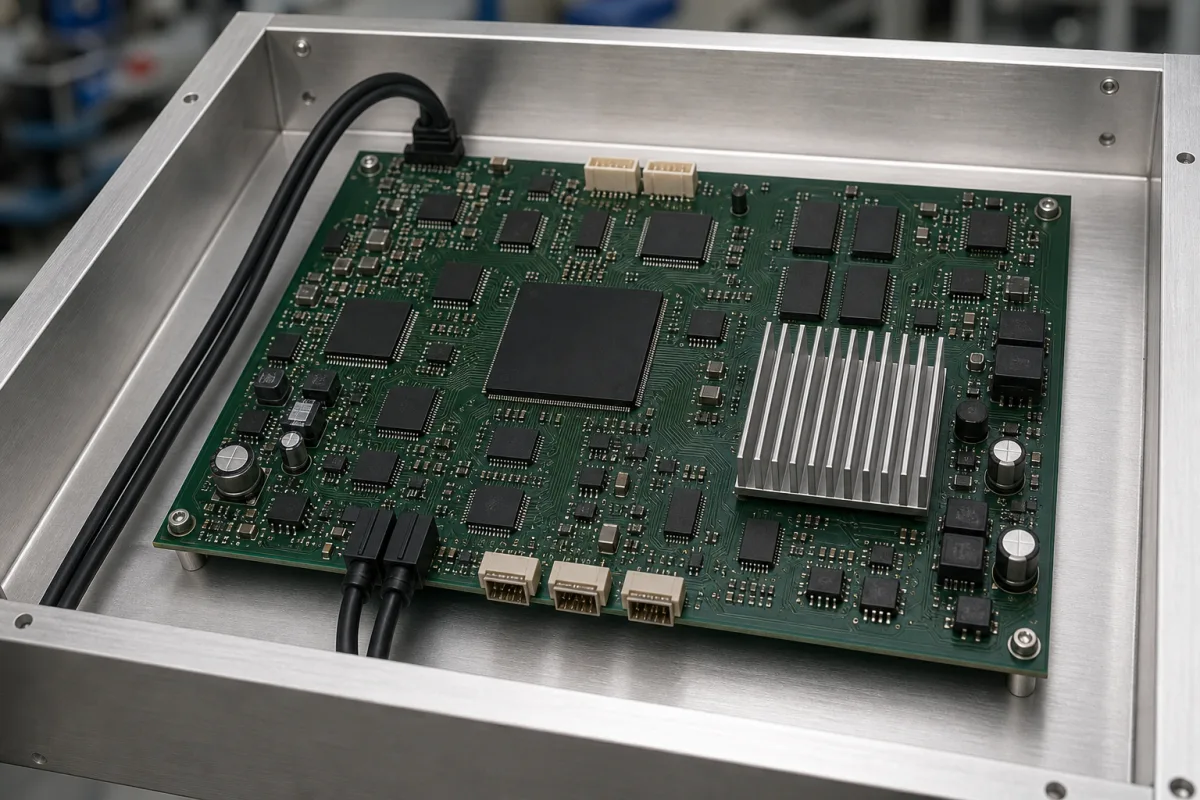
A specialized computing unit within a motion control card that executes real-time algorithms for precise motor control.
Product Specifications

Technical details and manufacturing context for Processor (DSP/FPGA)

Definition
The processor (DSP/FPGA) is the core computational component of a motion control card. It is responsible for executing complex, real-time control algorithms, processing feedback signals from encoders or sensors, and generating precise command signals for motor drivers. It enables features like multi-axis synchronization, trajectory planning, and closed-loop control.
Working Principle
The processor receives high-level motion commands (e.g., position, velocity profiles). Its internal architecture (DSP for algorithmic computation or FPGA for parallel, hardware-configurable logic) executes control algorithms in real-time. It processes feedback data, calculates error signals, and outputs precise pulse or analog signals to drive amplifiers, ensuring accurate and responsive motor movement.
Common Materials
Silicon (Semiconductor)
Technical Parameters
  • Clock speed determining the processor's computational speed and real-time performance. (MHz) Per Request
Components / BOM
  • Processing Core
    Executes the main control algorithms and mathematical computations.
    Material: silicon
  • I/O Interface
    Handles communication with encoders, sensors, and motor drivers.
    Material: copper/silicon
  • Memory (RAM/Flash)
    Stores program code, trajectory data, and temporary variables.
    Material: silicon
Engineering Reasoning
0.9-1.1V core voltage, -40°C to +125°C junction temperature, 100-1000MHz clock frequency
1.2V core voltage (electromigration threshold), +150°C junction temperature (silicon degradation point), 1.1GHz clock frequency (timing violation limit)
Design Rationale: Electromigration at >1.2V causes metal migration in interconnects; thermal runaway above 150°C creates hot spots through positive feedback; clock skew beyond 10% setup/hold margins violates synchronous logic timing
Risk Mitigation (FMEA)
Trigger Power supply ripple exceeding 50mVpp at switching frequency
Mode: Clock jitter propagation causing position loop instability
Strategy: Multi-stage LC filtering with 60dB attenuation at 100kHz-1MHz band
Trigger Alpha particle strike generating 10⁴ electron-hole pairs in SRAM cells
Mode: Single-event upset corrupting PID coefficient registers
Strategy: Triple modular redundancy with 2-out-of-3 voting logic in critical data paths

Industry Taxonomies & Aliases

Commonly used trade names and technical identifiers for Processor (DSP/FPGA).

Applied To / Applications

This component is essential for the following industrial systems and equipment:

Industrial Ecosystem & Supply Chain DNA

Complementary Systems
Downstream Applications
Specialized Tooling

Application Fit & Sizing Matrix

Operational Limits
pressure: Not applicable (sealed electronic component)
other spec: Clock frequency: 100 MHz to 1 GHz typical, Power consumption: 1W to 15W typical, I/O voltage: 1.2V to 3.3V
temperature: -40°C to +85°C (industrial grade), -40°C to +125°C (extended automotive/industrial)
Media Compatibility
✓ Industrial control cabinets with filtered air ✓ Automotive engine control units ✓ Robotic arm enclosures with vibration damping
Unsuitable: Direct exposure to conductive dust or corrosive chemicals without proper sealing
Sizing Data Required
  • Maximum control loop frequency required (Hz)
  • Number of simultaneous motor axes to control
  • Complexity of control algorithms (MIPS/MFLOPS requirement)

Reliability & Engineering Risk Analysis

Failure Mode & Root Cause
Thermal overstress
Cause: Inadequate cooling or excessive ambient temperature leading to junction temperature exceeding design limits, causing permanent damage to semiconductor structures.
Electrostatic discharge (ESD) damage
Cause: Improper handling during installation or maintenance without proper grounding, resulting in sudden voltage spikes that destroy sensitive internal components.
Maintenance Indicators
  • Unexpected system resets or lockups during normal operation
  • Abnormal heat emission from the processor housing detected via thermal imaging or touch
Engineering Tips
  • Implement active cooling with temperature monitoring and alarms to maintain junction temperatures within specified operating ranges.
  • Establish strict ESD protocols for all handling procedures, including use of grounded workstations and wrist straps during installation and maintenance.

Compliance & Manufacturing Standards

Reference Standards
ISO 9001:2015 - Quality Management Systems IEC 61508 - Functional Safety of Electrical/Electronic/Programmable Electronic Safety-Related Systems CE Marking - Compliance with EU Directives (e.g., EMC Directive 2014/30/EU)
Manufacturing Precision
  • Clock Frequency Stability: +/- 50 ppm
  • Power Supply Voltage Tolerance: +/- 5%
Quality Inspection
  • Automated Optical Inspection (AOI) for Solder Joints and Component Placement
  • Boundary Scan Test (JTAG) for Interconnect and Logic Verification

Factories Producing Processor (DSP/FPGA)

Verified manufacturers with capability to produce this product in China

✓ 92% Supplier Capability Match Found

T Technical Director from United States Feb 03, 2026
★★★★★
"Standard OEM quality for Machinery and Equipment Manufacturing applications. The Processor (DSP/FPGA) arrived with full certification."
Technical Specifications Verified
P Project Engineer from United Arab Emirates Jan 31, 2026
★★★★☆
"Great transparency on the Processor (DSP/FPGA) components. Essential for our Machinery and Equipment Manufacturing supply chain. (Delivery took slightly longer than expected, but technical support was excellent.)"
Technical Specifications Verified
S Sourcing Manager from Australia Jan 28, 2026
★★★★★
"The Processor (DSP/FPGA) we sourced perfectly fits our Machinery and Equipment Manufacturing production line requirements."
Technical Specifications Verified
Verification Protocol

“Feedback is collected from verified sourcing managers during RFQ (Request for Quote) and factory evaluation processes on CNFX. These reports represent historical performance data and technical audit summaries from our B2B manufacturing network.”

5 sourcing managers are analyzing this specification now. Last inquiry for Processor (DSP/FPGA) from Vietnam (1h ago).

Supply Chain Compatible Machinery & Devices

Automated Assembly Line System

Integrated production system for sequential component assembly operations

Explore Specs →
Automated Powder Coating System

Integrated industrial system for applying dry powder coatings to metal substrates.

Explore Specs →
Centrifugal Pump Impeller

Rotating component that transfers energy to fluid in centrifugal pumps.

Explore Specs →
High-Precision CNC Laser Cutting Machine

Computer-controlled industrial machine using focused laser beams to cut sheet metal with micron-level accuracy.

Explore Specs →

Frequently Asked Questions

What is the primary function of this DSP/FPGA processor in machinery manufacturing?

This specialized processor executes real-time algorithms within motion control cards to achieve precise motor control, ensuring accurate positioning, speed regulation, and torque management in industrial machinery.

How does this processor differ from general-purpose computing units?

Unlike general-purpose processors, this DSP/FPGA is optimized for deterministic real-time performance, low-latency I/O processing, and executing motion control algorithms with predictable timing critical for machinery applications.

What are the key specifications to consider when integrating this processor into motion control systems?

Key specifications include processing core architecture (DSP/FPGA), I/O interface capabilities, memory configuration (RAM/Flash), real-time performance metrics, power consumption, and compatibility with motion control algorithms and industrial communication protocols.

Can I contact factories directly on CNFX?

CNFX is an open directory, not a transaction platform. Each factory profile provides direct contact information and production details to help you initiate direct inquiries with Chinese suppliers.

Get Quote for Processor (DSP/FPGA)

Request technical pricing, lead times, or customized specifications for Processor (DSP/FPGA) directly from verified manufacturing units.

Your business information is encrypted and only shared with verified Processor (DSP/FPGA) suppliers.

Thank you! Your message has been sent. We'll respond within 1–3 business days.

Need to Manufacture Processor (DSP/FPGA)?

Connect with verified factories specializing in this product category

Add Your Factory Contact Us
Previous Product
Processing Unit
Next Product
Processor/Logic Solver