Industry-Verified Manufacturing Data (2026)

Memory (RAM/Flash)

Based on aggregated insights from multiple verified factory profiles within the CNFX directory, the standard Memory (RAM/Flash) used in the Computer, Electronic and Optical Product Manufacturing sector typically supports operational capacities ranging from standard industrial configurations to heavy-duty production requirements.

Technical Definition & Core Assembly

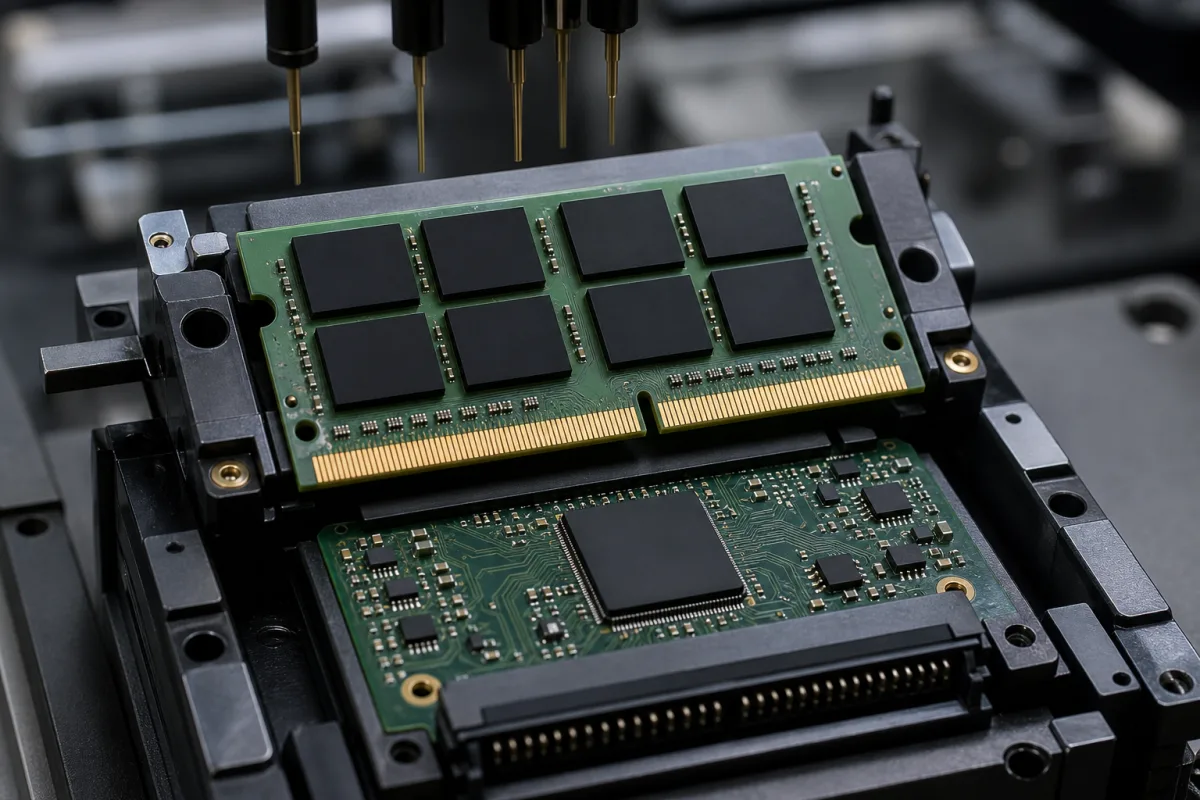
A canonical Memory (RAM/Flash) is characterized by the integration of Memory Chip and PCB Substrate. In industrial production environments, manufacturers listed on CNFX commonly emphasize Silicon construction to support stable, high-cycle operation across diverse manufacturing scenarios.

Electronic component that stores data and program instructions for processing by the CPU.
Product Specifications

Technical details and manufacturing context for Memory (RAM/Flash)

Definition
A critical component on the main circuit board that provides temporary (RAM) and/or permanent (Flash) data storage for computer systems, enabling data access, program execution, and system operation.
Working Principle
RAM (Random Access Memory) uses capacitors and transistors to store data temporarily as electrical charges, allowing fast read/write access but losing data when power is off. Flash memory uses floating-gate transistors to trap electrons, enabling non-volatile data storage that persists without power.
Common Materials
Silicon, Copper, Plastic
Technical Parameters
  • Storage capacity measured in gigabytes (GB) Standard Spec
Components / BOM
  • Memory Chip
    Core storage element containing memory cells
    Material: Silicon
  • PCB Substrate
    Base board that holds and connects memory chips
    Material: Fiberglass-reinforced epoxy
  • Connector Pins
    Electrical interface to the motherboard
    Material: Copper alloy
Engineering Reasoning
1.2-1.35 V (DDR4), 1.1-1.25 V (DDR5), -40°C to 85°C (commercial), -40°C to 125°C (industrial)
Voltage exceeding 1.5 V (DDR4) or 1.35 V (DDR5) for >10 ms, temperature exceeding 95°C (commercial) or 130°C (industrial), write/erase cycles exceeding 100,000 (NAND flash)
Design Rationale: Electromigration at >10^6 A/cm² current density causing conductor thinning, dielectric breakdown at >10 MV/cm electric field, thermal degradation of floating gate oxide at >125°C
Risk Mitigation (FMEA)
Trigger Alpha particle strike with energy >5 MeV
Mode: Single Event Upset causing bit flip from 0.3 fC charge injection
Strategy: Error Correction Code with Hamming distance 4, triple modular redundancy circuits
Trigger Electromigration at current density >2×10^6 A/cm²
Mode: Open circuit in 65 nm copper interconnects after 10^12 stress cycles
Strategy: Copper doping with 0.5% manganese, redundant vias at 150% design rule

Industry Taxonomies & Aliases

Commonly used trade names and technical identifiers for Memory (RAM/Flash).

Applied To / Applications

This component is essential for the following industrial systems and equipment:

Industrial Ecosystem & Supply Chain DNA

Complementary Systems
Downstream Applications
Specialized Tooling

Application Fit & Sizing Matrix

Operational Limits
voltage: 1.2V to 3.3V depending on technology
humidity: 5% to 95% non-condensing
temperature: -40°C to +85°C (industrial), 0°C to +70°C (commercial)
shock vibration: Up to 1500G shock, 10-2000Hz vibration resistance
operating frequency: Up to 6400 MT/s for DDR5 RAM, varies by flash type
Media Compatibility
✓ Server/Data Center Environments ✓ Industrial Control Systems ✓ Consumer Electronics
Unsuitable: High-radiation environments (nuclear facilities, space without shielding)
Sizing Data Required
  • Required Capacity (GB/TB)
  • Data Transfer Rate/Bandwidth (MT/s, GB/s)
  • Form Factor/Interface (DDR4/5, NVMe, SATA, DIMM/SODIMM)

Reliability & Engineering Risk Analysis

Failure Mode & Root Cause
Bit corruption
Cause: Electromigration or dielectric breakdown from voltage fluctuations, thermal cycling, or manufacturing defects leading to data loss or incorrect reads/writes.
Memory cell degradation
Cause: Excessive write/erase cycles (especially in Flash) or prolonged exposure to high temperatures causing wear-out and reduced storage capacity or performance.
Maintenance Indicators
  • Frequent system crashes, blue screens, or unexplained reboots indicating potential RAM instability.
  • Slow data access, file corruption errors, or failure to boot, suggesting Flash memory wear or bad sectors.
Engineering Tips
  • Implement environmental controls: Maintain stable operating temperatures (typically 0-70°C for commercial grade) and ensure clean, stable power supply with proper voltage regulation to reduce electrical stress.
  • Apply wear-leveling algorithms (for Flash) and use ECC (Error-Correcting Code) memory modules (for RAM) to distribute write cycles evenly and correct bit errors, extending functional life.

Compliance & Manufacturing Standards

Reference Standards
ISO/IEC 7816-3:2006 (Smart card interfaces) ANSI/EIA-364-1000.01 (Electrical connector performance) DIN EN 60749-26 (Semiconductor devices - Mechanical and climatic test methods)
Manufacturing Precision
  • Pin alignment: +/-0.05mm
  • Module thickness: +/-0.1mm
Quality Inspection
  • Electrical continuity test
  • Thermal cycling test

Factories Producing Memory (RAM/Flash)

Verified manufacturers with capability to produce this product in China

✓ 97% Supplier Capability Match Found

T Technical Director from Canada Feb 07, 2026
★★★★★
"Great transparency on the Memory (RAM/Flash) components. Essential for our Computer, Electronic and Optical Product Manufacturing supply chain."
Technical Specifications Verified
P Project Engineer from United States Feb 04, 2026
★★★★☆
"The Memory (RAM/Flash) we sourced perfectly fits our Computer, Electronic and Optical Product Manufacturing production line requirements. (Delivery took slightly longer than expected, but technical support was excellent.)"
Technical Specifications Verified
S Sourcing Manager from United Arab Emirates Feb 01, 2026
★★★★★
"Found 42+ suppliers for Memory (RAM/Flash) on CNFX, but this spec remains the most cost-effective."
Technical Specifications Verified
Verification Protocol

“Feedback is collected from verified sourcing managers during RFQ (Request for Quote) and factory evaluation processes on CNFX. These reports represent historical performance data and technical audit summaries from our B2B manufacturing network.”

15 sourcing managers are analyzing this specification now. Last inquiry for Memory (RAM/Flash) from Germany (1h ago).

Supply Chain Compatible Machinery & Devices

Modular Industrial Edge Computing Device

Rugged computing platform for industrial data processing at the network edge

Explore Specs →
Industrial Smart Camera Module

Embedded vision system for industrial automation and quality inspection.

Explore Specs →
Industrial Wireless Power Transfer Module

Wireless power transfer module for industrial equipment applications

Explore Specs →
Industrial Smart Sensor Module

Modular industrial sensor with embedded processing and wireless connectivity

Explore Specs →

Frequently Asked Questions

What are the key differences between RAM and Flash memory in industrial applications?

RAM provides volatile, high-speed temporary storage for active processing, while Flash offers non-volatile, persistent storage for data retention. In manufacturing, RAM supports real-time operations, and Flash stores firmware and critical data.

How do materials like silicon and copper affect memory performance and reliability?

Silicon enables precise semiconductor fabrication for memory chips, ensuring speed and density. Copper wiring enhances conductivity and signal integrity, reducing latency and improving durability in demanding industrial environments.

What specifications should manufacturers consider when selecting memory for electronic products?

Key specs include capacity (GB/TB), speed (MHz/MT/s), latency (CAS timings), form factor (DIMM, SODIMM, BGA), voltage requirements, and operating temperature range to ensure compatibility and performance in target applications.

Can I contact factories directly on CNFX?

CNFX is an open directory, not a transaction platform. Each factory profile provides direct contact information and production details to help you initiate direct inquiries with Chinese suppliers.

Get Quote for Memory (RAM/Flash)

Request technical pricing, lead times, or customized specifications for Memory (RAM/Flash) directly from verified manufacturing units.

Your business information is encrypted and only shared with verified Memory (RAM/Flash) suppliers.

Thank you! Your message has been sent. We'll respond within 1–3 business days.

Need to Manufacture Memory (RAM/Flash)?

Connect with verified factories specializing in this product category

Add Your Factory Contact Us
Previous Product
Memory (Flash/RAM)
Next Product
Memory Array