Industry-Verified Manufacturing Data (2026)

Quench Nozzle / Injector

Based on aggregated insights from multiple verified factory profiles within the CNFX directory, the standard Quench Nozzle / Injector used in the Machinery and Equipment Manufacturing sector typically supports operational capacities ranging from standard industrial configurations to heavy-duty production requirements.

Technical Definition & Core Assembly

A canonical Quench Nozzle / Injector is characterized by the integration of Nozzle Body and Orifice Plate. In industrial production environments, manufacturers listed on CNFX commonly emphasize Stainless Steel 316L construction to support stable, high-cycle operation across diverse manufacturing scenarios.

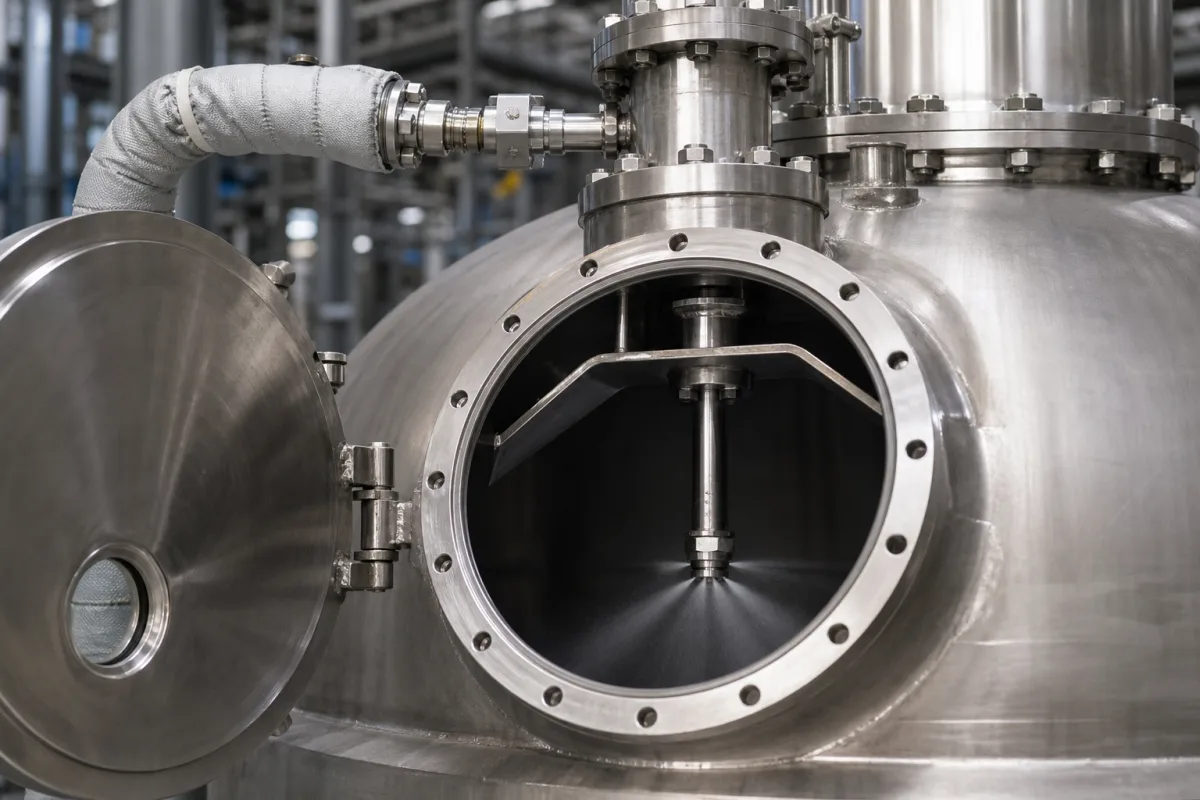
A precision component in emergency quench systems that rapidly delivers quenching media to control or terminate exothermic reactions.
Product Specifications

Technical details and manufacturing context for Quench Nozzle / Injector

Definition
The quench nozzle/injector is a critical safety component within emergency quench systems, designed to precisely and rapidly dispense quenching agents (such as water, inert gases, or chemical inhibitors) into process vessels or reactors. Its primary function is to quickly suppress or terminate runaway chemical reactions, prevent thermal decomposition, and mitigate the risk of explosions or fires by rapidly reducing temperature and diluting reactants.
Working Principle
The nozzle/injector operates by receiving pressurized quenching media from the system's supply line. When activated by the emergency control system, it opens a valve mechanism, allowing the media to flow through its internal orifice. The design of the nozzle tip (often featuring specific spray patterns like full cone, hollow cone, or flat fan) atomizes the quenching agent, maximizing surface area contact with the reactive materials to ensure rapid heat absorption and reaction suppression.
Common Materials
Stainless Steel 316L, Hastelloy C-276, Titanium Grade 2
Technical Parameters
  • Orifice diameter, typically ranging from 2mm to 25mm depending on flow rate requirements and system pressure (mm) Customizable
Components / BOM
  • Nozzle Body
    Main structural housing that connects to quench system piping and contains internal components
    Material: Stainless Steel 316L
  • Orifice Plate
    Precision-machined disk with calibrated opening that controls flow rate and creates desired spray pattern
    Material: Hastelloy C-276
  • Actuation Valve
    Fast-acting valve mechanism (typically pneumatic or hydraulic) that opens upon emergency signal to release quenching media
    Material: Stainless Steel 316L
  • Spray Tip
    Final discharge component that atomizes quenching media into optimal droplet size for rapid heat transfer
    Material: Titanium Grade 2
Engineering Reasoning
15-85 bar at 20-80°C with flow rates of 0.5-12 L/min
Structural failure occurs at sustained pressure >95 bar or temperature >150°C, with cavitation threshold at vapor pressure <0.023 bar absolute
Design Rationale: Thermal fatigue from cyclic quenching (ΔT>200°C) combined with cavitation erosion at vapor pressure <0.023 bar, following the Rayleigh-Plesset equation for bubble collapse
Risk Mitigation (FMEA)
Trigger Quenching media contamination with particulate >25μm
Mode: Orifice erosion increasing diameter beyond 0.5mm tolerance, causing flow deviation >15% from design specification
Strategy: Install dual-stage filtration (100μm pre-filter + 10μm final filter) with differential pressure monitoring
Trigger Thermal cycling exceeding 200°C differential at frequency >0.5Hz
Mode: Crack propagation in H13 tool steel following Paris' law (da/dN=CΔK^m) leading to structural failure
Strategy: Implement thermal barrier coating (Al2O3-TiO2) with 300μm thickness and infrared temperature feedback control

Industry Taxonomies & Aliases

Commonly used trade names and technical identifiers for Quench Nozzle / Injector.

Applied To / Applications

This component is essential for the following industrial systems and equipment:

Industrial Ecosystem & Supply Chain DNA

Complementary Systems
Downstream Applications
Specialized Tooling

Application Fit & Sizing Matrix

Operational Limits
pressure: Up to 100 bar (standard), 150 bar (high-pressure variant)
flow rate: 0.5 to 50 L/min (adjustable via orifice sizing)
temperature: -40°C to 400°C (operating), up to 800°C (short-term exposure)
slurry concentration: Up to 30% solids by weight (with hardened internals)
Media Compatibility
✓ Water-based quenching fluids ✓ Nitrogen gas (inert media) ✓ Aqueous foam solutions
Unsuitable: Concentrated sulfuric acid environments (causes rapid corrosion)
Sizing Data Required
  • Required quenching flow rate (L/min)
  • System operating pressure (bar)
  • Reaction vessel volume/geometry (m³ or dimensions)

Reliability & Engineering Risk Analysis

Failure Mode & Root Cause
Clogging/Deposit Buildup
Cause: Accumulation of scale, mineral deposits, or contaminants from the quench medium (e.g., water, oil) due to poor filtration, improper fluid chemistry, or low flow velocities.
Corrosion/Erosion
Cause: Chemical attack from aggressive quench fluids (e.g., water with high chloride content) or mechanical wear from abrasive particles in the fluid, often accelerated by high-pressure operation and material incompatibility.
Maintenance Indicators
  • Irregular or uneven spray pattern (visual deviation from designed spray angle/droplet distribution)
  • Abnormal noise (hissing, whistling, or knocking) during operation indicating flow restriction or internal damage
Engineering Tips
  • Implement routine inline filtration (e.g., 10-25 micron filters) and periodic fluid analysis to maintain quench medium cleanliness and chemistry within specified limits.
  • Conduct regular spray pattern testing and flow rate verification using calibrated equipment to detect early performance degradation before failure occurs.

Compliance & Manufacturing Standards

Reference Standards
ISO 9001:2015 Quality Management Systems ASTM A276/A276M-17 Standard Specification for Stainless Steel Bars and Shapes CE Marking (EU Machinery Directive 2006/42/EC)
Manufacturing Precision
  • Bore diameter: +/-0.01mm
  • Surface flatness: 0.05mm
Quality Inspection
  • Pressure Testing (Hydrostatic/Pneumatic)
  • Dimensional Verification (CMM/Calipers)

Factories Producing Quench Nozzle / Injector

Verified manufacturers with capability to produce this product in China

✓ 95% Supplier Capability Match Found

T Technical Director from Brazil Jan 30, 2026
★★★★★
"As a professional in the Machinery and Equipment Manufacturing sector, I confirm this Quench Nozzle / Injector meets all ISO standards."
Technical Specifications Verified
P Project Engineer from Canada Jan 27, 2026
★★★★☆
"Standard OEM quality for Machinery and Equipment Manufacturing applications. The Quench Nozzle / Injector arrived with full certification. (Delivery took slightly longer than expected, but technical support was excellent.)"
Technical Specifications Verified
S Sourcing Manager from United States Jan 24, 2026
★★★★★
"Great transparency on the Quench Nozzle / Injector components. Essential for our Machinery and Equipment Manufacturing supply chain."
Technical Specifications Verified
Verification Protocol

“Feedback is collected from verified sourcing managers during RFQ (Request for Quote) and factory evaluation processes on CNFX. These reports represent historical performance data and technical audit summaries from our B2B manufacturing network.”

8 sourcing managers are analyzing this specification now. Last inquiry for Quench Nozzle / Injector from Poland (1h ago).

Supply Chain Compatible Machinery & Devices

Hydraulic Press

Industrial machine using hydraulic pressure to compress, form, or assemble materials

Explore Specs →
Heavy-Duty CNC Plasma Cutting Machine

Industrial machine for precision metal cutting using plasma arc technology

Explore Specs →
Automated Assembly Line System

Integrated production system for sequential component assembly operations

Explore Specs →
Automated Powder Coating System

Integrated industrial system for applying dry powder coatings to metal substrates.

Explore Specs →

Frequently Asked Questions

What materials are available for quench nozzles/injectors?

Our quench nozzles/injectors are manufactured from high-performance materials including Stainless Steel 316L, Hastelloy C-276, and Titanium Grade 2 to ensure corrosion resistance and durability in demanding industrial environments.

What are the key components of a quench nozzle/injector assembly?

The standard bill of materials includes an actuation valve for precise control, a nozzle body for structural integrity, an orifice plate for flow regulation, and a spray tip for optimized media dispersion in emergency quenching applications.

How do quench nozzles/injectors enhance safety in machinery manufacturing?

These precision components rapidly deliver quenching media to control or terminate exothermic reactions, preventing equipment damage and ensuring operator safety by quickly suppressing hazardous thermal events in industrial processes.

Can I contact factories directly on CNFX?

CNFX is an open directory, not a transaction platform. Each factory profile provides direct contact information and production details to help you initiate direct inquiries with Chinese suppliers.

Get Quote for Quench Nozzle / Injector

Request technical pricing, lead times, or customized specifications for Quench Nozzle / Injector directly from verified manufacturing units.

Your business information is encrypted and only shared with verified Quench Nozzle / Injector suppliers.

Thank you! Your message has been sent. We'll respond within 1–3 business days.

Need to Manufacture Quench Nozzle / Injector?

Connect with verified factories specializing in this product category

Add Your Factory Contact Us
Previous Product
Quality Testing Station
Next Product
Quenching System