Process columns · Trays or structured packing, HETP and packed height, Y and X packing, vacuum service, distributors
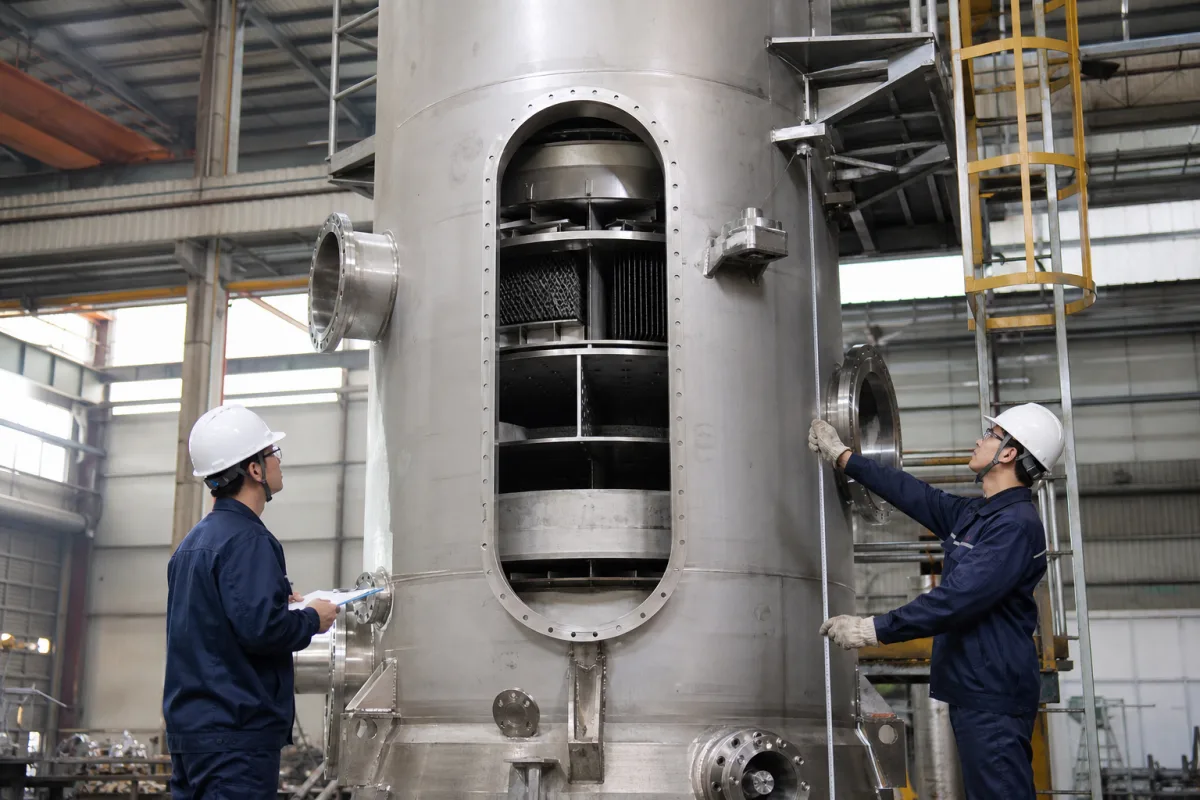
A distillation column is a vertical pressure vessel in which rising vapour and falling liquid exchange components across trays or packing, separating a feed by volatility, with a reboiler at the bottom and a condenser at the top. Ask three things first: whether trays or packing suit your pressure, liquid load and fouling, how many theoretical stages are needed and what height that means for the chosen internals, and how liquid will be distributed and the internals installed and inspected.
Industrial distillation and rectification columns for chemical and process plants, trayed or packed, at atmospheric, pressure or vacuum service, with their internals. Craft-spirit pot and column stills, molecular (short-path) and thin-film distillation units, and laboratory glass columns are outside this page.
CNFX editorial research · Sources checked October 12, 2026 · 4 sources
Koch-Glitsch states that FLEXIPAC structured packing gives lower pressure drop per theoretical stage and higher capacity than trays and conventional random packing, and that packed columns can improve yields and purity, reduce reflux ratio, raise throughput, cut pressure drop and liquid holdup and increase heat transfer. It recommends wire gauze packing for deep vacuum and low-liquid-rate distillation and for temperature-sensitive materials, because of its lowest pressure drop per theoretical stage. [1]
For beverage alcohol distillation Koch-Glitsch describes structured packing where low pressure drop and high separation efficiency are required, and valve, fixed-valve or sieve trays selected by capacity, turndown and fouling potential where operational flexibility or mechanical robustness is a priority. It calls liquid distributors, redistributors, collectors and packing supports critical to even vapour–liquid contact, particularly in large-diameter or high-capacity columns. [2]
FLEXIPAC packing is offered in stainless steel, high alloys, duplex steel, titanium and zirconium. [1]
Sulzer gives key characteristics for its Mellapak structured packing: pressure drop per theoretical stage of 0.3–1.0 mbar, about 2 mbar/m at 70–80 % of flooding, a minimum liquid load of about 0.2 m³/m²h and a maximum of more than 200 m³/m²h, in stainless steels, alloys and thermoplastics, for vacuum to moderate-pressure distillation and high-pressure absorption and desorption. It states that MellapakPlus, which reduces the corrugation angle to zero at both ends of each sheet, has up to 50 % higher capacity at the same number of theoretical stages per metre and can be used from 1 mbar vacuum to high-pressure applications. [4]
Give the supplier the feed composition and rate, product purities, operating pressure and temperature, number of theoretical stages if known, reflux ratio, fouling or polymerising tendency, turndown range, materials of construction, design code, and site limits on height and diameter.
02
Size the packed height from HETP and stages
Koch-Glitsch lists HETP (height equivalent to a theoretical plate) estimates for FLEXIPAC packing: Y types (45° inclination) range from 160 mm for 700Y through 315 mm for 250Y to 1590 mm for 4Y; X types (60°, for high capacity and low pressure drop, with lower pressure drop per stage than the same-size Y) range from 340 mm for 1X to 2270 mm for 4X. The values are estimates for atmospheric systems with low relative volatility and good liquid and vapour distribution; non-ideal systems need the supplier's input. [1]
Editorial calculation: a separation needing 20 theoretical stages would need about 20 × 315 mm ≈ 6.3 m of 250Y packing, or about 20 × 570 mm ≈ 11.4 m of 2X packing, before adding height for distributors, redistributors, supports and the column heads. [1]
Editorial calculation: at Sulzer's 0.3–1.0 mbar per theoretical stage, the 20-stage example above would lose about 6–20 mbar across the packing; at 2 mbar/m near 70–80 % of flooding, 6.3 m of packing would lose about 13 mbar. Compare these with the column top pressure in vacuum service, and ask the supplier for the rated pressure drop at your loads. [4]
Koch-Glitsch recommends rating packed columns with software built on test data specific to each packing. [1] Editorial note: ask the supplier for a hydraulic rating at your minimum and maximum loads, not only at design.
03
Weigh the column's energy use when choosing the scheme
A 2005 US Department of Energy report, Hybrid separations/distillation technology (prepared with the University of Texas at Austin, Oak Ridge National Laboratory and AIChE), states that distillation accounts for about 95% of separation energy in refining and chemical processing, with about 40,000 columns in over 200 processes in the United States, and that separations account for about 60% of in-plant energy in these two industries. It puts the thermodynamic efficiency of a commercial column at less than 10%. [3]
The report lists four ways to save distillation energy: make the column process itself more efficient, add an advanced process to form a hybrid system, replace distillation with another separation, or change the reaction steps or flowsheet to reduce the need for distillation. It cites estimated energy savings of 33% for hybrid technologies in some applications. [3]
Editorial calculation: 1.9 quads of reboiler energy is about 2.0 × 10¹⁸ J (1 quad ≈ 1.055 × 10¹⁸ J); dividing by 40,000 columns gives an average of roughly 50 TJ per column per year, about 1.6 MW of continuous reboiler duty.
US distillation service (DOE Table 1.1)
Example key components
Reboiler energy, quads/yr
Petroleum
Gasoline/naphtha
0.49
Crude oil
Light naphtha/heavy naphtha/light distillate
0.42
Liquefied petroleum gas
Ethane/propane/butane
0.22
Olefins
Ethylene/ethane, propylene/propane
0.12
Water–oxygenated hydrocarbons
Methanol/water, water/acetic acid
0.10
Aromatics
Ethylbenzene/styrene, benzene/toluene
0.08
Water–inorganics
Ammonia/water
0.06
Total reboiler energy (fuel at 80% boiler efficiency)
—
1.9 (2.4)
Give the supplier the feed, product specifications and utility costs, and ask for reboiler and condenser duty, reflux ratio, and options such as heat integration, internals upgrade or a hybrid membrane step.
04
Columns sold with reactors and tanks, or built to ASME, TEMA and API codes
Listings include fabricated distillation columns with reactors, tanks and heat exchangers, and columns built to ASME, TEMA and API codes among process equipment.
05
Shell, trays, packing, distributors, supports and reboiler of a column
Part
Role
Fix in the order
Column shell
Pressure vessel housing the internals.
Code, diameter, material.
Trays
Valve, fixed-valve or sieve; flexible and robust. [2]
Diameter, packed height, pressure drop, liquid load and reboiler duty for a column order
Packed height, pressure drop and liquid load carry Koch-Glitsch and Sulzer figures; diameter, wall thickness, corrosion allowance and weights follow from the hydraulic rating and the design code the fabricator works to.
3 companies list this product among what they make. Company figures are quoted from each
company's own website; every card states where the relationship came from.
Yangzhou Tongyang Chemical Equipment Co., Ltd.
Manufacturing site to be confirmed for the order
Lists distillation columns with reactors, heat exchangers, tanks and pressure vessels.
Explore company information and manufacturing capabilities, then discuss the scope of your project with a relevant supplier.
Share this page
Compiled and source-reviewed by the CNFX editorial team.
Each manufacturer above links to the page on that company's own website where the product is listed, with the date we checked it. How we source and review
· Page last updated 13 October 2026
Buyer questions
Should a distillation column use trays or packing?
Koch-Glitsch describes structured packing for low pressure drop and high efficiency, and trays chosen by capacity, turndown and fouling where flexibility or robustness matters. [1][2]
What is HETP?
Height equivalent to a theoretical plate; Koch-Glitsch estimates 160 mm to 2270 mm across FLEXIPAC sizes for ideal atmospheric systems. [1]
What packing suits vacuum distillation?
Koch-Glitsch prefers wire gauze packing for deep vacuum and low liquid rates because of its lowest pressure drop per theoretical stage. [1]
How much energy do distillation columns use?
A 2005 US DOE report estimates about 1.9 quads a year of reboiler energy for US distillation, about 95% of separation energy in refining and chemicals, across about 40,000 columns. [3]
How much pressure drop does structured packing add?
Sulzer lists 0.3–1.0 mbar per theoretical stage for Mellapak, and about 2 mbar/m at 70–80 % of flooding. [4]
Sources and what still needs a direct check
Sources checked 2026-10-12. Koch-Glitsch and Sulzer are column-internals makers describing their own packings and trays; Koch-Glitsch's HETP figures are estimates for ideal systems and Sulzer's pressure-drop and liquid-load figures are its own key characteristics for Mellapak. The US DOE report gives national energy figures for distillation.