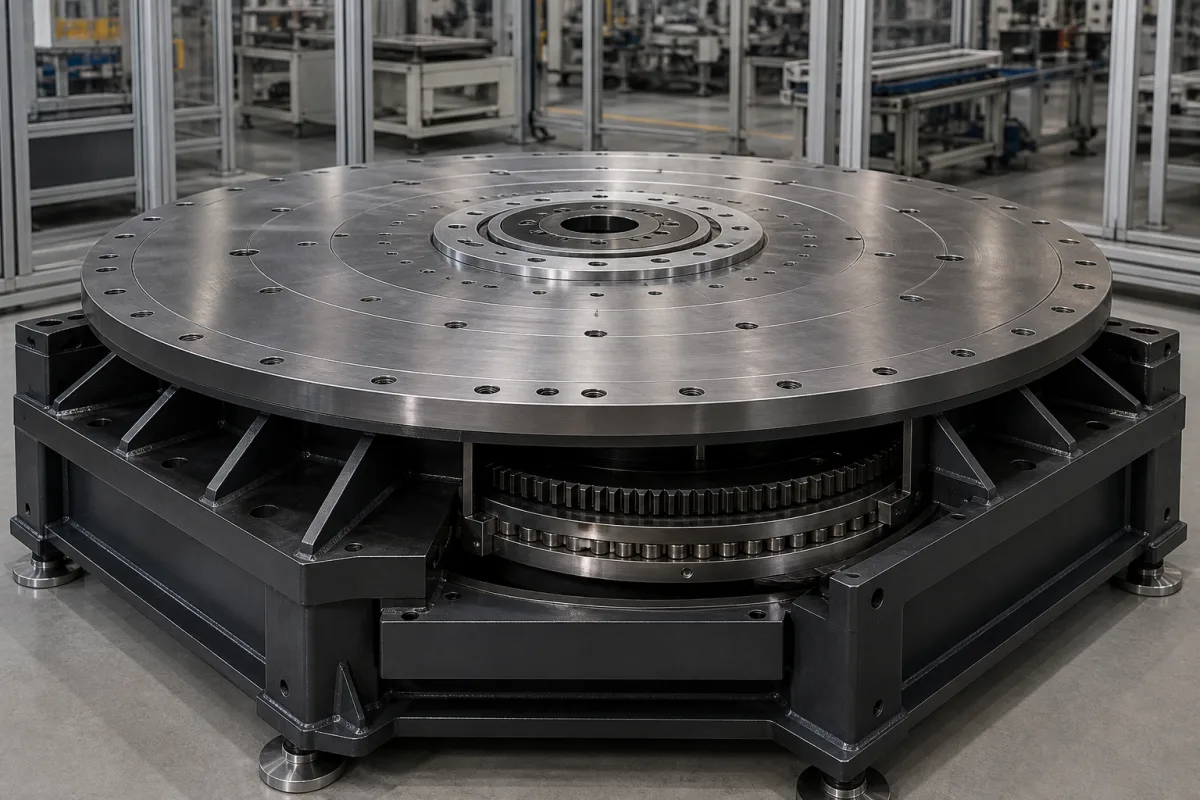
Rotating platform for carousels: slewing-ring turntable base
Carousel turntable bases on slewing rings · combined axial load and tilting moment, support flatness, geared ring and pinion drive, bolt preload and regreasing
A rotating platform for a carousel is a large flat deck bolted to one ring of a slewing bearing, with the other ring bolted to a fixed base frame and a pinion driving a gear cut into one of the rings. It carries the weight of everything on the deck and the tipping moment from off-centre loads, and turns slowly through full or part revolutions. Ask three things first: the axial load and tilting moment the platform must carry, how flat and stiff the base frame is under the bearing, and how the ring is bolted, driven and greased.
Carousel and turntable platforms supported on slewing rings (four-point ball, crossed roller and roller types), with geared ring and pinion drives, base frames and decks, specified by axial load, tilting moment, speed, support flatness, bolting and lubrication. CNC rotary tables and indexers, motorized precision rotary stages and hollow rotary tables for automation are covered on the Rotary table page. Rotating stage machinery for theatres, vehicle turntables sold as complete systems and drilling-rig rotary tables are outside this page.
CNFX editorial research · Sources checked October 12, 2026 · 3 sources
Size the slewing ring for combined load and tipping moment
Machine Design's introduction to slewing rings, prepared with information from Rotek, explains that one ring carries axial, radial and tilting moment loads together, and that some rings are used on turntables whose diameters are well beyond the bearing diameter, the moment capacity giving the stability. Catalogue capacities are non-simultaneous: the thrust capacity accounts for no moment or radial load, so combined loads must be turned into an equivalent load, for static raceway checks the load on the highest loaded rolling element. [3]
The same article advises selecting a ring on static capacity with an application service factor where slewing is intermittent with a broad spread of loads, and notes that dynamic capacity may govern in high-cycle use. For running torque under ideal conditions it uses a friction coefficient from 0.003 to 0.008 as a representative range and load distribution factors of 4.37 for balls and 4.1 for rollers, with starting torque about one-third above running torque. [3]
Speed is limited by ring type. SKF states that its four-point contact ball slewing bearings accept tangential speeds up to 4 m/s, while crossed cylindrical roller types are limited to approximately 1.5 m/s in continuous slewing and 2 m/s for brief periods. [1] Editorial calculation: on a 1,000 mm raceway, 4 m/s corresponds to about 76 rpm and 1.5 m/s to about 29 rpm.
Editorial note: for a carousel, list the deck mass, the heaviest load at the largest radius, the number of stations loaded at once and the start-stop cycle, so the supplier can calculate the resulting axial load and tilting moment against its static load curve.
Send the deck diameter and mass, payload per station and its radius, worst-case off-centre loading, rotation speed and angle, start-stop cycles per hour, drive type (pinion and motor), base frame drawing with flatness achievable, bolt size, indoor or outdoor use, and temperature range.
02
Make the base frame flat and stiff before bolting
SKF states that slewing bearings have limited rigidity because of their small cross-section relative to diameter, so the support structure should be designed for maximum axial and radial rigidity. It limits overall flatness of the support surface to tc = (dm + 1,000)/10,000 mm, where dm is the mean raceway diameter, limits flatness variation between consecutive measuring points to 0.0002 × n, and limits radial conicity to B/1,000 across the support width B. [1]
TGB's installation manual sets the maximum flatness deviation from the raceway diameter as δp = (Dr + 500)/10,000, reached only once in each 180° as a sine-like wave. [2] Editorial calculation: for a 1,000 mm raceway, SKF's formula allows 0.20 mm and TGB's 0.15 mm; follow the figure of the maker whose ring is fitted.
SKF requires machined support surfaces free from rust, paint or burrs and gives a roughness range printed as Ra = 3.2 to 6.3 mm, which reads as a unit misprint for micrometres; confirm with the maker. It names hexagon head bolts to DIN EN ISO 4014 in strength grade 10.9 for securing slewing bearings. [1]
TGB gives tightening torques for 10.9 metric bolts on non-lubricated threads from 15 ± 1 Nm (M6) and 126 ± 10 Nm (M12) to 609 ± 50 Nm (M20), and requires bolts to be preloaded crosswise in three steps of 30%, 80% and 100%, with thread locker on the last three to five threads. Bolts are retightened after no more than 100 hours of first operation, and its manual also says to retighten every 3 months; split rings and split washers are not permitted and bolts, nuts and washers are not reused. [2]
03
Plan regreasing for the platform's duty
TGB ties regreasing to speed and environment, for operating temperatures between −20 °C and 65 °C, linear speeds below 4 m/s and low to medium loads, and names insufficient lubrication as the cause of slewing ring failure it finds more than any other. [2]
Every 200 operating hours or once every 6 months [2]
Extreme climate or very dirty surroundings
Every 100 operating hours or once every 3 months [2]
SKF states that the permissible operating temperature of the slewing bearings in its catalogue is “determined primarily by the spacer and seal material and the grease used for lubrication” and “typically ranges from –25 to +70 °C.” [1] Gear teeth on the ring are greased separately; TGB describes brushing grease onto the teeth or using a lubricating pinion. [2]
04
Carousel platform data the slewing-ring maker will ask for
These are the order fields for a carousel platform, read against the slewing-ring sources above.
Field
What sets it
Ask the supplier for
Rated load capacity (kg)
Combined axial load and tilting moment, not axial alone. [3]
Static load curve with your load point.
Rotation speed (rpm)
Tangential speed limit by ring type, e.g. 4 m/s ball, 1.5 m/s crossed roller. [1]
Speed at raceway and gear.
Positioning accuracy (deg)
Pinion backlash and drive control.
Stated accuracy and stop method.
Repeatability (deg)
Drive and indexing device.
Value and test.
Drive motor power (kW)
Turning torque from friction and load; starting torque about one-third higher. [3]
Torque calculation.
Supply voltage (V AC)
Drive motor supply.
Voltage and frequency.
Operating temperature (°C)
−25 to +70 °C general case (SKF); −20 to 65 °C for TGB intervals. [1][2]
Range for seals and grease.
Protection rating
Seals and drive enclosure.
IP of drive; seal type.
Material
Ring steel such as C45 or 42CrMo4 in TGB codes. [2]
Slewing ring and rotating platform makers reviewed
Luoyang Tedin lists slewing bearings and a hollow rotating platform; ask whether it supplies the geared ring only or a complete turntable base.
TEDIN Bearing
Manufacturing site to be confirmed for the order
Lists slewing bearings for combined axial, radial and overturning loads, and a hollow rotating platform on crossed roller bearings with a helical gear stage.
Explore company information and manufacturing capabilities, then discuss the scope of your project with a relevant supplier.
Share this page
Compiled and source-reviewed by the CNFX editorial team.
Each manufacturer above links to the page on that company's own website where the product is listed, with the date we checked it. How we source and review
· Page last updated 13 October 2026
Buyer questions
Can I pick a slewing ring by its axial capacity alone?
No. Machine Design notes catalogue capacities are non-simultaneous; axial load and tilting moment must be combined into an equivalent load. [3]
How flat must the base be under a slewing ring?
SKF limits overall flatness to (dm + 1,000)/10,000 mm; TGB uses (Dr + 500)/10,000. For a 1,000 mm raceway that is 0.20 mm and 0.15 mm. [1][2]
How often should a carousel slewing ring be regreased?
TGB gives every 400 h or 12 months below 0.5 rpm, every 200 h or 6 months above it, and every 100 h or 3 months in extreme conditions. [2]
Sources and what still needs a direct check
Sources checked 2026-10-12. SKF and TGB publish catalogue and installation data for their own slewing rings; Machine Design's article was prepared with information from Rotek, a slewing ring maker.