Editorial Technical Reference

Rotary Carousel

This page explains how Rotary Carousel is classified within Beverage Manufacturing. Technical values and manufacturer relationships are research references; confirm the current specification and supplier evidence for each order.

Technical Definition & Core Assembly

A rotating platform component that holds and transports beverage bottles through the rinsing process in a high-speed rinsing machine.
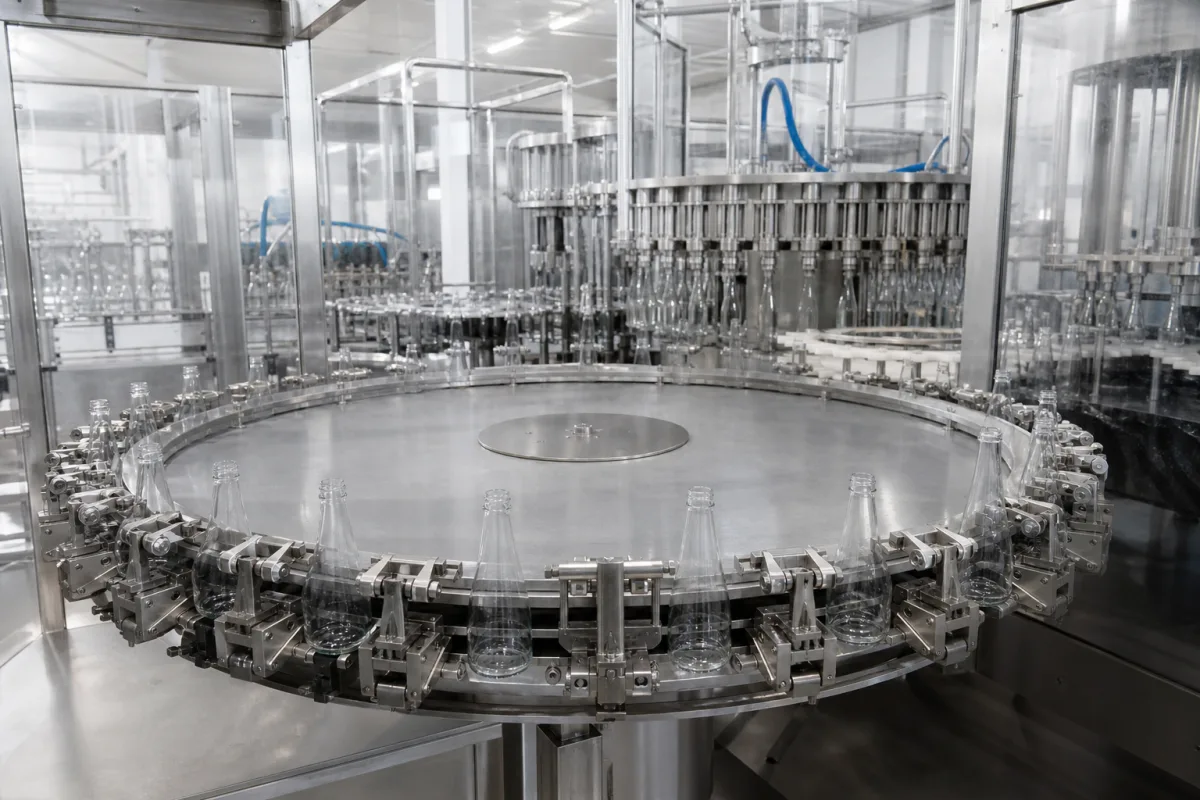
Representative product image. Confirm appearance and specifications with the manufacturer.

Product Specifications

Technical details and manufacturing context for Rotary Carousel

Definition
The Rotary Carousel is a critical component of the High-Speed Rotary Beverage Bottle Rinsing Machine, serving as the central rotating platform that securely holds multiple beverage bottles in designated positions. It systematically transports bottles through various rinsing stations (such as pre-rinse, main rinse, and final rinse zones) while maintaining precise positioning and timing synchronization with other machine components to ensure thorough and efficient cleaning. Constructed from stainless steel (grades 304 or 316L as per ASTM A240), the carousel is designed for durability and corrosion resistance in washdown environments. Its rated capacity ranges from 12,000 to 24,000 bottles per hour, depending on the carousel diameter (1200–2400 mm) and rotation speed (5–15 rpm). The drive power requirement is 1.5–5.5 kW, with a supply voltage of 380–480 V AC (three-phase, 50/60 Hz) per IEC 60038. Positioning accuracy is maintained within ±0.05 mm to ensure proper alignment with rinsing nozzles. The carousel operates in ambient temperatures of 5–40°C, with ingress protection rated IP54–IP65 per IEC 60529. The weight ranges from 800 to 2500 kg, increasing with diameter and material thickness. These specifications serve as reference ranges; actual values must be confirmed with the legal manufacturer or supplier for the specific model and application. The carousel is a component, not a standalone machine, and its integration requires careful consideration of the rinsing machine's overall design, including bottle handling, spray timing, and discharge operations.
Working Principle
The carousel rotates continuously or intermittently around a central axis, driven by an electric motor through a gear reduction system. Bottles are loaded onto the carousel at the entry station, then carried through sequential rinsing positions where nozzles spray cleaning solutions. The rotation speed and indexing are precisely controlled to coordinate with spray timing, bottle handling, and discharge operations. The carousel's positioning accuracy ensures that each bottle is correctly aligned with the nozzles at each station, allowing for effective rinsing. The drive system provides the necessary torque to handle the load, and the rotation speed is adjustable to match the required throughput. The carousel's design allows for integration with other machine components, such as infeed and outfeed conveyors, to create a continuous rinsing process.
Common Materials
Stainless Steel (304 or 316 grade)
Technical Parameters
ParameterTypical rangeNotes & selection driver
Rated Capacity12000–24000 bottles/hThroughput range for standard beverage lines
Carousel Diameter1200–2400 mmDetermines number of rinsing stations
Rotation Speed5–15 rpmHigher speeds reduce dwell time
Positioning Accuracy±0.05 mmEnsures proper alignment with rinsing nozzles
Drive Power1.5–5.5 kWDepends on load and speed
Supply Voltage380–480 V ACThree-phase, 50/60 HzIEC 60038
Operating Temperature5–40 °CAbove 40°C may require cooling
Ingress ProtectionIP54–IP65IP65 for washdown environmentsIEC 60529
Material Grade304–316L316L for corrosive mediaASTM A240
Weight800–2500 kgIncreases with diameter and material

Ranges are indicative industry figures for RFQ preparation, not a supplier commitment. Confirm every value and standard with the legal manufacturer before ordering.

Components / BOM
  • Rotating Platform
    Main structural component that holds bottle fixtures and rotates around central axis
    Material: Stainless Steel
  • Central Drive Shaft Part
    Transmits rotational force from motor to the carousel platform
    Material: Carbon Steel with Stainless Coating
  • Bottle Holding Fixtures
    Securely hold beverage bottles in position during rotation and rinsing
    Material: Food-Grade Plastic or Stainless Steel
  • Bearing Assembly
    Supports rotational movement and reduces friction between stationary and rotating parts
    Material: Stainless Steel with Food-Grade Lubricant
  • Drive Motor
    Turns the carousel; without it the platform and shaft do not move.
  • Gear Reduction System
    Steps the motor down to carousel speed and multiplies torque for the loaded platform.
  • Indexing Control
    Holds the angular position so each bottle stops square under its nozzle.

Industrial Ecosystem & Supply Chain Structure

Complementary Systems
Downstream Applications
Specialized Tooling

Application Fit & Sizing Matrix

Operational Limits
pressure: Atmospheric to 2 bar (max differential pressure across seals)
flow rate: Up to 1200 bottles per minute (depending on configuration)
temperature: +5°C to +40°C
slurry concentration: Not applicable - designed for clean-in-place (CIP) fluids and rinse water only
Media Compatibility
✓ Carbonated beverages (CO2 environment) ✓ Non-carbonated beverages (juices, water) ✓ Food-grade cleaning solutions (CIP chemicals)
Unsuitable: Abrasive slurries or particulate-laden fluids (would damage seals and bearings)
Sizing Data Required
  • Bottle diameter and height (mm)
  • Required throughput (bottles per minute)
  • Available floor space footprint (mm x mm)

Reliability & Engineering Risk Analysis

Failure Mode & Root Cause
Bearing fatigue failure
Cause: Inadequate lubrication, misalignment, or excessive loading leading to spalling and eventual bearing seizure.
Gear tooth wear/pitting
Cause: Contaminated lubricant, improper meshing, or cyclic overloading causing surface degradation and loss of transmission accuracy.
Maintenance Indicators
  • Unusual grinding or clicking noises during rotation
  • Visible wobble or excessive vibration during operation
Engineering Tips
  • Implement condition-based lubrication with high-quality synthetic grease and monitor bearing temperatures
  • Conduct laser alignment checks quarterly and install vibration monitoring sensors for early fault detection

Indicative industry ranges for design and RFQ preparation. Confirm the exact figures and applicable standard with the manufacturer before specifying.

Compliance & Manufacturing Standards

Applicable Standards
ISO 12100:2010 Safety of machinery - General principles for design - Risk assessment and risk reduction ANSI B11.19 Performance Requirements for Risk Reduction Measures: Safeguarding and Other Means of Reducing Risk CE Marking (Machinery Directive 2006/42/EC) for conformity with EU health, safety, and environmental requirements

Quoted from the published standard.

Manufacturing Precision
  • Bearing seat concentricity: +/-0.01mm
  • Indexing accuracy: +/-0.02 degrees
Quality Inspection
  • Runout test (radial and axial) to verify rotational precision
  • Load capacity and fatigue test under maximum rated conditions

Manufacturers of Rotary Carousel

Manufacturer profiles associated with Rotary Carousel.

Sourcing Rotary Carousel from China?
Tell us your specification and target quantity — we will match it against manufacturer records and come back with the factories that fit.
Request manufacturers We manufacture this

Manufacturer listings support early research and capability understanding. They are not certification, ranking, or transaction guarantees.

Technical documentation
Request current drawings, revision history, and a signed specification sheet.
Manufacturing capability
Verify equipment lists, process limits, capacity, and representative production evidence.
Inspection readiness
Confirm test methods, calibrated equipment, sampling plans, and traceable reports.
Supplier transparency
Check the legal entity, factory address, ownership, certifications, and direct contacts.

CNFX does not score or rank suppliers. Buyers must verify all claims and documents with the legal manufacturer before ordering.

Supply Chain Compatible Machinery & Devices

Automated Beverage Container Leak Detection System

The Automated Beverage Container Leak Detection System is an industrial device designed for integration into bottling or canning lines.

Explore Specs →
Automated Beverage Container Depalletizing Machine

Industrial machine that automatically removes beverage containers from pallets for production line feeding

Explore Specs →
Regeneration Section

A dedicated section within an industrial system designed to restore or renew the functional properties of materials, media, or components through controlled processes.

Explore Specs →
High-Speed Rotary Bottle Filling Machine

Automated industrial machine for precise liquid filling of beverage containers at high production rates.

Explore Specs →

Frequently Asked Questions

What is the Rotary Carousel used for?

The Rotary Carousel is a component of a high-speed rotary beverage bottle rinsing machine. It holds and transports bottles through various rinsing stations to ensure thorough cleaning.

What materials are used in the Rotary Carousel?

The carousel is typically made of stainless steel, with grades 304 or 316L as per ASTM A240. The specific grade depends on the application and corrosion requirements.

What are the key specifications to consider?

Key specifications include rated capacity (12,000–24,000 bottles/h), carousel diameter (1200–2400 mm), rotation speed (5–15 rpm), positioning accuracy (±0.05 mm), drive power (1.5–5.5 kW), supply voltage (380–480 V AC), operating temperature (5–40°C), ingress protection (IP54–IP65), and weight (800–2500 kg). These are reference ranges; confirm with the manufacturer.

How does the carousel achieve precise positioning?

The carousel uses a controlled drive system and indexing mechanism to maintain positioning accuracy within ±0.05 mm, ensuring proper alignment with rinsing nozzles at each station.

Data Basis

Editorial classification, named public sources where available, and source-reviewed manufacturer records.

Preliminary Technical Classification
This page supports structured research, RFQ preparation, and supplier evaluation. It does not replace buyer-led supplier qualification, standards review, or technical approval.
Buyer enquiry

Request manufacturing insight for Rotary Carousel

Ask for use case, specification boundaries, supplier type, and RFQ preparation information for this product.

Where it goes
Straight to the CNFX editorial desk, and to the manufacturer if this product is linked to a claimed profile. Nothing is broadcast to a supplier list.
Your details stay here
We do not sell or rent enquiry data, and we do not add you to a mailing list. Used only to answer this request.
No commission, no middleman
CNFX is a directory. We take no cut of any order and never negotiate on a supplier's behalf.
What we don't claim
A listing is not an endorsement. Qualify every supplier and verify every figure yourself before ordering.

Your business information is used only to process this request.

Thank you! Your message has been sent. We'll respond within 1–3 business days.
Sorry, we couldn't send your message. Please try again, or email us at contact@cnfx.com.

Need to Manufacture Rotary Carousel?

Compare manufacturer profiles with relevant product and process capability.

Previous Product
Vacuum Gripper End-Effector
Last Product
Get QuotesChat