Industry-Verified Manufacturing Data (2026)

Spray Nozzle Assembly

Based on aggregated insights from multiple verified factory profiles within the CNFX directory, the standard Spray Nozzle Assembly used in the Machinery and Equipment Manufacturing sector typically supports operational capacities ranging from standard industrial configurations to heavy-duty production requirements.

Technical Definition & Core Assembly

A canonical Spray Nozzle Assembly is characterized by the integration of Nozzle Tip / Orifice and Fluid Cap / Body. In industrial production environments, manufacturers listed on CNFX commonly emphasize Stainless Steel (e.g., 303, 316) construction to support stable, high-cycle operation across diverse manufacturing scenarios.

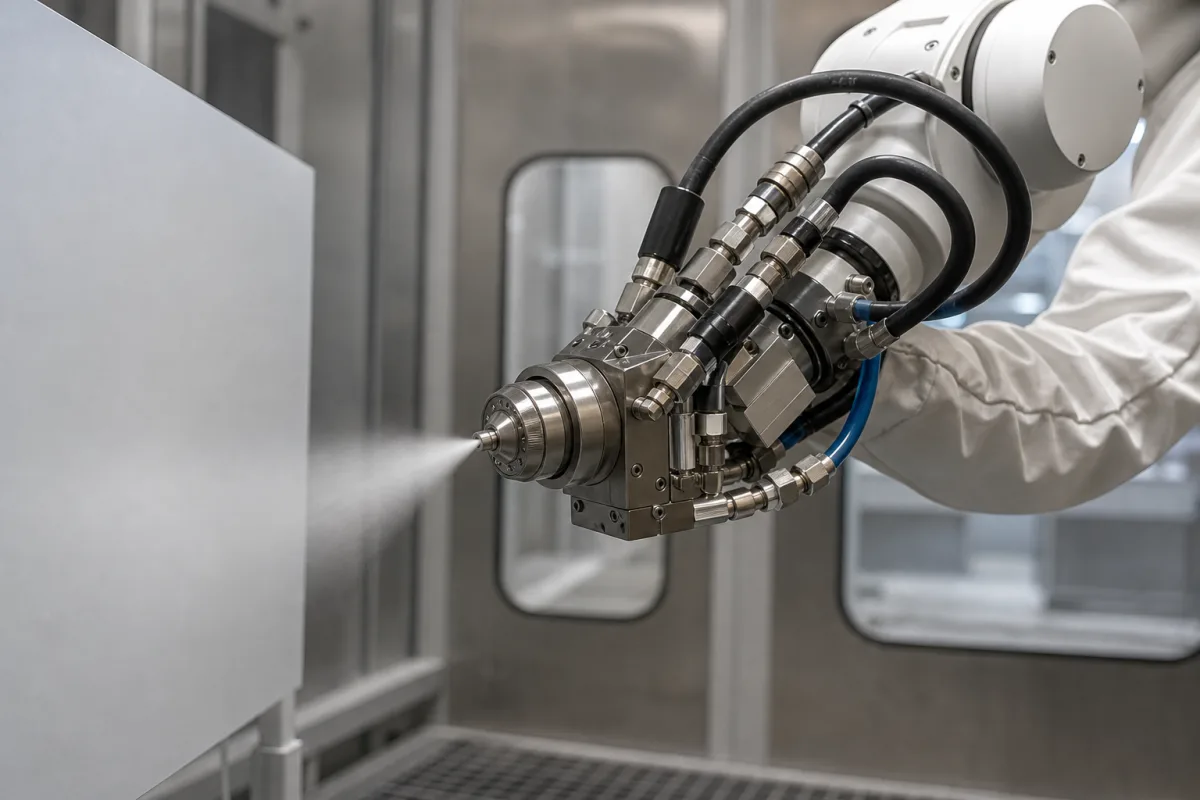
A precision assembly that atomizes and directs coating materials onto surfaces as part of an automated robotic spraying system.
Product Specifications

Technical details and manufacturing context for Spray Nozzle Assembly

Definition
The spray nozzle assembly is a critical component of the Robotic Coating Spray Arm responsible for the final stage of material application. It precisely controls the atomization, flow rate, spray pattern, and direction of liquid coatings (such as paints, sealants, or protective films) onto target surfaces, ensuring uniform coverage and finish quality in automated industrial processes.
Working Principle
Coating material is fed under pressure into the assembly. Internal components, typically including a nozzle tip, fluid cap, and air cap (in air-assisted systems), work together to break the liquid stream into fine droplets (atomization). The geometry of these components and the control of fluid/air pressure determine the spray pattern (e.g., fan, cone) and droplet size, which is then directed onto the workpiece by the robotic arm's positioning.
Common Materials
Stainless Steel (e.g., 303, 316), Hardened Tool Steel, Tungsten Carbide, Ceramic (e.g., Alumina)
Technical Parameters
  • Orifice diameter of the nozzle tip, critical for determining flow rate and influencing droplet size. (mm) Customizable
Components / BOM
  • Nozzle Tip / Orifice
    Forms the final exit point for the fluid, defining the orifice diameter and influencing atomization.
    Material: Tungsten Carbide or Hardened Steel
  • Fluid Cap / Body
    Houses the nozzle tip and directs fluid flow into it. Provides the main connection to the fluid supply.
    Material: Stainless Steel
  • Air Cap (for air-assisted models)
    Directs compressed air around the fluid stream to assist in atomization and shape the spray pattern.
    Material: Stainless Steel or Brass
  • Seals / Gaskets
    Ensure leak-proof connections between components and to the fluid supply.
    Material: PTFE (Teflon), Viton, or Buna-N
Engineering Reasoning
3.5-8.0 bar (50-115 psi) at 0.8-2.2 L/min flow rate
Cavitation occurs at 0.35 bar (5 psi) pressure drop across orifice, material fatigue at 10^7 cycles at 6.9 MPa (1000 psi) stress
Design Rationale: Cavitation-induced erosion from Bernoulli's principle (P1-P2 > 0.5ρv^2) and high-cycle fatigue from Von Mises stress exceeding yield strength (σ_vm > 345 MPa for 316L stainless)
Risk Mitigation (FMEA)
Trigger Particulate contamination > 15 μm in fluid stream
Mode: Orifice erosion increasing diameter by 0.1 mm, causing 25% flow deviation
Strategy: Install 10 μm absolute filtration with differential pressure monitoring at 0.7 bar (10 psi) threshold
Trigger Solvent evaporation during idle periods (30+ minutes)
Mode: Polymerized material buildup reducing effective orifice area by 40%
Strategy: Implement automatic solvent purge cycle every 15 minutes of inactivity

Industry Taxonomies & Aliases

Commonly used trade names and technical identifiers for Spray Nozzle Assembly.

Applied To / Applications

This component is essential for the following industrial systems and equipment:

Industrial Ecosystem & Supply Chain DNA

Complementary Systems
Downstream Applications
Specialized Tooling

Application Fit & Sizing Matrix

Operational Limits
pressure: 0.5 to 10 bar
flow rate: 0.1 to 5.0 L/min
temperature: -20°C to 120°C
slurry concentration: Up to 25% solids by weight
Media Compatibility
✓ Water-based paints ✓ Solvent-based coatings ✓ Adhesive sealants
Unsuitable: Abrasive slurries with >25% solids or corrosive acids
Sizing Data Required
  • Required flow rate (L/min)
  • Desired spray pattern width (mm)
  • Operating pressure (bar)

Reliability & Engineering Risk Analysis

Failure Mode & Root Cause
Clogging
Cause: Accumulation of particulate matter, mineral deposits, or chemical residues from the fluid stream, often due to inadequate filtration or incompatible fluid chemistry.
Wear/Deformation
Cause: Abrasive erosion from suspended solids in the fluid, cavitation due to pressure drops, or chemical corrosion from aggressive media, leading to altered spray patterns and reduced efficiency.
Maintenance Indicators
  • Irregular or asymmetric spray pattern (e.g., streaking, uneven distribution)
  • Unusual noises such as hissing, whistling, or rattling during operation, indicating internal damage or blockage
Engineering Tips
  • Implement a routine preventive maintenance schedule including inspection, cleaning, and replacement of filters to prevent clogging and minimize abrasive wear.
  • Optimize operating parameters (pressure, flow rate) within the nozzle's specified range to avoid cavitation and excessive stress, and select nozzle materials compatible with the fluid's chemical properties.

Compliance & Manufacturing Standards

Reference Standards
ISO 9001:2015 - Quality management systems ANSI/ASME B46.1-2019 - Surface Texture (Surface Roughness, Waviness, and Lay) DIN 19569-10:2016 - Wastewater treatment plants - Principles for the design of structures and technical equipment
Manufacturing Precision
  • Bore diameter: +/-0.02mm
  • Thread concentricity: 0.05mm TIR (Total Indicator Runout)
Quality Inspection
  • Flow rate and spray pattern test
  • Pressure decay leak test

Factories Producing Spray Nozzle Assembly

Verified manufacturers with capability to produce this product in China

✓ 95% Supplier Capability Match Found

S Sourcing Manager from Brazil Jan 24, 2026
★★★★★
"Reliable performance in harsh Machinery and Equipment Manufacturing environments. No issues with the Spray Nozzle Assembly so far."
Technical Specifications Verified
P Procurement Specialist from Canada Jan 21, 2026
★★★★☆
"Testing the Spray Nozzle Assembly now; the technical reliability results are within 1% of the laboratory datasheet. (Delivery took slightly longer than expected, but technical support was excellent.)"
Technical Specifications Verified
T Technical Director from United States Jan 18, 2026
★★★★★
"Impressive build quality. Especially the technical reliability is very stable during long-term operation."
Technical Specifications Verified
Verification Protocol

“Feedback is collected from verified sourcing managers during RFQ (Request for Quote) and factory evaluation processes on CNFX. These reports represent historical performance data and technical audit summaries from our B2B manufacturing network.”

14 sourcing managers are analyzing this specification now. Last inquiry for Spray Nozzle Assembly from Vietnam (1h ago).

Supply Chain Compatible Machinery & Devices

Hydraulic Press

Industrial machine using hydraulic pressure to compress, form, or assemble materials

Explore Specs →
Heavy-Duty CNC Plasma Cutting Machine

Industrial machine for precision metal cutting using plasma arc technology

Explore Specs →
Automated Assembly Line System

Integrated production system for sequential component assembly operations

Explore Specs →
Automated Powder Coating System

Integrated industrial system for applying dry powder coatings to metal substrates.

Explore Specs →

Frequently Asked Questions

What materials are best for corrosive coating applications?

For corrosive environments, 316 stainless steel or ceramic (alumina) nozzle assemblies offer superior chemical resistance compared to standard 303 stainless steel or tool steel options.

How do I maintain consistent atomization in automated spraying systems?

Ensure proper alignment of air caps and nozzle tips, regularly inspect seals/gaskets for wear, and follow manufacturer specifications for pressure and fluid viscosity to maintain consistent spray patterns.

What factors determine nozzle tip replacement frequency?

Replacement frequency depends on material abrasiveness, operating pressure, and hours of use. Tungsten carbide tips last longest for abrasive materials, while regular inspection for wear patterns helps optimize maintenance schedules.

Can I contact factories directly on CNFX?

CNFX is an open directory, not a transaction platform. Each factory profile provides direct contact information and production details to help you initiate direct inquiries with Chinese suppliers.

Get Quote for Spray Nozzle Assembly

Request technical pricing, lead times, or customized specifications for Spray Nozzle Assembly directly from verified manufacturing units.

Your business information is encrypted and only shared with verified Spray Nozzle Assembly suppliers.

Thank you! Your message has been sent. We'll respond within 1–3 business days.

Need to Manufacture Spray Nozzle Assembly?

Connect with verified factories specializing in this product category

Add Your Factory Contact Us
Previous Product
Spray Nozzle / Distribution Tray
Next Product
Spray Nozzle/Head