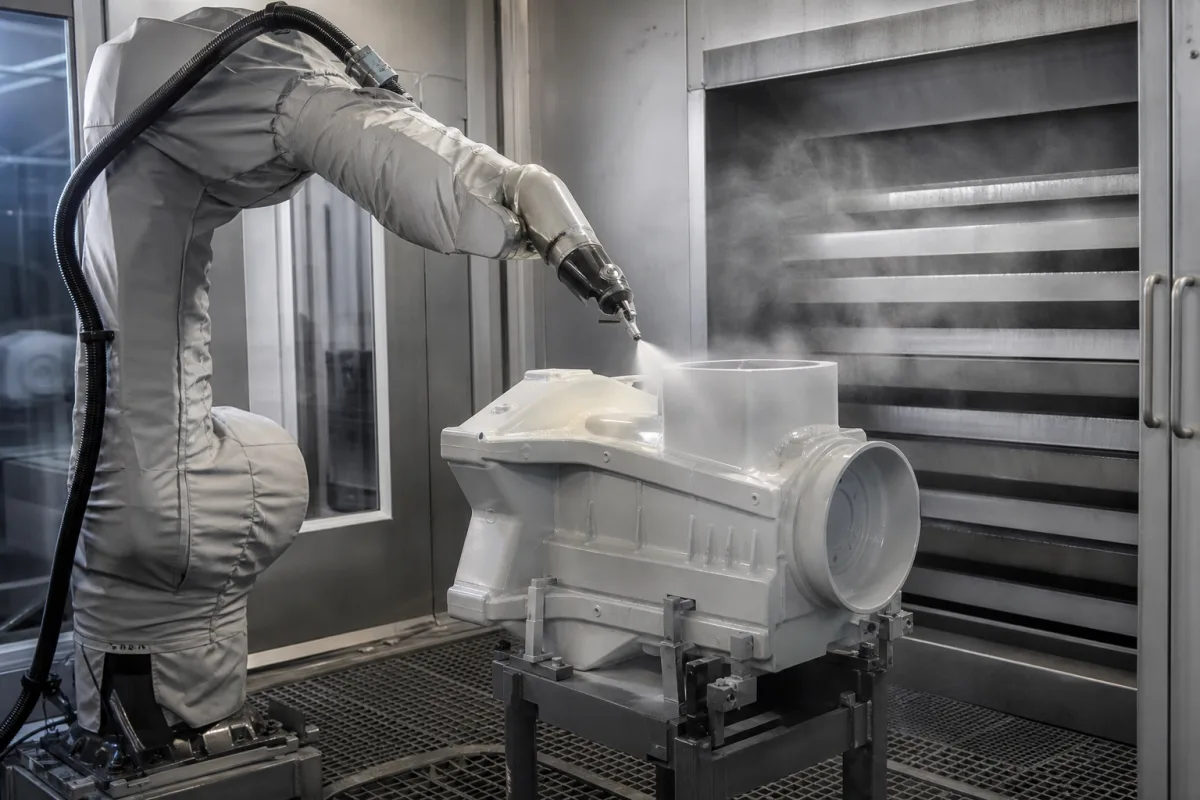
Robotic coating spray arm for foundry sand cores and moulds: spraying refractory core wash with an explosion-protected robot
Foundry core and mould washes applied by robot · water versus alcohol carriers, Baumé control, explosion-protected arms and the spray-area rules that follow from a flammable carrier
Sand cores and moulds are coated with a refractory wash before metal is poured, to stop the metal penetrating the sand and to give a clean casting skin. Done by robot, the arm carries a spray gun fed with a slurry of refractory filler in water or alcohol, and has to put an even layer into pockets and onto vertical walls of the core. The choice of carrier shapes the cell: an alcohol wash dries fast but turns the booth into a flammable spraying area, and the robot has to be built for it.
Robot arms and robot spray cells that apply refractory coatings (core and mould washes) to foundry sand cores and moulds, with their spray guns, coating supply and booth. Automatic spray units that apply die lubricant and blow-off air on high pressure die casting machines are covered on the Automated mold spraying and cooling system page; servo spray manipulators for graphite lubricant on hot forging dies on the Spray manipulator page; chillers and temperature control units for moulding tools on the Mould cooling unit for plastic and rubber moulding machines page. The sand cores themselves are covered on the Casting core (foundry sand core) page. Dip and flow coating of cores, and the coating chemistry itself, are outside this page except where compared.
CNFX editorial research · Sources checked October 13, 2026 · 4 sources
What the arm sprays: water-based and alcohol-based core washes and their Baumé
Hill and Griffith's PYROSEAL 120 is an example of the water-based side: a talc and bentonite refractory coating for ferrous and non-ferrous castings, usable on small intricate cores up to heavy cores and moulds, supplied ready to use at 80 °Baumé and thinned with trim water to the working Baumé. The data sheet lists refractoriness up to 3000 °F, anti-sag properties on vertical sidewalls, air, oven or soft-flame torch drying, and use on no-bake, shell, hot box, cold box, oil and sodium silicate cores; it carries a note not to substitute alcohol for water. [1] Editorial calculation: 3000 °F is about 1,650 °C.
For alcohol-based coatings, an ASK Chemicals expert writing in Foundry Management & Technology explains that these products arrive as heavy slurries diluted with alcohol, in 99% or 91% purity grades; 99% alcohol dries faster and is more flammable, while 91% alcohol carries about 9% water, which slows drying. Diluting a coating made with 99% isopropyl alcohol using 91% alcohol can raise its viscosity instead of lowering it; in the article's example, reaching the same working Baumé of 70 degrees with 91% alcohol leaves percent solids and density well below target, so less refractory reaches the core. [2]
For a spray robot this means the coating fed to the gun has to be held at a measured Baumé and density with the solvent the coating was formulated for; the robot program alone cannot correct a wash that was thinned with the wrong carrier. [2][1]
The image shows a robot arm in a fabric protective cover spraying white coating onto a large core or mould on a fixture, in a booth with a filter wall behind. Ask which carrier the cell is designed for, and whether the coating supply measures Baumé or density before it reaches the gun.
02
An alcohol carrier makes it a flammable spraying area: Class I equipment, 20 ft separation and 100 ft/min airflow
Under OSHA's spray finishing rule, 29 CFR 1910.107, a spraying area is any area where dangerous quantities of flammable vapours or mists, or combustible residues, are present because of spraying. Electrical equipment in it must be explosion-proof for Class I, Group D under the Class I, Division 1 rules; equipment outside but within 20 feet, without a partition, must not spark in normal operation and must meet Class I, Division 2. [3]
The same section bars open flames and spark-producing equipment in a spraying area or within 20 feet unless a partition separates them, and requires mechanical ventilation that keeps running during spraying and long enough afterwards to exhaust vapours from drying parts. In a dry spray booth with overspray filters, the average air velocity over the open face must be at least 100 linear feet per minute, or 60 for electrostatic spraying. [3] Editorial calculation: 20 feet is about 6.1 m and 100 ft/min about 0.51 m/s.
Editorial note: torch or flame drying, which the PYROSEAL 120 sheet allows for that water-based wash, has to be planned outside this 20 ft zone if the same cell ever sprays an alcohol-based coating. [1][3]
03
What an explosion-protected spray arm brings: Ex approval, wrist sealing and repeatability
ABB's IRB 5500-27 paint robot data sheet shows the specification an arm working in such a zone carries: explosion protection by Ex i, Ex p and Ex c for installation in Zone 1 and Zone 21 in Europe and in Division I, Class I and II, a 13 kg wrist payload, IP66 protection with an IP54 wrist, seven axes, and a static repeatability of 0.15 mm measured to ISO 9283. [4]
The data sheet gives an ambient range of 0 to +40 °C for the robot with a recommended maximum below 30 °C, and states that solutions for both solvent-borne and water-borne paint are available, with paint pumps mounted as close as 15 cm to the wrist to cut waste at colour change. [4]
Editorial note: this is an automotive paint robot used here as a published example of Ex ratings and repeatability; a refractory wash is a filled slurry, so ask the cell builder how the pumps, valves and gun are protected against the abrasive filler and settling, and how the arm's cover is changed when coating builds up on it.
Cores, coating and booth data for a robotic core-wash cell
Paste it into your enquiry below or into an email to a maker, then replace every bracket.
Cores/moulds: [largest size and weight; pockets and vertical walls to coat; fixture or robot-held]
Coating: [product; water or alcohol carrier; working Baumé/density; diluent]
Rate: [cores per hour; coats per core]
Booth: [dry filter or water-wash; face velocity; Ex zone]
Robot: [Ex approval; reach; payload; protective cover]
Drying: [air, oven or torch; location]
Explore company information and manufacturing capabilities, then discuss the scope of your project with a relevant supplier.
Share this page
Compiled and source-reviewed by the CNFX editorial team.
Each manufacturer above links to the page on that company's own website where the product is listed, with the date we checked it. How we source and review
· Page last updated 13 October 2026
Buyer questions
Can a water-based core wash be thinned with alcohol?
Hill and Griffith's PYROSEAL 120 data sheet says not to substitute alcohol for water; it is thinned with trim water from 80 °Baumé. [1]
Why does the alcohol grade matter when diluting a core coating?
ASK Chemicals explains that 91% alcohol carries about 9% water, and using it on a coating made with 99% IPA can raise viscosity and leave solids and density low at a 70 °Baumé working level. [2]
What booth rules apply when a robot sprays alcohol-based coating?
Under 29 CFR 1910.107, electrical equipment in the spraying area must meet Class I, Division 1, equipment within 20 ft Division 2, and a dry booth needs at least 100 ft/min face velocity. [3]
What explosion protection does a paint robot carry?
ABB lists Ex i, Ex p and Ex c protection for Zone 1 and Zone 21 and Division I, Class I and II on its IRB 5500-27, with 0.15 mm repeatability to ISO 9283. [4]
Sources and what still needs a direct check
Sources checked 2026-10-13. A US coating supplier's data sheet for a water-based core wash, an ASK Chemicals expert answer in Foundry Management & Technology on alcohol dilution, the OSHA spray finishing regulation, and an ABB paint robot data sheet.