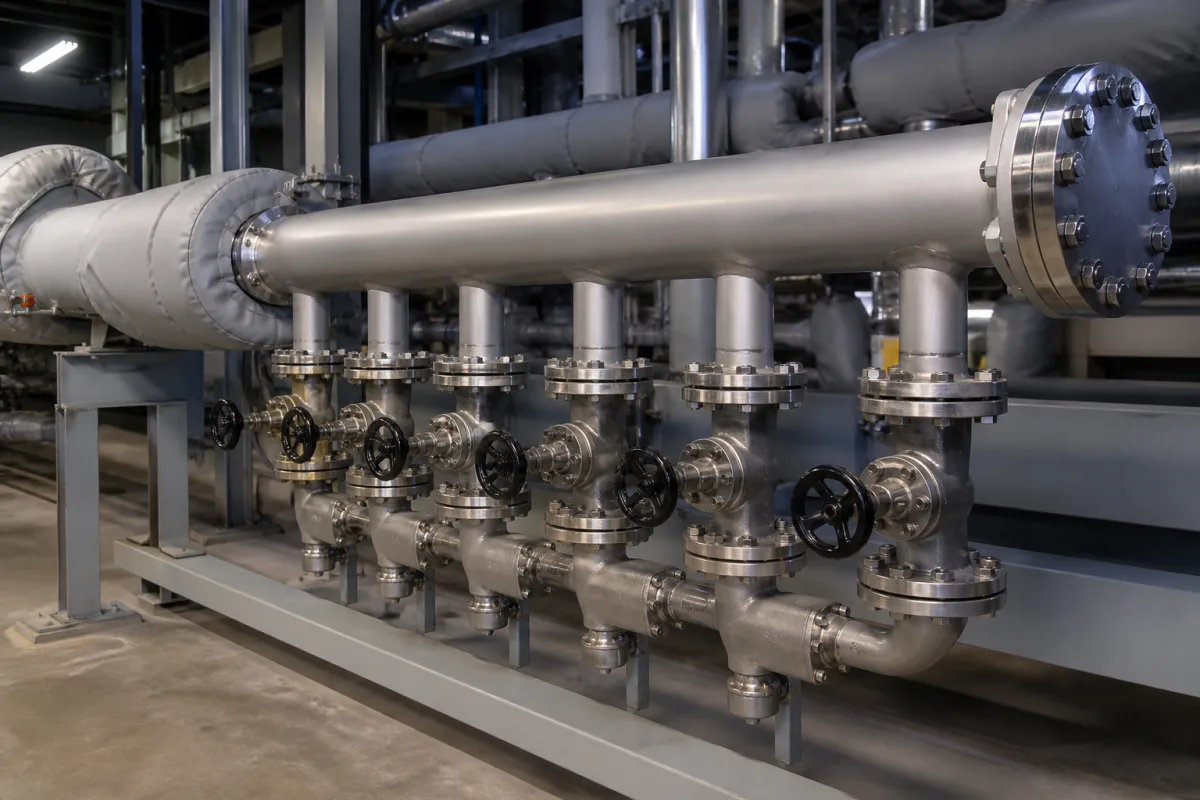
Boiler house steam manifold · Header velocity and size, off-takes and drainage, load sharing between boilers, warm-up
A steam distribution header is a large-bore pipe or vessel — Spirax Sarco describes a steam manifold “usually referred to as the main distribution header” — into which one or more boilers discharge and from which steam is distributed through valved branches to plant mains and users. Ask three things first: what steam flow, pressure and velocity it is sized for, how its off-takes, drains and isolation valves are arranged, and how it is brought on line and shares load between boilers.
Steam headers and distribution manifolds in boiler houses and plant rooms, with their off-take valves, drains and connections. Boiler steam drums, steam traps, separators and pressure reducing stations are covered elsewhere or outside this page, as are condensate and water manifolds.
CNFX editorial research · Sources checked October 12, 2026 · 4 sources
Size the header, take steam from the top and drain the bottom
Spirax Sarco's boiler house tutorial says the header diameter should be calculated for a maximum steam velocity of 15 m/s at full load, because low velocity helps entrained moisture fall out. Off-takes should always be from the top of the header, so that condensate falls to the bottom and only dry steam is exported, and condensate should be removed as soon as it forms; for this, "a mechanical trap, for instance a float trap, is the best choice". If the header is the first trapping point after the boilers, the trap may be drained to the blowdown vessel rather than the feedtank, because the condensate can contain carryover. [1]
For pipework beyond the header, Spirax Sarco's pipe sizing module states that "as a general rule, a velocity of 25 to 40 m/s is used when saturated steam is the medium", treats 40 m/s as a practical limit, notes that "in longer supply lines, it is often necessary to restrict velocities to 15 m/s to avoid high pressure drops", and works an example in which 5,000 kg/h of dry saturated steam at 7 bar g needs a 130 mm bore at 25 m/s, so a 150 mm pipe is selected. [2]
Editorial calculation: at the same mass flow and pressure, required bore scales with the square root of the velocity ratio, so the 5,000 kg/h at 7 bar g example sized at the header's 15 m/s needs about 130 × √(25/15) ≈ 168 mm bore. [2][1]
The header should be designed for the boiler operating pressure; Spirax Sarco notes that flange ratings fall with temperature, so a PN16 flange rated 16 bar at 120 °C is only suitable for up to 13.8 bar saturated steam (198 °C). [1]
Give the supplier the number of boilers and their outputs, design pressure and temperature, total and branch steam flows, number, sizes and positions of inlets and off-takes, drain and trap arrangement, isolation and non-return valves, pressure relief and instrument connections, supports, insulation, material and the design code and inspection required.
02
Compare header velocity limits between two boiler-house references
Boiler maker Fulton publishes the velocity basis its engineers use to size near-boiler steam piping, including the steam header, from the total horsepower of all boilers that can run at once and the operating pressure. It suggests 4,500 ft/min for near-boiler piping and explains what happens at higher velocities. [4]
Editorial calculation: Spirax Sarco's 15 m/s header limit above is about 2,950 ft/min, two-thirds of Fulton's 4,500 ft/min. For the same mass flow and pressure, bore scales with the square root of the velocity ratio, so a header sized at 15 m/s has about 1.23 times the bore of one sized at 22.9 m/s (√(22.86/15)); in Spirax Sarco's 5,000 kg/h at 7 bar g example, about 136 mm bore at Fulton's 4,500 ft/min against about 168 mm at 15 m/s. [4][1][2]
The two references size for different aims: Fulton links the upper velocities to water carry-over from the boiler water line, Spirax Sarco uses a low header velocity so entrained moisture can fall out to the drain. State which velocity basis the header supplier used, and give the combined output of every boiler that can run at the same time. [4][1]
Fulton velocity
Editorial conversion
Fulton's description
4,500 ft/min
22.9 m/s
Ideal top-end velocity: efficient, dry steam with allowance for some upset water conditions [4]
5,000 ft/min
25.4 m/s
A good velocity "as long as the boiler is maintianed [sic] often", with water chemistry within the maker's guidelines and piping to good practice [4]
5,500 ft/min
27.9 m/s
Could cause some bouncing along the water line even in a well-maintained, well-piped system [4]
6,000 ft/min
30.5 m/s
Water line bounces and is unstable; water discharges with the steam, with possible low-water cut-out alarms and water hammer [4]
03
Lay out the header so boilers share load
Spirax Sarco explains that a “common header” fed from boilers along its length and discharging at one end lets the boilers nearest the off-take discharge more steam: it states that "typically, if boiler number 1 is fully loaded, number 2 will be around 1% overloaded, number 3 around 6%, and number 4 around 15% overloaded", which can make the water level unstable and lock the boiler out. It aims for pressure drops from each boiler outlet to the plant off-take within 0.1 bar. [1]
A header discharging from the centre keeps any boiler from being overloaded by more than 1% if the pipework is properly sized, and a branching "family tree" arrangement is recommended for four or more heavily loaded boilers with sequencing control. Where two or more boilers share a header, a second lockable stop valve is fitted in each boiler connection, and a non-return function is needed; simple flap non-return valves can oscillate and cyclically overload boilers. [1]
Spirax Sarco adds that a well-designed boiler under steady load produces steam with a dryness fraction of about 96–99%, and recommends a separator close to the boiler; the header gives an extra separating function if that separator is overwhelmed. [1]
04
Bring the header and mains on line slowly
Spirax Sarco warns that warm-up must avoid waterhammer, thermal shock and priming. A boiler main stop valve has a flat seat and passes about 80% of its capacity in the first 10% of its movement, so on larger plants a control valve after the stop valve, or a small control valve in a loop around an isolation valve, gives a controlled warm-up. [1]
For the mains leaving the header, Spirax Sarco advises a fall of at least 1:100 in the direction of flow (1:40 where lines rise), drain points every 30–50 m and at low points, and, "as a general rule", sizing branch lines of not more than 10 m on 25–40 m/s; where a main must rise against the flow, it suggests a velocity of no more than 15 m/s. [3]
05
One fabricator listing headers as sub-cylinders
Jiangsu Prettech is the company shown below; its page lists steam distribution headers, which it calls sub-cylinders.
The supplier reviewed builds headers (sub-cylinders) alongside tanks and heat exchangers; ask for the design code, calculations, material certificates and pressure test report.
06
Body, inlets, off-takes, valves, drain, relief and supports
Inlet positions belong on this list because, as the load-sharing section shows, where the boilers join the header decides how evenly they share load.
Part
Role
Fix in the order
Header body
Collects and distributes steam at low velocity. [1]
Bore, design pressure, outlets and material for the quotation
Boiler outputs, flows and off-take positions come from your plant. Spirax Sarco supplies the sizing rules in the middle column; shell thickness and material come from the pressure equipment code.
1 company lists this product among what they make. Company figures are quoted from each
company's own website; every card states where the relationship came from.
Jiangsu Prettech Machinery & Technology Co., Ltd.
Manufacturing site to be confirmed for the order
Lists steam distribution headers (sub-cylinders) alongside tanks and shell-and-tube heat exchangers.
Explore company information and manufacturing capabilities, then discuss the scope of your project with a relevant supplier.
Share this page
Compiled and source-reviewed by the CNFX editorial team.
Each manufacturer above links to the page on that company's own website where the product is listed, with the date we checked it. How we source and review
· Page last updated 13 October 2026
Buyer questions
What velocity should a steam header be sized for?
Spirax Sarco sizes boiler-house headers for a maximum of 15 m/s at full load so moisture can fall out. [1]
Why are off-takes taken from the top of a steam header?
So condensate falls to the bottom and is drained, and only dry steam is exported. [1]
How should a multi-boiler header be laid out?
Spirax Sarco recommends discharging from the centre, or a branching arrangement, so pressure drops stay within 0.1 bar and boilers share load. [1]
Sources and what still needs a direct check
Sources checked 2026-10-12. Spirax Sarco is a steam equipment maker; its learning modules give its engineering guidance. Your header's design must follow the pressure equipment code that applies at site. Fulton, a boiler maker, publishes the velocity basis it uses for near-boiler steam headers.