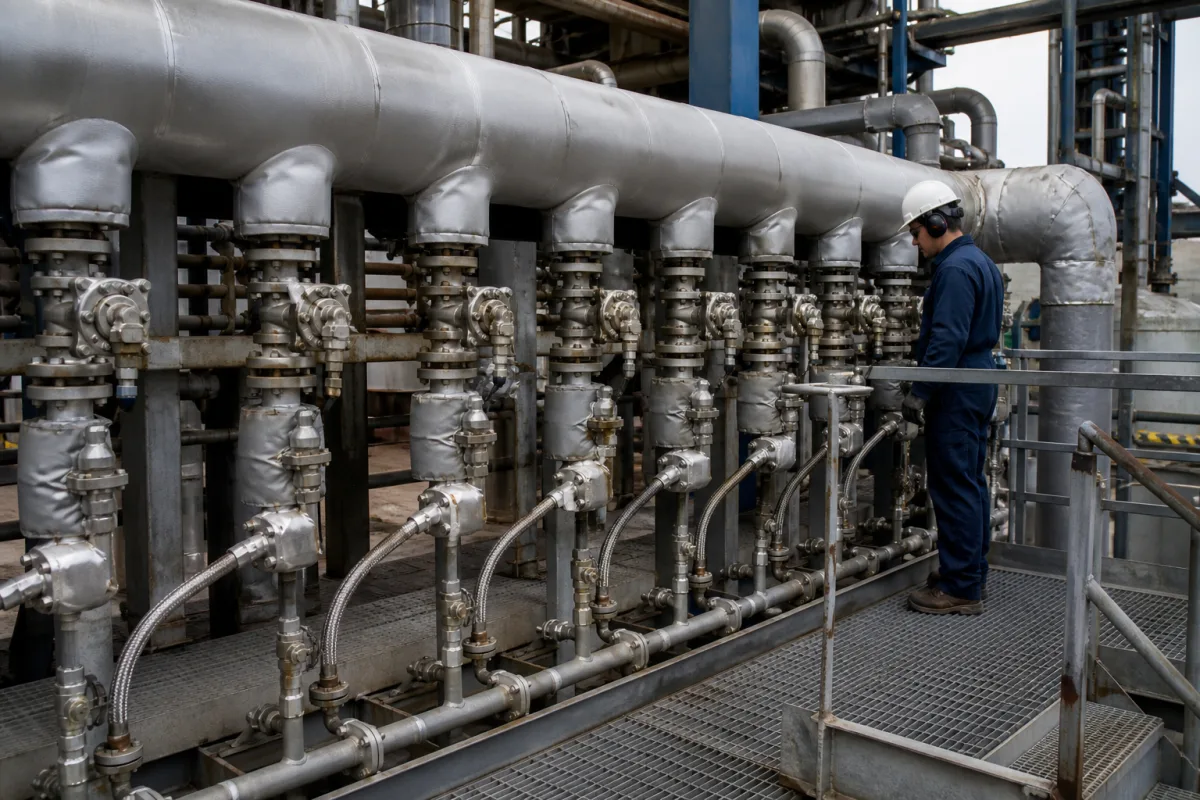
Steam distribution manifold (the forged manifold that feeds steam tracer lines, and its condensate collection partner)
Steam tracing manifolds · forged steam distribution manifolds with a valve per tracer line, condensate collection manifolds with siphon tube and trap stations, blowdown and freeze protection, station counts and pressure ratings
Steam tracing keeps product lines warm with small steam tubes run along them, and every tracer needs its own supply valve and its own trap. A steam distribution manifold groups the supply valves in one place, and a matching condensate collection manifold groups the traps. Order them as a pair: count the tracer lines, decide how each station isolates and drains, and settle how the condensate side handles flash steam and frost.
Steam distribution manifolds and condensate collection manifolds for steam tracing and pipeline drainage, with their station valves, siphon tubes, trap stations, drains, blowdown and insulation jackets. Boiler-house steam headers are covered on the Steam distribution header (steam manifold) page; the traps on the Steam trap page; drain pockets on steam mains on the Drip leg on a steam main page; duct humidifier steam manifolds on the Steam dispersion manifold and multi-tube header panel for duct humidification page.
CNFX editorial research · Sources checked October 12, 2026 · 4 sources
GESTRA describes steam tracing as used "primarily to maintain a reasonable product temperature and viscosity in order to simplify pumping and avoid freezing, solidification and stagnation", and notes that "Although the rates of condensate are relatively small, steam trap populations will be large since all tracer lines need to be individually trapped." Condensate from those traps is collected in a manifold, and steam to the tracers can be distributed through a similar one. [3] Forbes Marshall puts it the same way: steam manifolds give "centralised distribution of steam to multiple tracers", condensate manifolds are "central collection points", and both have a valve for each tracer. [4]
Spirax Sarco's view is that "The modern method of manifolding is to purchase the manifold as a standard piece of equipment just like buying a steam trap", with an optional insulation jacket and mounting kit for tracing. [1]
02
Supply side: one isolating valve per tracer line
Spirax Sarco's MSC distribution manifolds are designed for vertical installation; "The forged distribution bodies have integral piston valves providing easy isolation of your tracing lines", so each line can be isolated, depressurised and maintained, and "In order to prevent corrosion, steam distribution manifolds are most commonly sold with a bottom drain valve." [1] TLV's VSDM steam distribution manifold and VCCM condensate collection manifold are carbon steel (A53 Gr.B body, A105 station connections), "ASME code certified with a U1 stamp", with a built-in blowdown and freeze protection connection; its dimension table lists 6, 8, 10 and 12 station sizes with weights from 18 to 61 lb across the two manifolds. [2]
Count the tracer lines per manifold, then add spare stations; state steam pressure and temperature, connection type (screwed, socket weld, flanged) and whether insulation jackets are wanted.
03
Condensate side: siphon tube, trap stations and freeze protection
Spirax Sarco's standard condensate collection manifolds include "an internal siphon pipe to promote even temperature distribution and ensure single-phase discharge of condensate", which it says also helps prevent corrosion, freezing and damage. [1] TLV's "Full 1” siphon construction on the 3” VCCM manifold reduces back pressure and prevents destructive two-phase flow into condensate return piping", and consolidating traps on the manifold "allows lower installation heights, making traps more accessible, easier to install, isolate, test and troubleshoot". [2]
Forbes Marshall recommends thermostatic traps for tracing: the capsule holds condensate back until it cools to a set temperature, so some sensible heat is also used for tracing. [4] GESTRA adds that manifolds can collect condensate from the pipeline drains of a large plant as well as from tracers. [3]
Condensate manifold feature
Purpose given
Source
Internal siphon pipe
Even temperature; single-phase discharge; less corrosion and freezing
1 company lists this product among what they make. Company figures are quoted from each
company's own website; every card states where the relationship came from.
Suzhou EJ Industry Co.,Ltd
Manufacturing site to be confirmed for the order
Lists a Steam Manifold product category alongside industrial valves, strainers and fittings.
Explore company information and manufacturing capabilities, then discuss the scope of your project with a relevant supplier.
Share this page
Compiled and source-reviewed by the CNFX editorial team.
Each manufacturer above links to the page on that company's own website where the product is listed, with the date we checked it. How we source and review
· Page last updated 13 October 2026
Buyer questions
Why not trap tracers individually along the line?
GESTRA notes trap populations are large because every tracer needs its own trap; collecting them on a manifold eases design and layout, and TLV adds easier access for testing. [3][2]
What does the siphon tube in a condensate manifold do?
Spirax Sarco says it promotes even temperature and single-phase discharge; TLV says its 1-inch siphon reduces back pressure and prevents two-phase flow. [1][2]
How is each tracer isolated?
Spirax Sarco's MSC distribution manifolds have an integral piston valve per tracer line. [1]
Which trap suits tracing?
Forbes Marshall recommends thermostatic traps so some sensible heat is also used. [4]
Sources and what still needs a direct check
Sources checked 2026-10-12. Spirax Sarco, GESTRA and TLV publish manifold product pages and data; Forbes Marshall publishes a SteamPedia article on tracing condensate recovery.