Editorial Technical Reference

Touchscreen HMI

This page explains how Touchscreen HMI is classified within Machinery and Equipment Manufacturing. Technical values and manufacturer relationships are research references; confirm the current specification and supplier evidence for each order.

Technical Definition & Core Assembly

Touchscreen-based human-machine interface for controlling and monitoring the friction testing system

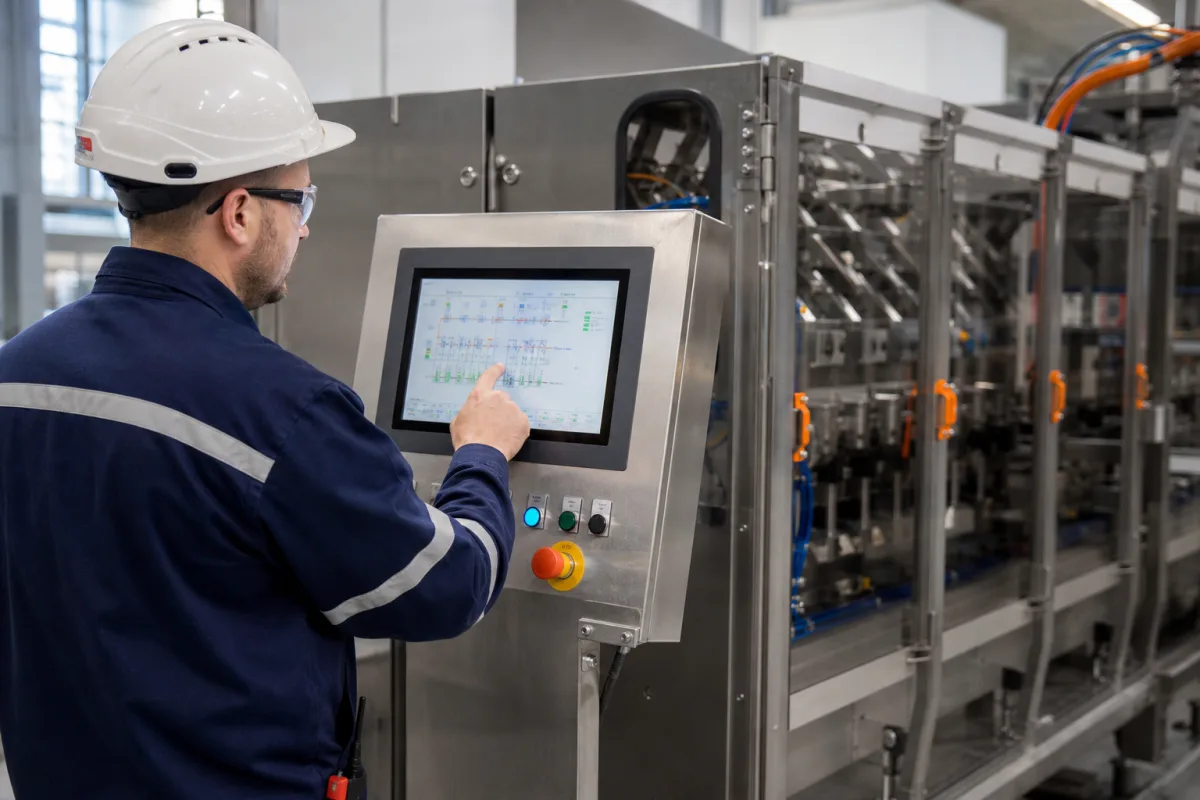
Representative product image. Confirm appearance and specifications with the manufacturer.

Product Specifications

Technical details and manufacturing context for Touchscreen HMI

Definition
The Touchscreen HMI is a component used as the primary control and monitoring interface for the Automated Beverage Container Friction Testing System. It enables operators to configure test parameters, initiate testing sequences, monitor real-time friction data, and view test results for beverage containers. The HMI employs capacitive or resistive touch technology to detect user input on the display surface. It processes touch commands through embedded software and communicates with the system's PLC or controller via industrial protocols such as Modbus RTU/TCP or Ethernet/IP. The display shows system status, test parameters, and results on an LCD/LED screen. The device is constructed with a tempered glass front, polycarbonate plastic housing, aluminum alloy frame, and copper touch sensors. Available specifications include screen sizes from 7 to 15 inches, resolutions from 800×480 to 1920×1080 pixels, and touch technology ranging from resistive to capacitive. Communication protocols supported are Modbus RTU/TCP and Ethernet/IP. The ingress protection rating is IP54 to IP65 per IEC 60529. Operating temperature is 0 to 50 °C, storage temperature is -20 to 60 °C, and operating humidity is 10 to 90% RH (non-condensing). Supply voltage is 24 V DC ±10%, with power consumption from 15 to 30 W. The processor is an ARM Cortex-A8 to A9, memory ranges from 256 to 1024 MB RAM, and weight varies from 0.8 to 2.5 kg. These values are directory reference ranges; verify model-specific values with the manufacturer.
Working Principle
The touchscreen HMI operates by detecting touch input via capacitive or resistive sensing. Capacitive screens use copper touch sensors to detect changes in capacitance, while resistive screens rely on pressure. The embedded software interprets touch commands and communicates with the system's PLC or controller using industrial protocols such as Modbus RTU/TCP or Ethernet/IP. The HMI then updates the display to show system status, test parameters, and results. The display uses LCD or LED technology, and the device is designed for industrial environments with an IP54 to IP65 rating.
Common Materials
Tempered glass, Polycarbonate plastic, Aluminum alloy frame, Copper touch sensors
Technical Parameters
ParameterTypical rangeNotes & selection driver
Screen SizeRequired7–15 inchesDiagonal measurement of the touchscreen display
ResolutionRequired800×480–1920×1080 pixelsDisplay resolution (e.g., 1920x1080)
Touch TechnologyRequiredResistive–Capacitive N/AType of touch sensing technology (capacitive, resistive, etc.)
Communication ProtocolRequiredModbus RTU/TCP, Ethernet/IP N/AIndustrial communication protocol supported (Modbus, Ethernet/IP, Profinet, etc.)
Ingress Protection RatingRequiredIP54–IP65 IP codeProtection level against dust and water ingressIEC 60529
Operating Temperature0–50 °CBelow 0°C may cause display lag
Storage Temperature-20–60 °CAvoid extreme cold for LCD
Operating Humidity10–90 % RHNon-condensing
Supply Voltage24 ±10% V DCWide input range optional
Power Consumption15–30 WDepends on screen size and brightness
ProcessorARM Cortex-A8–A9Higher speed for complex animations
Memory256–1024 MB RAMMore memory for data logging
Weight0.8–2.5 kgVaries with screen size

Ranges are indicative industry figures for RFQ preparation, not a supplier commitment. Confirm every value and standard with the legal manufacturer before ordering.

Components / BOM
  • Touchscreen Display
    Visual interface for displaying system information and receiving touch input
    Material: Tempered glass with touch sensor layer
  • Controller Board
    Processes touch inputs and manages communication with the main system controller
    Material: Fiberglass PCB with electronic components
  • Enclosure Part
    Protects internal components from environmental factors and physical damage
    Material: Aluminum alloy or stainless steel
  • Mounting Bracket Part
    Secures the HMI to the testing system frame
    Material: Steel or aluminum

Industry Taxonomies & Aliases

Commonly used trade names and technical identifiers for Touchscreen HMI.

Applied To / Applications

This component is essential for the following industrial systems and equipment:

Industrial Ecosystem & Supply Chain Structure

Complementary Systems
Downstream Applications
Specialized Tooling

Application Fit & Sizing Matrix

Operational Limits
pressure: N/A (electronic interface only)
other spec: IP65 rating, 1000:1 contrast ratio, 10 million touch cycles
temperature: 0°C to 50°C (operating), -20°C to 70°C (storage)
Media Compatibility
✓ Industrial control cabinets ✓ Clean manufacturing environments ✓ Laboratory settings
Unsuitable: Outdoor direct sunlight or extreme weather exposure
Sizing Data Required
  • Required screen size and resolution
  • Communication protocols (Ethernet/IP, Modbus, etc.)
  • Mounting configuration and panel cutout dimensions

Reliability & Engineering Risk Analysis

Failure Mode & Root Cause
Touchscreen Calibration Drift
Cause: Accumulation of contaminants (dust, oils, moisture) on the screen surface interfering with capacitive sensing, or degradation of the touch sensor layer due to prolonged exposure to UV light or harsh chemicals.
Display Failure (Dead Pixels, Flickering, or Complete Blackout)
Cause: Thermal stress from continuous operation or high ambient temperatures damaging the LCD/LED backlight components and driver circuits, or voltage spikes/surges from the power supply corrupting the display controller.
Maintenance Indicators
  • Unresponsive or erratic touch response (e.g., phantom touches, lag, or dead zones) indicating sensor contamination or calibration issues.
  • Visible screen artifacts (flickering, discoloration, lines, or permanent pixel damage) or audible buzzing from the display backlight, signaling imminent display or power component failure.
Engineering Tips
  • Implement a regular cleaning and inspection schedule using manufacturer-approved, non-abrasive, anti-static screen cleaners and soft microfiber cloths to prevent contaminant buildup and physical damage.
  • Ensure stable, clean power supply with proper surge protection and voltage regulation, and maintain ambient temperature within the HMI's specified operating range (typically 0-50°C) to reduce thermal and electrical stress on components.

Indicative industry ranges for design and RFQ preparation. Confirm the exact figures and applicable standard with the manufacturer before specifying.

Compliance & Manufacturing Standards

Applicable Standards
ISO 9241-420:2011 (Ergonomics of human-system interaction - Part 420: Selection of physical input devices) IEC 61000-6-2:2016 (Electromagnetic compatibility - Immunity for industrial environments) EN 60950-1:2006 (Safety of information technology equipment)

Quoted from the published standard.

Manufacturing Precision
  • Touchscreen flatness: ≤0.2mm across active area
  • Touch position accuracy: ±1.5mm from reference point
Quality Inspection
  • Environmental stress testing (temperature, humidity, vibration per IEC 60068-2 series)
  • Optical performance testing (luminance uniformity, contrast ratio, color gamut verification)

Manufacturers of Touchscreen HMI

1 company lists this product among what they make. Company figures are quoted from each company's own website; every card states where the relationship came from.

Horsent
Chengdu, Sichuan, CN
Also makes: Panel PC, Touch Screen, Touchscreen Display and 4 more
Listed on the company's own website · profile compiled by CNFX from public sources

Manufacturer listings support early research and capability understanding. They are not certification, ranking, or transaction guarantees.

Technical documentation
Request current drawings, revision history, and a signed specification sheet.
Manufacturing capability
Verify equipment lists, process limits, capacity, and representative production evidence.
Inspection readiness
Confirm test methods, calibrated equipment, sampling plans, and traceable reports.
Supplier transparency
Check the legal entity, factory address, ownership, certifications, and direct contacts.

CNFX does not score or rank suppliers. Buyers must verify all claims and documents with the legal manufacturer before ordering.

Supply Chain Compatible Machinery & Devices

Heavy-Duty CNC Plasma Cutting Machine

The Heavy-Duty CNC Plasma Cutting Machine is a standalone industrial device designed for cutting conductive metals such as steel, stainless steel, aluminum, and copper alloys.

Explore Specs →
Automated Powder Coating System

Integrated industrial system for applying dry powder coatings to metal substrates.

Explore Specs →
Centrifugal Pump Impeller

The centrifugal pump impeller is a critical rotating component that converts mechanical energy from the motor into kinetic energy in fluid systems.

Explore Specs →
High-Precision CNC Laser Cutting Machine

Computer-controlled industrial machine using focused laser beams to cut sheet metal with micron-level accuracy.

Explore Specs →

Frequently Asked Questions

What communication protocols does this HMI support?

The HMI supports Modbus RTU/TCP and Ethernet/IP industrial protocols for communication with the system's PLC or controller.

What is the ingress protection rating?

The ingress protection rating is IP54 to IP65 per IEC 60529, indicating protection against dust and water ingress suitable for industrial environments.

What are the operating temperature limits?

The operating temperature range is 0 to 50 °C. Below 0 °C may cause display lag. Storage temperature is -20 to 60 °C.

What touch technologies are available?

The HMI is available with resistive or capacitive touch technology. Capacitive uses copper touch sensors, while resistive relies on pressure.

Data Basis

Editorial classification, named public sources where available, and source-reviewed manufacturer records.

Preliminary Technical Classification
This page supports structured research, RFQ preparation, and supplier evaluation. It does not replace buyer-led supplier qualification, standards review, or technical approval.
Buyer enquiry

Request manufacturing insight for Touchscreen HMI

Ask for use case, specification boundaries, supplier type, and RFQ preparation information for this product.

Where it goes
Straight to the CNFX editorial desk, and to the manufacturer if this product is linked to a claimed profile. Nothing is broadcast to a supplier list.
Your details stay here
We do not sell or rent enquiry data, and we do not add you to a mailing list. Used only to answer this request.
No commission, no middleman
CNFX is a directory. We take no cut of any order and never negotiate on a supplier's behalf.
What we don't claim
A listing is not an endorsement. Qualify every supplier and verify every figure yourself before ordering.

Your business information is used only to process this request.

Thank you! Your message has been sent. We'll respond within 1–3 business days.
Sorry, we couldn't send your message. Please try again, or email us at contact@cnfx.com.

Need to Manufacture Touchscreen HMI?

Compare manufacturer profiles with relevant product and process capability.

Previous Product
Z-axis Ram/Spindle
Last Product
Get QuotesChat