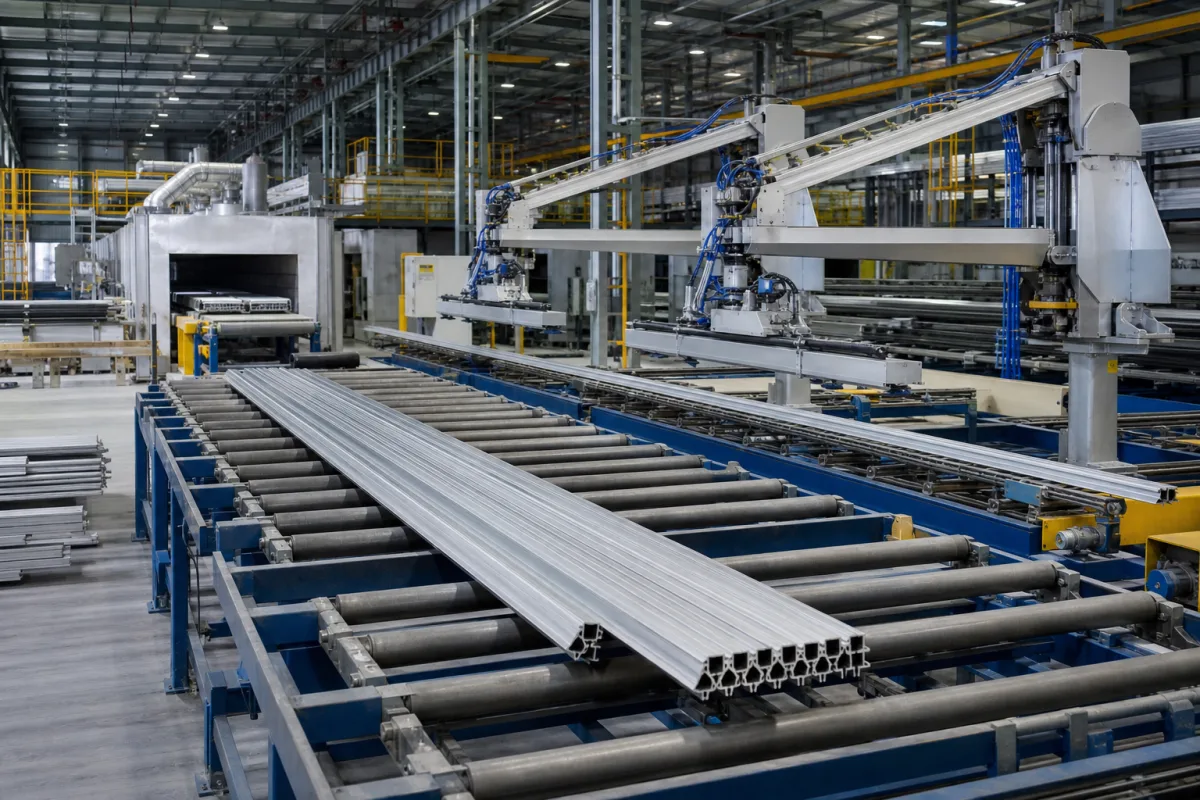
Aluminium profile stacker and ageing-basket loading system (after the finish saw)
After the finish saw · Layer stacking with spacers, ageing baskets and skips, skip buffer and oven loading, destacking for packing
This page covers the handling that begins once the profile has been cut to length: a stacker that builds layers of profiles, separated by spacers, in a basket, rack or skip; the buffer and crane that hold loaded skips; the transfer into the ageing oven; and the destacker that takes the aged profiles apart again for packing. Settle three things before asking for a price: how profiles of your lengths and weights are laid into the basket without marking, whether ageing runs in stacked baskets or with profiles hung one by one, and how many skips the buffer must hold between saw, oven and packing.
Unlike the press-exit line, this product starts after the finish saw: profile stackers with spacer feeders, ageing baskets, racks and skips, skip buffers and cranes, transfer into the ageing oven, and destackers feeding packing lines. Pullers, quench, cooling table, stretcher and saw are covered on the Aluminium profile extrusion line: puller, quench, cooling, stretcher and saw after the press page; the press itself is covered on the Aluminium extrusion press page. The ageing oven's heating system and the packing and strapping machines are outside this page.
CNFX editorial research · Sources checked October 12, 2026 · 6 sources
Building layers of cut profiles with spacers in an ageing basket
Ube Industries' US patent 4,712,961 (filed 2 August 1985) describes the job this machine replaces: cut shapes from the extrusion press were stacked onto a pallet with spacers between adjacent layers, and the patent says operators had to cooperate to load the shapes one by one by hand. Its apparatus feeds hollow spacers of rectangular cross-section from a cassette box onto a spacer conveyor under parallel tables, lifts them, and lets transfer frames with conveyor belts lay shapes and spacers alternately on the pallet. [1]
Friedrich Elhaus' US patent 4,776,741 (granted 11 October 1988) places the stacker directly behind the cut-off saw so that the saw operator can watch the stacking and step in. Driven diagonal rollers push the cut sections toward the centre of the conveying path; a "loose roller carpet" coupled to two linear drive chains is then pulled out from under the layer, leaving it on supports that lower into the transport or annealing rack. The stated aim is to fill the inner width of the rack as compactly as possible, and the same device can be switched to manual stacking without structural change. [2]
Presezzi Extrusion's stacker and destacker page claims a saving of 4 to 6 operators per day for stacking at the saw, offers stacking with no contact between one layer and the next, and allows more than one order to be stacked in a single basket. [4]
Editorial note: ask the supplier for the shortest and longest cut length the stacker accepts, the heaviest layer it can lower, the spacer section and material it feeds, and how profile surfaces are protected where they touch spacers and supports.
For each profile family, give the cut length range, weight per metre, section width, the number of profiles per layer you want, spacer type, and the inner dimensions of your ageing baskets or skips.
02
Moving loaded skips through the buffer, the ageing oven and the destacker
Vollert's reference for Hydro Extrusion at Rackwitz, Germany, shows the buffer side: an automatic crane installed in 2009 with a 9 m span stacks skips of aluminium profiles weighing up to 2.5 t up to 5 high in a floor-based buffer with 120 storage bins, and four fixed chain conveyors carry the material on to anodising. [6]
The same reference gives bridge speed 1.1 m/s over 21 m and lift speed 0.4 m/s over 11 m. Editorial calculation: at full speed, a full bridge traverse takes about 21 ÷ 1.1 ≈ 19 s and a full lift 11 ÷ 0.4 ≈ 28 s, ignoring acceleration and positioning; ask the supplier for a measured cycle time per skip move. [6]
Cometal Engineering's US patent 7,533,552 (Italian priority 22 January 2004) describes the conventional route: once cut, profiles are grouped side by side on support tables or in baskets and taken to an ageing chamber or tunnel, held at a preset temperature for a preset time, then sent to anodising, coating, machining, basket shipment or the warehouse. As drawbacks of horizontal layers in the chamber it lists discontinuous handling, the need to separate profile layers, difficulty running "First-in, First-out" ageing and the space needed for profile packs. Its alternative picks the cut profiles off the bench, turns them vertical and hangs them on an overhead conveyor with one or more parallel lines, running straight or in a zig-zag through an oven whose compartments can be held at different temperatures. [3]
After ageing, Presezzi says one profile destacker can serve up to 3 packing lines, and its internal-logistics page describes dynamic buffers run by plant management software in place of fork-lifts and manually operated cranes. [4][5]
State the skip or basket size and loaded weight, how many skips must wait between saw, oven and packing, ceiling height for a crane, and whether profiles go straight on to anodising or coating.
03
Stacked baskets or hanging profiles through the ageing oven
Cometal's patent sets the two routes side by side; choose before the stacker is specified, because the hanging route replaces the basket stacker with a pick-up and turning device.
Find aluminium profile stacker and ageing-basket handling makers
5 companies list this product among what they make. Company figures are quoted from each
company's own website; every card states where the relationship came from.
Explore company information and manufacturing capabilities, then discuss the scope of your project with a relevant supplier.
Share this page
Compiled and source-reviewed by the CNFX editorial team.
Each manufacturer above links to the page on that company's own website where the product is listed, with the date we checked it. How we source and review
· Page last updated 13 October 2026
Buyer questions
Why are spacers put between layers of cut profiles?
Ube's US patent 4,712,961 stacks extruded shapes on a pallet with spacers between adjacent layers and feeds hollow rectangular spacers automatically because loading shapes and spacers by hand needed operators working together, one shape at a time. [1]
Can profiles be aged without baskets?
Cometal's US patent 7,533,552 hangs cut profiles vertically on an overhead conveyor that carries them through the ageing oven without containers, in one or more parallel lines. [3]
How heavy are loaded skips in a profile buffer?
Vollert's crane at Hydro Extrusion Rackwitz stacks skips of aluminium profiles weighing up to 2.5 t, up to 5 high. [6]
Sources and what still needs a direct check
Sources checked 2026-10-12. Three US patents (Ube Industries, Friedrich Elhaus, Cometal Engineering) describe the stacking and ageing-transfer mechanisms; Presezzi Extrusion and Vollert are equipment makers publishing product and reference pages.