Industry-Verified Manufacturing Data (2026)

Vacuum Sensor

Based on aggregated insights from multiple verified factory profiles within the CNFX directory, the standard Vacuum Sensor used in the Machinery and Equipment Manufacturing sector typically supports operational capacities ranging from standard industrial configurations to heavy-duty production requirements.

Technical Definition & Core Assembly

A canonical Vacuum Sensor is characterized by the integration of Sensing Element and Pressure Port. In industrial production environments, manufacturers listed on CNFX commonly emphasize Stainless steel housing construction to support stable, high-cycle operation across diverse manufacturing scenarios.

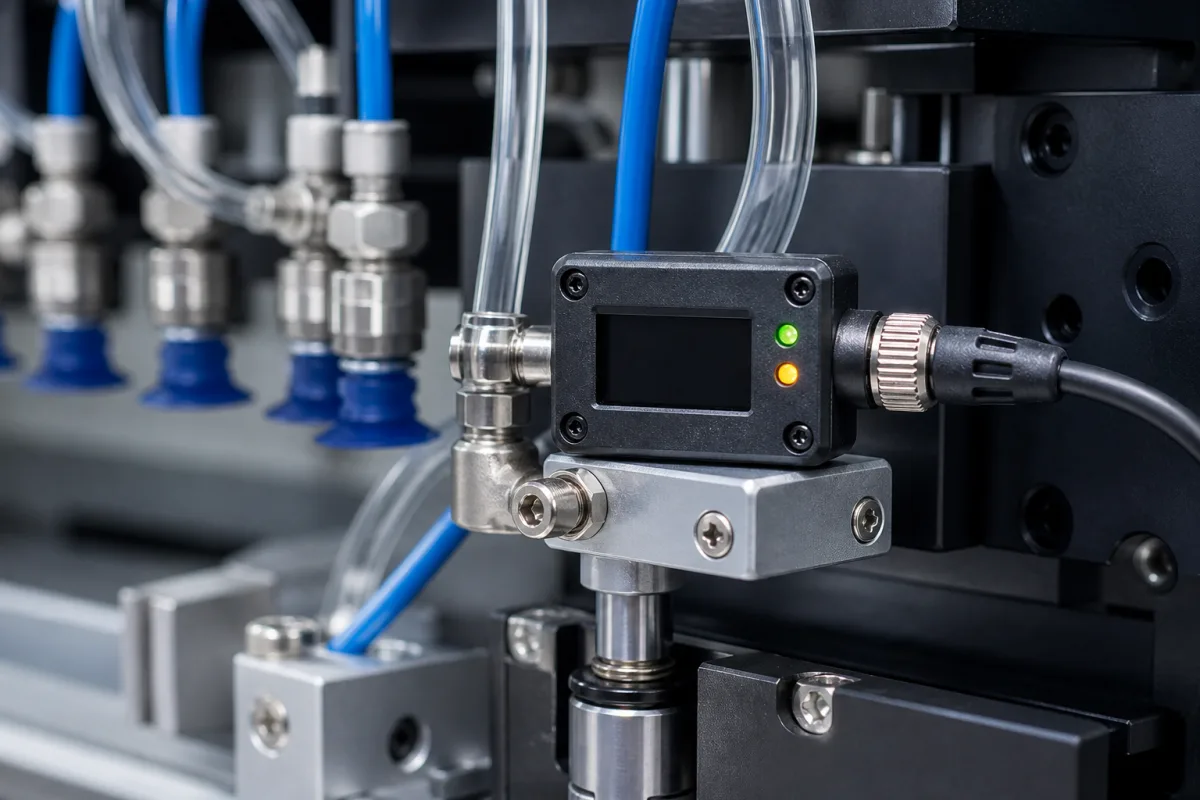
A device that detects and measures vacuum pressure levels within a placement head system.
Product Specifications

Technical details and manufacturing context for Vacuum Sensor

Definition
A vacuum sensor is a critical component within placement head systems used in automated manufacturing equipment. It monitors and measures the vacuum pressure generated by the placement head's vacuum system, ensuring proper suction force for picking, holding, and placing components during assembly processes. The sensor provides real-time feedback to the control system to maintain consistent vacuum levels and detect any leaks or failures.
Working Principle
The vacuum sensor typically operates using piezoelectric, capacitive, or strain gauge technologies to detect pressure changes. As vacuum pressure decreases (suction increases), the sensor's internal element deforms or changes electrical characteristics, generating a proportional electrical signal that is converted to a pressure reading. This data is transmitted to the control system for monitoring and adjustment.
Common Materials
Stainless steel housing, Silicon sensing element, Ceramic substrate
Technical Parameters
  • Vacuum pressure measurement range (mbar) Standard Spec
Components / BOM
  • Sensing Element
    Converts vacuum pressure changes into electrical signals
    Material: Silicon or ceramic
  • Pressure Port
    Interface for connecting to vacuum system
    Material: Stainless steel
  • Signal Conditioning Circuit
    Processes and amplifies the raw sensor signal
    Material: Printed circuit board with electronic components
  • Protective Housing
    Encloses and protects internal components from environmental factors
    Material: Stainless steel or aluminum
Engineering Reasoning
0-101.325 kPa absolute (0-760 Torr, 0-29.92 inHg)
Below 0.1 Pa absolute (0.00075 Torr) or above 120 kPa absolute (900 Torr)
Design Rationale: Pirani gauge thermal conductivity principle disruption: Below 0.1 Pa, mean free path exceeds sensor dimensions (>50 cm), causing non-linear response; above 120 kPa, convective cooling overwhelms radiative cooling, saturating thermal equilibrium
Risk Mitigation (FMEA)
Trigger Condensation of water vapor at 273.15 K dew point within vacuum lines
Mode: Capacitance diaphragm sensor membrane corrosion and short circuit
Strategy: Integrate Peltier cooling stage at 263.15 K upstream with moisture trap
Trigger Electromagnetic interference from 400 Hz PWM motor drivers exceeding 50 V/m field strength
Mode: Piezoresistive Wheatstone bridge output signal corruption with 12 mV RMS noise
Strategy: Implement mu-metal shielding with 80 dB attenuation and differential signaling

Industry Taxonomies & Aliases

Commonly used trade names and technical identifiers for Vacuum Sensor.

Applied To / Applications

This component is essential for the following industrial systems and equipment:

Industrial Ecosystem & Supply Chain DNA

Complementary Systems
Downstream Applications
Specialized Tooling

Application Fit & Sizing Matrix

Operational Limits
pressure: 0 to 1000 mbar absolute
flow rate: 0 to 10 L/min
temperature: -20°C to 85°C
slurry concentration: 0 to 5% solids by weight
Media Compatibility
✓ clean dry air ✓ nitrogen gas ✓ non-corrosive process gases
Unsuitable: condensing or corrosive environments with aggressive chemicals
Sizing Data Required
  • required vacuum level (mbar)
  • system volume (L)
  • response time requirement (ms)

Reliability & Engineering Risk Analysis

Failure Mode & Root Cause
Sensor drift or calibration loss
Cause: Contamination buildup on sensing elements (dust, oil, process residues) or thermal stress affecting internal components
Electrical connection failure
Cause: Corrosion at terminal points due to moisture ingress, vibration-induced wire fatigue, or poor installation practices
Maintenance Indicators
  • Erratic or unstable vacuum readings during steady-state operation
  • Audible hissing or whistling from sensor housing indicating seal failure or crack
Engineering Tips
  • Implement regular calibration checks using traceable standards and maintain clean, dry instrument air purge systems
  • Use vibration-isolating mounts and moisture-resistant conduit seals in installation, with periodic torque verification of electrical connections

Compliance & Manufacturing Standards

Reference Standards
ISO 21358:2020 - Vacuum technology - Vacuum gauges - Specifications ANSI/ISA-67.04.01-2000 - Setpoints for Nuclear Safety-Related Instrumentation DIN 28400-1:2012 - Vacuum technology - Terms and definitions - Part 1: General terms
Manufacturing Precision
  • Pressure measurement accuracy: +/-0.5% of reading
  • Leak rate: < 1×10⁻⁹ mbar·L/s
Quality Inspection
  • Helium leak detection test
  • Calibration verification against NIST-traceable standards

Factories Producing Vacuum Sensor

Verified manufacturers with capability to produce this product in China

✓ 97% Supplier Capability Match Found

P Procurement Specialist from Canada Feb 16, 2026
★★★★★
"Great transparency on the Vacuum Sensor components. Essential for our Machinery and Equipment Manufacturing supply chain."
Technical Specifications Verified
T Technical Director from United States Feb 13, 2026
★★★★★
"The Vacuum Sensor we sourced perfectly fits our Machinery and Equipment Manufacturing production line requirements."
Technical Specifications Verified
P Project Engineer from United Arab Emirates Feb 10, 2026
★★★★★
"Found 53+ suppliers for Vacuum Sensor on CNFX, but this spec remains the most cost-effective."
Technical Specifications Verified
Verification Protocol

“Feedback is collected from verified sourcing managers during RFQ (Request for Quote) and factory evaluation processes on CNFX. These reports represent historical performance data and technical audit summaries from our B2B manufacturing network.”

9 sourcing managers are analyzing this specification now. Last inquiry for Vacuum Sensor from UAE (1h ago).

Supply Chain Compatible Machinery & Devices

Heavy-Duty CNC Plasma Cutting Machine

Industrial machine for precision metal cutting using plasma arc technology

Explore Specs →
Automated Assembly Line System

Integrated production system for sequential component assembly operations

Explore Specs →
Automated Powder Coating System

Integrated industrial system for applying dry powder coatings to metal substrates.

Explore Specs →
Centrifugal Pump Impeller

Rotating component that transfers energy to fluid in centrifugal pumps.

Explore Specs →

Frequently Asked Questions

What is the typical application for this vacuum sensor in machinery manufacturing?

This vacuum sensor is specifically designed for placement head systems in machinery manufacturing, where it detects and measures vacuum pressure levels to ensure precise component handling and placement during automated assembly processes.

How does the silicon sensing element improve sensor performance?

The silicon sensing element provides excellent sensitivity and stability for vacuum pressure measurement, offering high accuracy, fast response times, and reliable performance in industrial environments with temperature variations and mechanical stress.

What maintenance is required for this vacuum sensor?

Minimal maintenance is required due to the durable stainless steel housing and ceramic substrate. Regular cleaning of the pressure port to prevent contamination and periodic calibration checks are recommended to maintain optimal performance.

Can I contact factories directly on CNFX?

CNFX is an open directory, not a transaction platform. Each factory profile provides direct contact information and production details to help you initiate direct inquiries with Chinese suppliers.

Get Quote for Vacuum Sensor

Request technical pricing, lead times, or customized specifications for Vacuum Sensor directly from verified manufacturing units.

Your business information is encrypted and only shared with verified Vacuum Sensor suppliers.

Thank you! Your message has been sent. We'll respond within 1–3 business days.

Need to Manufacture Vacuum Sensor?

Connect with verified factories specializing in this product category

Add Your Factory Contact Us
Previous Product
Vacuum Sealed Door
Next Product
Vacuum Sensors