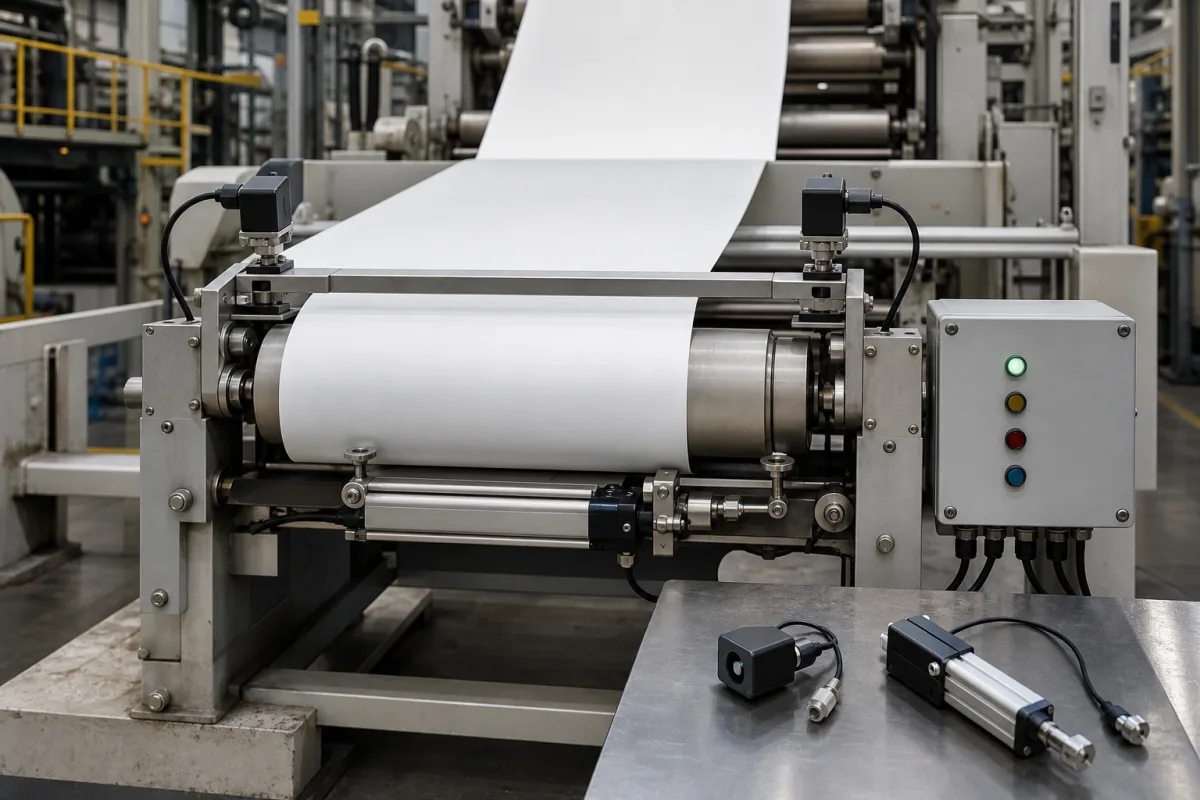
Narrow-web guiding system (compact roll guides for label and converting lines)
Narrow-web guiding systems · compact roll guides for label, tape and film strips up to about 400 mm, correction speed, travel and roll span
A narrow-web guiding system is a small closed-loop guide — sensor, controller, actuator and a compact pivoting roll frame — sized for label stock, tapes, film strips and slit webs on printing, laminating and die-cutting lines. Ask three things first: the narrowest and widest web the frame takes, how fast the guide corrects compared with how fast the web runs, and how short a roll span the machine leaves for the guide.
Compact intermediate roll guides and their sensors, controllers and actuators for narrow webs, from strips under 150 mm to webs of about 320 mm on 400 mm rollers, including guides built into label printing and laser die-cutting lines. Wide-web guiding — offset pivot and steering guides for full-width lines, unwind and rewind guiding, and span sizing for wide frames — is covered on the Web edge guide system page. Tension control and slitter-rewinders are outside this page.
CNFX editorial research · Sources checked October 12, 2026 · 3 sources
Mitsuhashi's PG-10 small roll guide, an offset-type roll guide for intermediate alignment of narrow webs of 150 mm width or less, lists a correction speed of 7.5 mm/s and a control travel of ±6 mm, both stated for a 50 mm roll span, and a maximum sheet speed of 100 m/min. Its DC motor runs on 24 V DC at 0.4 A. [1]
Editorial calculation: at 100 m/min the web moves 1.67 m/s, so in the 0.6 s it takes to run 1 m of web the PG-10 can move the web edge 7.5 × 0.6 = 4.5 mm — within its ±6 mm travel. At lower line speeds the same correction is made over a shorter length of web. [1]
Precision Converting's PG-400A offset pivot guide lists a maximum drive speed of 40 mm/s, a guide angle of ±15°, automatic stroke measurement and a large LCD display. [2] Editorial calculation: 40 mm/s is about 5.3 times the PG-10's 7.5 mm/s; ask each supplier at which roll span and load the stated speed applies, since Mitsuhashi ties its figures to a 50 mm span. [2][1]
Where the guide is part of a machine, the line speed is set by the process. Golden Laser's roll-to-roll label laser cutting machine lists a maximum web width of 350 mm, a maximum web speed of 120 m/min depending on laser power, material and cut pattern, ±0.1 mm accuracy, and an electronic web guide with an ultrasonic edge guide sensor in its standard configuration. [3]
Give the supplier the material and its thickness, narrowest and widest web, line speed range, the correction you expect to remove, the guiding reference (edge, line or centre), available roll span and roller positions, supply voltage and controller interface.
02
Fit the guide frame to the web width and a short roll span
Precision Converting's PG-400A uses 400 mm long rollers for webs from 100 to 320 mm wide, with 50, 60 or 80 mm roller diameters, a 200 mm span between its two rollers, AC 220 V and 80 W input, and an environment of −10 to 60 °C below 90% RH. It lists maximum tension as "300N.M" without further definition; ask the supplier to confirm the unit. [2]
Mitsuhashi's PG-10 is built for shorter spans: roll surface lengths of 100 to 200 mm, a standard roll diameter of 38 mm and roll spans of 50 to 120 mm. Mitsuhashi explains that the guide corrects by twisting the web at the entry and exit sides of the roll guide, which eases the tension difference between the two web edges; it describes the PG-10 as suited to materials prone to permanent distortion or which tear easily. [1]
Editorial calculation: the PG-400A's 320 mm maximum web leaves 80 mm of its 400 mm roller free, 40 mm each side if centred, which bounds how far a web at full width can be shifted before an edge runs off the roller. [2] Editorial note: for each web width you run, check that roller length minus web width covers the correction travel needed.
On sensing, Golden Laser specifies an ultrasonic edge sensor for its label line. [3] Precision Converting also lists photoelectric guide sensors and a reflection-type colour web guide sensor among its guide products. [2]
03
Small roll guide, offset pivot guide or a guide built into the converting line
Ask each supplier for correction speed and travel at your roll span, the web widths the frame accepts, and the sensor options for your material.
Guide
Web and frame
Speed and travel
Mitsuhashi PG-10 small roll guide
≤150 mm webs; 100–200 mm rolls; 50–120 mm span. [1]
Listed hardware includes the PG-400A offset pivot guide for 100–320 mm webs, steering, unwind and rewind guides, and edge or centre guiding with tension control components.
Precision Converting Co.,Limited
Manufacturing site to be confirmed for the order
Lists the PG-400A offset pivot guide for 100–320 mm webs, with steering, unwind and rewind guides, controllers and sensors.
Explore company information and manufacturing capabilities, then discuss the scope of your project with a relevant supplier.
Share this page
Compiled and source-reviewed by the CNFX editorial team.
Each manufacturer above links to the page on that company's own website where the product is listed, with the date we checked it. How we source and review
· Page last updated 13 October 2026
Buyer questions
How fast does a small roll guide correct?
Mitsuhashi lists 7.5 mm/s with ±6 mm travel at a 50 mm roll span for its PG-10, for webs up to 150 mm at up to 100 m/min. [1]
What web widths does a 400 mm guide take?
Precision Converting lists 100 to 320 mm webs for its PG-400A on 400 mm rollers with a 200 mm span. [2]
Which sensor does a label laser line use for guiding?
Golden Laser lists an electronic web guide with an ultrasonic edge guide sensor on its 350 mm roll-to-roll label laser cutting machine. [3]
Sources and what still needs a direct check
Sources checked 2026-10-12. Mitsuhashi, Precision Converting and Golden Laser describe their own products. Ask for correction speed and travel measured at your roll span and web.