Editorial Technical Reference

Automotive Final Assembly System

This page explains how Automotive Final Assembly System is classified within Manufacture of Motor Vehicles. Technical values and manufacturer relationships are research references; confirm the current specification and supplier evidence for each order.

Technical Definition & Core Assembly

Integrated production line for complete vehicle assembly with automated stations and material handling.
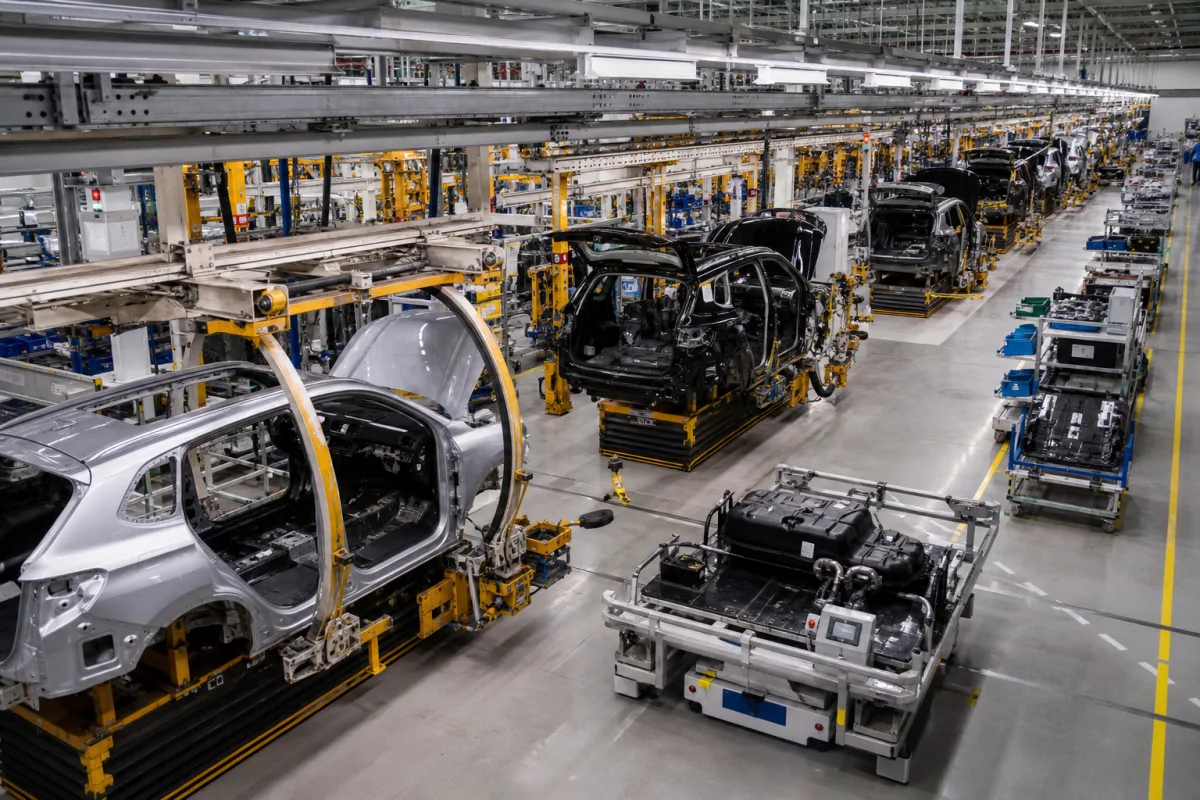
Representative product image. Confirm appearance and specifications with the manufacturer.

Product Specifications

Technical details and manufacturing context for Automotive Final Assembly System

Definition
The Automotive Final Assembly System is a comprehensive industrial system designed for the sequential assembly of complete motor vehicles, including passenger cars, light trucks, and commercial vehicles. This integrated production line coordinates multiple specialized workstations through automated material handling systems to assemble chassis, powertrain, body, interior, and electrical components into finished vehicles. It serves as the core manufacturing infrastructure for automotive OEMs, enabling high-volume production with consistent quality control throughout the assembly process. The system represents a critical capital investment in automotive manufacturing facilities and requires precise synchronization of mechanical, electrical, and control subsystems.

Typical system parameters include a production capacity of 20–40 vehicles per hour, a system length of 300–800 meters, conveyor speeds of 0.5–2.0 m/min, and a power consumption of 150–400 kW. Cycle time per station ranges from 90–180 seconds, with a payload capacity of 500–1500 kg. Positioning accuracy for automated stations is ±0.5 mm, and the operating temperature range is 5–45°C. The system operates on compressed air at 0.6–0.8 MPa (ISO 8573-1) and requires a three-phase electrical supply of 380 V AC ±10%, 50 Hz (IEC 60038). The control system is PLC-based with Ethernet/IP (IEC 61131-3), and safety circuits comply with ISO 13849-1 PL d. Noise level at operator positions is ≤75 dB(A) per ISO 11201.

These values are reference ranges for directory purposes and must be verified with the legal manufacturer for specific models and applications. The system is designed for integration with MES/SCADA systems, and its modular architecture allows customization to meet specific production requirements. Buyers should confirm all technical specifications, including standards compliance, with the supplier before procurement.
Working Principle
Vehicles move sequentially through specialized stations on automated conveyors while robotic systems and human operators install components according to precise assembly sequences controlled by programmable logic controllers (PLCs) and manufacturing execution systems (MES). The conveyor system transports vehicles at speeds of 0.5–2.0 m/min, and each station has a cycle time of 90–180 seconds. Automated stations use positioning accuracy of ±0.5 mm to ensure precise component fit. The entire system operates within a temperature range of 5–45°C and uses compressed air at 0.6–0.8 MPa for tools and automation. PLCs coordinate the sequence, while MES tracks production data and quality metrics. Safety circuits conform to ISO 13849-1 PL d, and noise levels are maintained at ≤75 dB(A) at operator positions.
Common Materials
Structural Steel, Aluminum Alloy, Industrial Plastics, Electrical Wiring
Technical Parameters
ParameterTypical rangeNotes & selection driver
Production CapacityRequired20–40 vehicles/hourMaximum sustainable assembly rate
System LengthRequired300–800 metersTotal linear dimension of assembly line
Conveyor SpeedRequired0.5–2.0 m/minMaximum speed of vehicle transport system
Power ConsumptionRequired150–400 kWTotal electrical power requirement
Cycle Time90–180 secondsTime per vehicle at each station
Payload Capacity500–1500 kgMaximum vehicle weight supported
Positioning Accuracy±0.5 mmFor automated stations, critical for fit and finish
Operating Temperature5–45 °CBelow 5°C may affect pneumatic components
Operating Pressure0.6–0.8 MPaCompressed air for tools and automationISO 8573-1
Electrical Supply380 V AC ±10%, 50 HzThree-phase, other voltages on requestIEC 60038
Control SystemPLC-based, Ethernet/IPCompatible with MES/SCADAIEC 61131-3
Safety StandardISO 13849-1 PL dSafety circuits and guardingISO 13849-1
Noise Level≤75 dB(A)At operator position, per EU directiveISO 11201

Ranges are indicative industry figures for RFQ preparation, not a supplier commitment. Confirm every value and standard with the legal manufacturer before ordering.

Components / BOM

Industry Taxonomies & Aliases

Commonly used trade names and technical identifiers for Automotive Final Assembly System.

Industrial Ecosystem & Supply Chain Structure

Complementary Systems
Downstream Applications
Specialized Tooling

Application Fit & Sizing Matrix

Operational Limits
pressure: 0.5-1.2 bar (pneumatic systems)
other spec: Cycle Time: 45-90 seconds per vehicle, Power Supply: 400-480V 3-phase 50/60Hz, Humidity: 30-70% RH non-condensing
temperature: 15-35°C (operating environment)
Media Compatibility
✓ Automotive steel/aluminum body panels ✓ Plastic/composite interior components ✓ Electronic control modules and wiring harnesses
Unsuitable: Corrosive chemical processing environments (e.g., acid baths, plating lines)
Sizing Data Required
  • Annual production volume (vehicles/year)
  • Vehicle platform dimensions (length × width × height)
  • Required automation level (manual vs. fully automated stations)

Reliability & Engineering Risk Analysis

Failure Mode & Root Cause
Conveyor System Jamming
Cause: Accumulation of debris, misaligned pallets, or worn drive components causing mechanical obstruction and production stoppage.
Robotic Arm Positioning Drift
Cause: Wear in harmonic drives, encoder feedback errors, or thermal expansion in servo motors leading to inaccurate assembly operations.
Maintenance Indicators
  • Unusual grinding or squealing noises from conveyor motors or robotic joints indicating imminent bearing failure.
  • Visible misalignment or wobbling in robotic end-effectors during precision tasks like windshield installation.
Engineering Tips
  • Implement predictive maintenance using vibration analysis on critical rotating equipment and thermal imaging on electrical panels to detect early degradation.
  • Establish strict contamination control protocols with regular cleaning schedules and use of protective covers to prevent debris ingress in sensitive assembly areas.

Indicative industry ranges for design and RFQ preparation. Confirm the exact figures and applicable standard with the manufacturer before specifying.

Compliance & Manufacturing Standards

Applicable Standards
ISO/TS 16949:2009 - Quality management for automotive production CE Marking - Conformity with EU safety, health, and environmental requirements

Quoted from the published standard.

Manufacturing Precision
  • Body Panel Gap: +/- 0.5mm
  • Wheel Alignment: +/- 0.1 degrees
Quality Inspection
  • Dimensional Verification with CMM (Coordinate Measuring Machine)
  • Functional Testing of Electrical Systems

Manufacturers of Automotive Final Assembly System

Manufacturer profiles associated with Automotive Final Assembly System.

Sourcing Automotive Final Assembly System from China?
Tell us your specification and target quantity — we will match it against manufacturer records and come back with the factories that fit.
Request manufacturers We manufacture this

Manufacturer listings support early research and capability understanding. They are not certification, ranking, or transaction guarantees.

Technical documentation
Request current drawings, revision history, and a signed specification sheet.
Manufacturing capability
Verify equipment lists, process limits, capacity, and representative production evidence.
Inspection readiness
Confirm test methods, calibrated equipment, sampling plans, and traceable reports.
Supplier transparency
Check the legal entity, factory address, ownership, certifications, and direct contacts.

CNFX does not score or rank suppliers. Buyers must verify all claims and documents with the legal manufacturer before ordering.

Frequently Asked Questions

What is the typical production capacity of an automotive final assembly system?

The typical production capacity is 20–40 vehicles per hour, depending on the specific configuration and vehicle type. This range is a reference; the actual capacity must be confirmed with the manufacturer for the intended application.

What are the key technical parameters to consider when selecting such a system?

Key parameters include system length (300–800 m), conveyor speed (0.5–2.0 m/min), cycle time (90–180 seconds per station), payload capacity (500–1500 kg), positioning accuracy (±0.5 mm), operating temperature (5–45°C), and power consumption (150–400 kW). These values are reference ranges and should be verified with the supplier.

What standards are relevant for the control system and safety?

The control system is PLC-based and complies with IEC 61131-3, with Ethernet/IP communication for MES/SCADA integration. Safety circuits are designed to meet ISO 13849-1 PL d. These standards are procurement references; compliance must be confirmed with the manufacturer.

How does the system ensure quality during assembly?

Quality is maintained through precise positioning accuracy (±0.5 mm) at automated stations, consistent cycle times, and integration with MES for real-time monitoring and data collection. However, specific quality assurance measures should be discussed with the manufacturer.

Data Basis

Editorial classification, named public sources where available, and source-reviewed manufacturer records.

Preliminary Technical Classification
This page supports structured research, RFQ preparation, and supplier evaluation. It does not replace buyer-led supplier qualification, standards review, or technical approval.
Buyer enquiry

Request manufacturing insight for Automotive Final Assembly System

Ask for use case, specification boundaries, supplier type, and RFQ preparation information for this product.

Where it goes
Straight to the CNFX editorial desk, and to the manufacturer if this product is linked to a claimed profile. Nothing is broadcast to a supplier list.
Your details stay here
We do not sell or rent enquiry data, and we do not add you to a mailing list. Used only to answer this request.
No commission, no middleman
CNFX is a directory. We take no cut of any order and never negotiate on a supplier's behalf.
What we don't claim
A listing is not an endorsement. Qualify every supplier and verify every figure yourself before ordering.

Your business information is used only to process this request.

Thank you! Your message has been sent. We'll respond within 1–3 business days.
Sorry, we couldn't send your message. Please try again, or email us at contact@cnfx.com.

Need to Manufacture Automotive Final Assembly System?

Compare manufacturer profiles with relevant product and process capability.

Previous Product
Automotive Body Panel Stamping Press
Last Product
Get QuotesChat