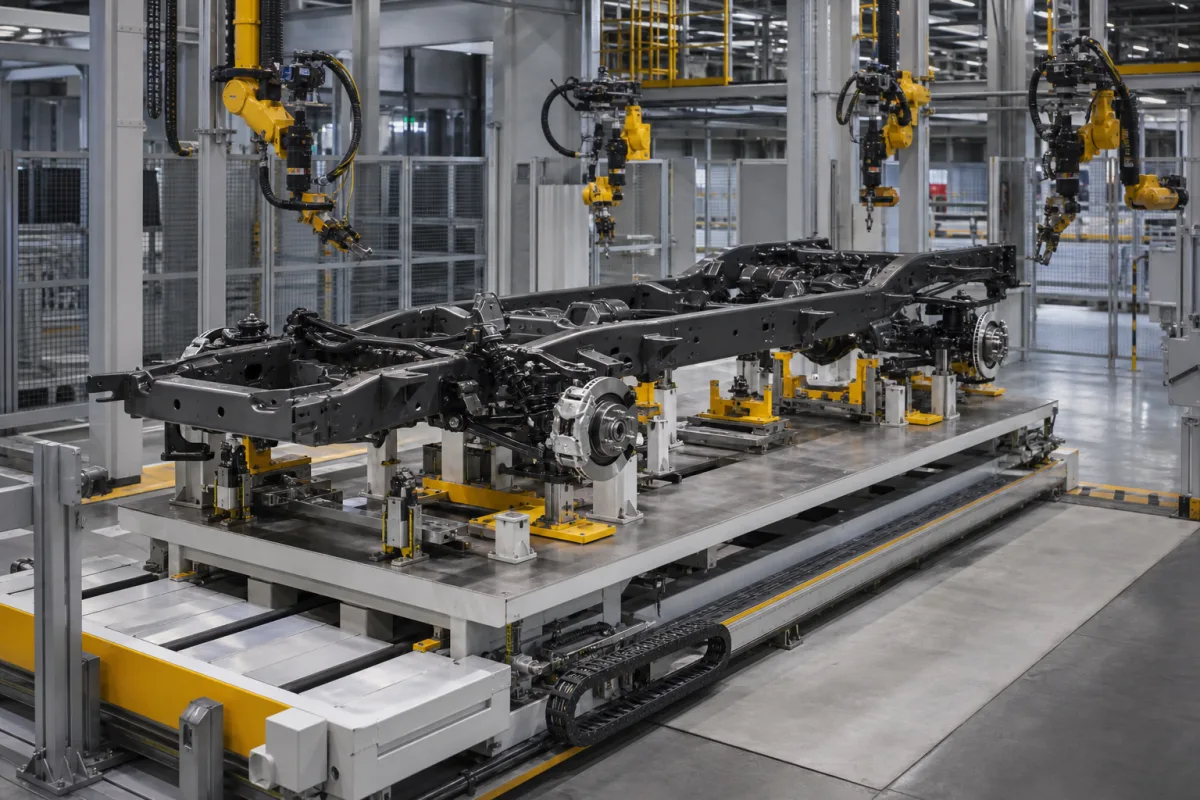
Ladder-frame chassis dressing station: locating the frame on pallet risers and tightening rubber-bushed suspension joints at their design position
Body-on-frame pickups and SUVs · the station where a bare ladder frame is held on locator posts while axles, links, springs and brake corners go on, before any body is near it
On a body-on-frame pickup or SUV, the chassis is a vehicle in its own right before the body arrives: a ladder frame carrying the axles, control arms or leaf springs, coil springs, dampers and brake corners. The dressing station holds that frame in a known position while these parts go on, and it decides two things the vehicle carries for life. One is where each bracket and joint ends up relative to the frame datums. The other is the twist locked into every rubber-bushed joint, because a bushing clamped while the wheel hangs free is wound up as soon as the vehicle stands on its wheels.
Assembly stations for body-on-frame vehicles in which a bare ladder frame, held on a pallet or fixture, is fitted with axles, suspension links, springs, dampers and brake corners and its rubber-bushed joints are tightened: frame location on risers and pins, pallet changeover between wheelbases, suspension positioning before final tightening, and the bushing wind-up it is meant to avoid. Assembly robots as machines are covered on the Assembly robot page. Rigging axle and drive modules on an assembly frame and marrying them to a unibody are covered on the Chassis rigging and marriage line page, and torque control of fixtured nutrunners on the Fixtured electric nutrunner torque control system page. Robotic welding of trailer and semi-trailer frames is covered on the Trailer frame welding robot page, and welding of switchgear frames on the Frame welding station for switchgear and enclosure frames page.
CNFX editorial research · Sources checked October 13, 2026 · 4 sources
Risers, locator pins and modular plates: holding the frame where the tools expect it
Comau's reconfigurable assembly pallet patent describes the conventional layout: rails and cross-members carrying support beams, each with risers whose locating pins engage holes in the vehicle at predetermined positions, so that programmable robots and other precision equipment find the part where they expect it. [1] The patent is written around sheet-metal passenger-car bodies; the same riser-and-pin principle is what holds a frame on a dressing pallet.
Comau also describes a hook and armature linkage inside the hollow riser and locating pin: an actuator on the support beam extends the hook to lock the part to the riser and retracts it to release. [1] On a frame line the open question for the buyer is which frame holes and faces are the datums, because every bracket, spring hanger and control-arm pivot is then fitted relative to them.
Editorial note on the figure: 0.1–0.13 mm is a positioning requirement for the pin, quoted for body pallets. It is not a tolerance on the frame itself, which the frame drawing sets; ask for both.
Pallet feature in the Comau patent
What it does
Locating pin accuracy
Required to be within 0.1–0.13 mm of the design position in X, Y and Z [1]
Riser fixing on older pallets
Bolted to the support beam with four bolts and doweled into a predrilled hole to lock its position [1]
Sliding support beam
Moves one set of risers along the pallet for a body whose holes sit at another longitudinal position, but only if the pin diameter is the same [1]
Modular riser plate
Pre-mounted risers for one model on a removable plate that a robot swaps; plate locators engage receivers on the pallet [1]
Example plate
About 800 × 200 mm, aluminium 20 to 50 mm thick [1]
Longer wheelbase
Risers on the second model's plates spaced further apart along X [1]
Specify the frame datum holes and faces the pallet must engage, the pin diameters per model, whether the frame is clamped to the risers or only located, and how the pallet changes between wheelbases.
02
Rubber-bushed links on the frame: tightening at the design position, not with the wheels hanging
A bonded rubber bush is clamped through its inner tube; once the bolt is tight, any rotation of the arm twists the rubber. DaimlerChrysler's patent on assembling a linked suspension describes the consequence when the bushes are tightened with the vehicle suspended: when the vehicle comes down onto its wheels, the rubber resists the rotation of the upper control arms and the bush tubes are left prestressed, which it says may cause a tighter ride or ruin the bushes. [2]
Mazda's patent explains why the lift is measured from the detected rebound position rather than from a fixed height: the full rebound position varies from body to body, and keeping the lift amount constant still returns the part to the right position before the bush is tightened. [3] Its own method addresses the step before that, fitting the coil spring: the swing arm is forced away from the body to open the spring seat, with the damper already fastened so that it stops the arm swinging too far, and the device runs beside the body conveyance line of a mixed-model production line. [3]
How much twist a bush can take is a rated value. Paulstra's catalogue of small industrial Flexibloc and Silentbloc bushes lists a maximum torsion angle for each reference alongside separate radial, axial and conical limits; for the 6 to 10 mm bores on its page 281 the torsion figure runs from 10° for the 8 mm bore, 16 mm outside diameter 561104 to 35° for the 8 mm bore, 32 mm outside diameter 561418. [4] These are not vehicle suspension bushes; the point is that torsion is specified per bush. Editorial comparison: the 14° pre-rotation in the DaimlerChrysler claim would exceed the 10° rating of the 561104, which is why the suspension bush maker's torsion limit, and the arm angle between full rebound and design position, belong in the station specification.
Approach
How the joint reaches its design position before tightening
Lifting device
Wheels pushed up by a lift while the vehicle is suspended, simulating the ground force; bolts tightened in that state. The patent calls it expensive, a hazard for the assembler and time-consuming [2]
Pre-rotation tool
Bolt fitted loosely, the bush tube turned with a tool against the rubber's counter-torque, bolt tightened, tool removed; a stop bar on the tool sets the angle, which the patent gives as 14° in one claim [2]
Lift from full rebound
Lift member contacts the temporarily fastened part at full rebound, detects that position, raises the part by a set amount from it, and the rubber bush is tightened in that state [3]
For each rubber-bushed joint, ask the vehicle engineering team for the design-position arm angle or wheel-centre height, the bush maker's torsion rating, and which method the station uses to reach that position before the final tightening (lift, pre-rotation tool or tighten later on wheels).
03
Data to send with a chassis dressing station enquiry
Paste it into your enquiry below or into an email to a maker, then replace every bracket.
Frame: [models; wheelbases; mass; datum holes and faces]
Pallet: [risers and pin diameters per model; clamping; changeover method]
Parts fitted here: [axles; links or leaf springs; coil springs; dampers; brake corners]
Bushed joints: [list; design-position angle or height; bush torsion rating]
Positioning method: [lift from rebound; pre-rotation tool; final tightening on wheels]
Tightening: [joint list with torque or angle specification; recording]
Cycle: [jobs per hour; manual, assisted or robotic]
Explore company information and manufacturing capabilities, then discuss the scope of your project with a relevant supplier.
Share this page
Compiled and source-reviewed by the CNFX editorial team.
Each manufacturer above links to the page on that company's own website where the product is listed, with the date we checked it. How we source and review
· Page last updated 13 October 2026
Buyer questions
Why should suspension bushes not be tightened with the wheels hanging?
DaimlerChrysler's linked-suspension patent explains that the rubber then resists the arm rotation when the vehicle is lowered onto its wheels, leaving the bushes prestressed, which it says may cause a tighter ride or ruin them. [2]
How can a joint be tightened at design position without lifting the wheels?
The same patent fits the bolt loosely, turns the bush tube against the rubber's counter-torque with a tool stopped at a set angle, 14° in one claim, and tightens the bolt before removing the tool. [2]
How accurate are the locator pins on an assembly pallet?
Comau's pallet patent states a requirement of 0.1–0.13 mm from the design position in all three coordinates. [1]
How much twist can a bonded rubber bush take?
It is rated per bush. For Paulstra's Flexibloc and Silentbloc references with 6 to 10 mm bores, the listed maximum torsion angle runs from 10° to 35°. [4]
Sources and what still needs a direct check
Sources checked 2026-10-13. Three patents from Comau, DaimlerChrysler and Mazda describe assembly pallets, bushing pre-rotation and suspension positioning on the line; a Paulstra catalogue page gives rated torsion angles for bonded rubber bushes.