Editorial Technical Reference

Component Presentation System

This page explains how Component Presentation System is classified within Motor Vehicle Manufacturing. Technical values and manufacturer relationships are research references; confirm the current specification and supplier evidence for each order.

Technical Definition & Core Assembly

A subsystem within a chassis assembly station that organizes, positions, and presents components to assembly operators or robotic systems in the correct sequence and orientation.
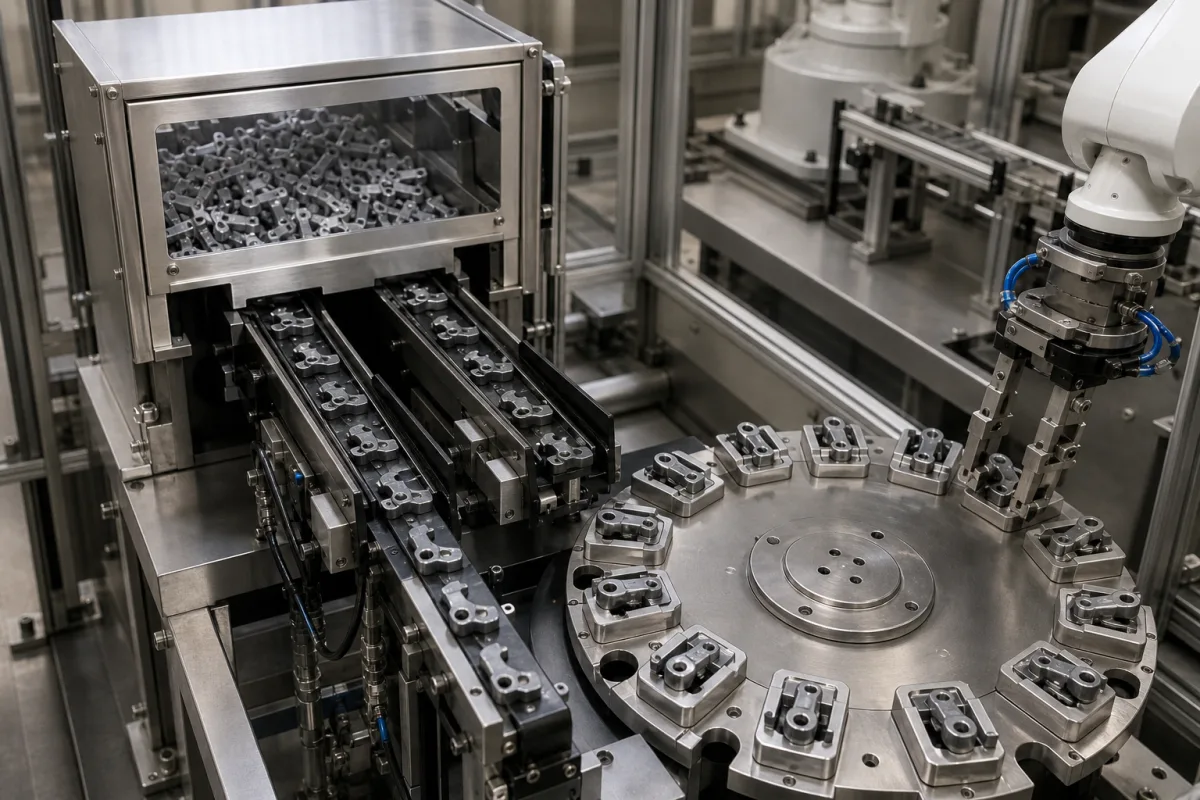
Representative product image. Confirm appearance and specifications with the manufacturer.

Product Specifications

Technical details and manufacturing context for Component Presentation System

Definition
The Component Presentation System is an integral part of the Chassis Assembly Station, responsible for the controlled feeding and presentation of chassis components (e.g., brackets, mounts, cross-members) to the assembly point. It ensures components are correctly oriented, sequenced according to the build order, and readily accessible, thereby optimizing ergonomics for manual assembly or providing precise pick-up points for automated systems, directly contributing to assembly accuracy, cycle time reduction, and line balancing. The system typically receives components from a feeding mechanism (e.g., conveyor, magazine, pallet). It then uses a combination of mechanical guides, actuators, and sensors to orient and position each component into a predefined presentation fixture or nest. Control logic, often integrated with the station's PLC, sequences the presentation based on the assembly program, confirms component presence and correct positioning via sensors, and signals readiness for the assembly operation (manual pick-up or robotic gripper engagement). The system is designed for integration into motor vehicle manufacturing lines, with materials including carbon steel, aluminum alloy, and engineering plastics. Key parameters include operating pressure (1.0–1.6 MPa), supply voltage (24 V DC ±10%), cycle time (3–8 s), positioning accuracy (±0.05 mm per ISO 9283), load capacity (15–60 kg per station), operating temperature (-40–85 °C per IEC 60068-2-1), ingress protection (IP54–IP65 per IEC 60529), material grade (304–316 SS per ASTM A240), weight (80–150 kg), and footprint (1.2–2.5 m²). These values are reference ranges and must be verified for the specific model and application. Always confirm model-specific values and standards with the legal manufacturer or supplier.
Working Principle
The system receives components from a feeding mechanism such as a conveyor, magazine, or pallet. Mechanical guides, actuators, and sensors orient and position each component into a predefined presentation fixture or nest. Control logic, often integrated with the station's PLC, sequences the presentation based on the assembly program. Sensors confirm component presence and correct positioning, then signal readiness for manual pick-up or robotic gripper engagement. This ensures correct orientation and sequence, optimizing ergonomics and enabling precise automated handling.
Common Materials
Carbon Steel, Aluminum Alloy, Engineering Plastics (e.g., Delrin, Nylon)
Technical Parameters
ParameterTypical rangeNotes & selection driver
Operating Pressure1.0–1.6 MPa
Supply Voltage24 ±10% V DCOutside range may cause solenoid malfunction
Cycle Time3–8 sFaster cycles reduce operator wait time
Positioning Accuracy±0.05 mmCritical for robotic pickingISO 9283
Load Capacity15–60 kgPer presentation station
Operating Temperature-40–85 °COutside range may affect sensor performanceIEC 60068-2-1
Ingress ProtectionIP54–IP65Higher rating for dusty environmentsIEC 60529
Material Grade304–316 SS316 for corrosion resistanceASTM A240
Weight80–150 kgAffects floor loading and installation
Footprint1.2–2.5 Must fit within station layout

Ranges are indicative industry figures for RFQ preparation, not a supplier commitment. Confirm every value and standard with the legal manufacturer before ordering.

Components / BOM
  • Presentation Fixture / Nest Part
    Holds and locates the specific chassis component in the exact orientation required for assembly.
    Material: Tool Steel or Aluminum
  • Actuation Mechanism
    Moves the component into the presentation position (e.g., pneumatic cylinder, electric actuator, rotary indexer).
    Material: Steel, Aluminum
  • Sensor Array
    Detects component presence, verifies correct orientation/position, and provides feedback to the control system.
    Material: Various (sensor housing typically plastic or metal)
  • Mounting Frame / Base Part
    Provides structural support and precise mounting for all other components of the presentation system within the assembly station.
    Material: Steel
  • Mechanical Guides
    Funnel each part into the nest so it lands in the one orientation the fixture accepts.

Applied To / Applications

This component is essential for the following industrial systems and equipment:

Industrial Ecosystem & Supply Chain Structure

Complementary Systems
Downstream Applications
Specialized Tooling

Application Fit & Sizing Matrix

Operational Limits
pressure: Atmospheric (non-pressurized)
other spec: Component size range: 1mm to 100mm, Orientation accuracy: ±0.5°, Cycle rate: up to 60 components/minute
temperature: 0°C to 50°C
Media Compatibility
✓ Electronic components (SMD chips, resistors, capacitors) ✓ Small mechanical parts (screws, washers, pins) ✓ Plastic injection-molded parts
Unsuitable: Corrosive chemical environments or abrasive particulate media
Sizing Data Required
  • Maximum component dimensions (LxWxH)
  • Required presentation sequence complexity
  • Throughput rate (components per hour)

Reliability & Engineering Risk Analysis

Failure Mode & Root Cause
Seal degradation and leakage
Cause: Chemical incompatibility with process fluids leading to swelling, hardening, or cracking of elastomeric seals; improper installation causing seal misalignment or damage
Corrosion and material degradation
Cause: Exposure to corrosive chemicals or atmospheric conditions; galvanic corrosion due to dissimilar metal contact in the system; erosion from high-velocity particulate flow
Maintenance Indicators
  • Visible fluid leakage around connection points or seals indicating seal failure
  • Unusual vibration or audible knocking sounds during operation suggesting internal component wear or misalignment
Engineering Tips
  • Implement regular seal compatibility testing with process fluids and establish a preventive seal replacement schedule based on service hours rather than waiting for failure
  • Install corrosion monitoring coupons at strategic locations and conduct periodic material thickness measurements using ultrasonic testing to track degradation rates

Indicative industry ranges for design and RFQ preparation. Confirm the exact figures and applicable standard with the manufacturer before specifying.

Compliance & Manufacturing Standards

Applicable Standards
ANSI/BIFMA X5.1 Office Chairs - Tests CE Marking (EU Machinery Directive 2006/42/EC)

Quoted from the published standard.

Manufacturing Precision
  • Component Alignment: +/- 0.5mm
  • Surface Finish: Ra 3.2μm maximum
Quality Inspection
  • Dimensional Verification with CMM
  • Load Testing (Static & Dynamic)

Manufacturers of Component Presentation System

Manufacturer profiles associated with Component Presentation System.

Sourcing Component Presentation System from China?
Tell us your specification and target quantity — we will match it against manufacturer records and come back with the factories that fit.
Request manufacturers We manufacture this

Manufacturer listings support early research and capability understanding. They are not certification, ranking, or transaction guarantees.

Technical documentation
Request current drawings, revision history, and a signed specification sheet.
Manufacturing capability
Verify equipment lists, process limits, capacity, and representative production evidence.
Inspection readiness
Confirm test methods, calibrated equipment, sampling plans, and traceable reports.
Supplier transparency
Check the legal entity, factory address, ownership, certifications, and direct contacts.

CNFX does not score or rank suppliers. Buyers must verify all claims and documents with the legal manufacturer before ordering.

Supply Chain Compatible Machinery & Devices

Automotive Wireless Power Transfer System

The Automotive Wireless Power Transfer System is an integrated solution for contactless charging of electric vehicles.

Explore Specs →
Automotive Active Suspension Damping System

The Automotive Active Suspension Damping System is an advanced suspension solution designed for motor vehicles.

Explore Specs →
Ground Assembly Unit

A foundational structural component that provides stable mounting and alignment for equipment within an industrial system.

Explore Specs →
Vehicle Assembly Unit

A modular component within an industrial system responsible for assembling vehicle structures and subassemblies.

Explore Specs →

Frequently Asked Questions

What is the primary function of a Component Presentation System?

It organizes, positions, and presents chassis components to assembly operators or robotic systems in the correct sequence and orientation, ensuring efficient and accurate assembly.

How does the system ensure correct component orientation?

It uses mechanical guides, actuators, and sensors to orient each component into a predefined fixture or nest. Sensors verify correct positioning before signaling readiness for assembly.

What are typical operating parameters?

Reference ranges include operating pressure 1.0–1.6 MPa, supply voltage 24 V DC ±10%, cycle time 3–8 s, positioning accuracy ±0.05 mm, load capacity 15–60 kg, and operating temperature -40–85 °C. Always verify with the manufacturer.

How is the system integrated into an assembly line?

It is typically integrated with the station's PLC, receiving components from a feeding mechanism and sequencing presentation based on the assembly program. It provides signals for manual or robotic pick-up.

Data Basis

Editorial classification, named public sources where available, and source-reviewed manufacturer records.

Preliminary Technical Classification
This page supports structured research, RFQ preparation, and supplier evaluation. It does not replace buyer-led supplier qualification, standards review, or technical approval.
Buyer enquiry

Request manufacturing insight for Component Presentation System

Ask for use case, specification boundaries, supplier type, and RFQ preparation information for this product.

Where it goes
Straight to the CNFX editorial desk, and to the manufacturer if this product is linked to a claimed profile. Nothing is broadcast to a supplier list.
Your details stay here
We do not sell or rent enquiry data, and we do not add you to a mailing list. Used only to answer this request.
No commission, no middleman
CNFX is a directory. We take no cut of any order and never negotiate on a supplier's behalf.
What we don't claim
A listing is not an endorsement. Qualify every supplier and verify every figure yourself before ordering.

Your business information is used only to process this request.

Thank you! Your message has been sent. We'll respond within 1–3 business days.
Sorry, we couldn't send your message. Please try again, or email us at contact@cnfx.com.

Need to Manufacture Component Presentation System?

Compare manufacturer profiles with relevant product and process capability.

Previous Product
Vehicle Assembly Unit
Last Product
Get QuotesChat