Industry-Verified Manufacturing Data (2026)

Robotic Assembly Arms

Based on aggregated insights from multiple verified factory profiles within the CNFX directory, the standard Robotic Assembly Arms used in the Motor Vehicle Manufacturing sector typically supports operational capacities ranging from standard industrial configurations to heavy-duty production requirements.

Technical Definition & Core Assembly

A canonical Robotic Assembly Arms is characterized by the integration of End Effector and Servo Motors. In industrial production environments, manufacturers listed on CNFX commonly emphasize Aluminum alloy construction to support stable, high-cycle operation across diverse manufacturing scenarios.

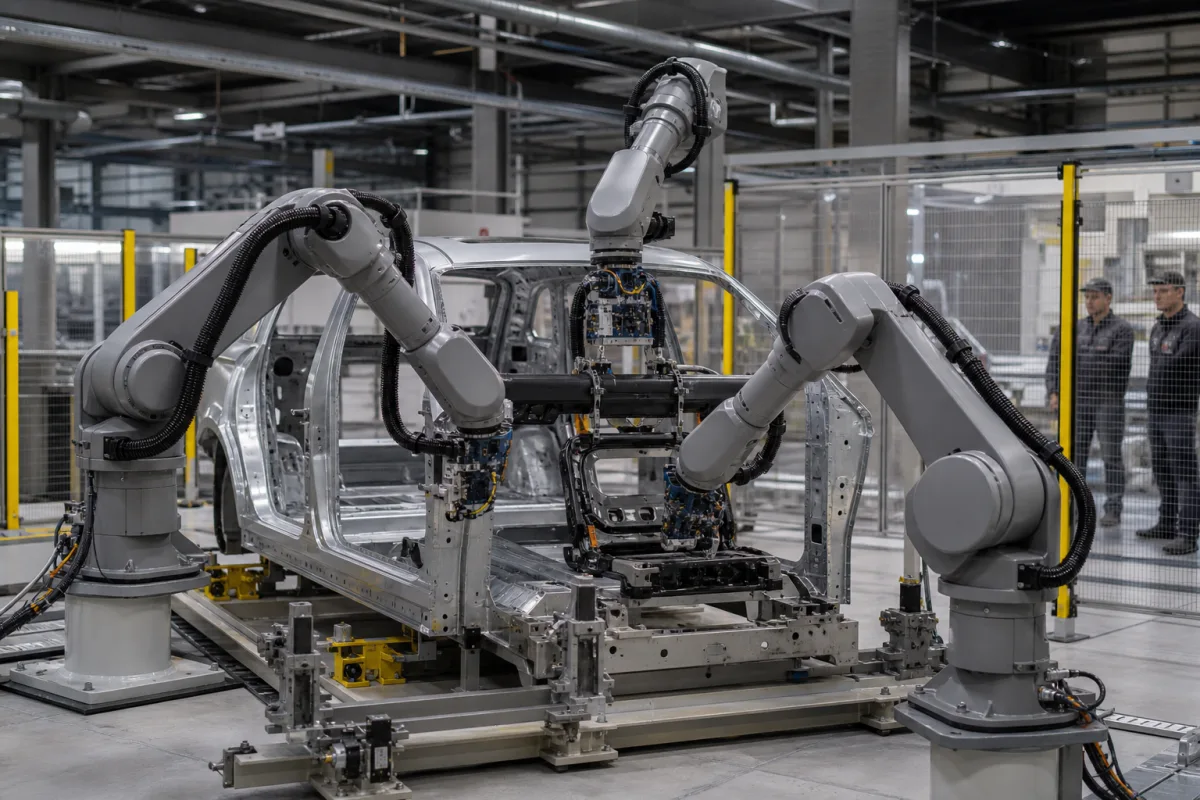
Automated robotic manipulators designed for precise assembly operations in automotive chassis production

Product Specifications

Technical details and manufacturing context for Robotic Assembly Arms

Definition
Specialized robotic arms integrated within the Automotive Modular Chassis Assembly System that perform high-precision assembly tasks including component placement, fastening, welding, and quality inspection during chassis manufacturing processes
Working Principle
Utilizes servo motors, precision gears, and advanced control systems to execute programmed assembly sequences with sub-millimeter accuracy, typically operating in 6-axis configurations for maximum flexibility in chassis component manipulation
Common Materials
Aluminum alloy, Carbon steel, Industrial-grade polymers
Technical Parameters
  • Positioning accuracy for chassis component assembly (mm) Per Request
Components / BOM
  • End Effector
    Specialized tooling for gripping, welding, or fastening chassis components
    Material: Tool steel
  • Servo Motors
    Provide precise rotational movement for each joint axis
    Material: Copper windings, steel housing
  • Control System
    Processes assembly instructions and coordinates arm movements
    Material: Electronic components, aluminum housing
Engineering Reasoning
0.1-1.5 mm positioning accuracy, 0.5-2.0 m/s maximum speed, 5-150 kg payload capacity
Joint backlash exceeding 0.05 mm, servo motor temperature exceeding 85°C, encoder resolution loss below 0.001°
Design Rationale: Harmonic drive gear tooth fatigue at 10^7 cycles under 80% rated torque, permanent magnet demagnetization at 150°C Curie temperature, ball screw thermal expansion coefficient mismatch (17 μm/m·K vs 23 μm/m·K)
Risk Mitigation (FMEA)
Trigger Servo amplifier current ripple exceeding 5% RMS at 2 kHz switching frequency
Mode: Permanent magnet synchronous motor cogging torque variation exceeding 2% rated torque
Strategy: Multi-level inverter topology with 7-level PWM modulation and 0.1 μF snubber capacitors
Trigger Harmonic drive flexspline fatigue crack propagation at stress intensity factor K_I = 25 MPa√m
Mode: Circular spline-to-flexspline transmission error exceeding 30 arc-seconds
Strategy: Carburized SCM420 steel with case depth 0.8 mm and surface hardness 58 HRC minimum

Industry Taxonomies & Aliases

Commonly used trade names and technical identifiers for Robotic Assembly Arms.

Industrial Ecosystem & Supply Chain DNA

Complementary Systems
Downstream Applications
Specialized Tooling

Application Fit & Sizing Matrix

Operational Limits
pressure: N/A (mechanical system)
other spec: Payload capacity: 5-500 kg, Repeatability: ±0.02-0.1 mm, Reach: 1-3 m, IP rating: IP54-IP67
temperature: 0°C to 50°C (operating), -20°C to 70°C (storage)
Media Compatibility
✓ Automotive chassis components (steel/aluminum) ✓ Fasteners and connectors ✓ Adhesive/sealant application systems
Unsuitable: High-corrosive chemical bath environments (e.g., acid pickling tanks)
Sizing Data Required
  • Payload weight and center of gravity
  • Required reach and work envelope dimensions
  • Cycle time and precision requirements (±mm repeatability)

Reliability & Engineering Risk Analysis

Failure Mode & Root Cause
Gearbox backlash and wear
Cause: Inadequate lubrication, contamination ingress, or excessive cyclic loading leading to pitting, spalling, and increased positional error
Encoder or resolver signal degradation
Cause: Electrical noise interference, thermal drift, mechanical misalignment, or aging of optical/ magnetic components causing loss of positional feedback accuracy
Maintenance Indicators
  • Unusual grinding, clicking, or whining noises from joints during motion, indicating gear wear or bearing failure
  • Erratic or 'jumpy' arm movement, drift from programmed positions, or servo fault alarms suggesting feedback or drive system issues
Engineering Tips
  • Implement condition-based lubrication with high-purity, manufacturer-specified greases and monitor particle counts in gearbox oil to prevent abrasive wear
  • Regularly calibrate and align encoders/resolvers, ensure proper shielding and grounding of feedback cables, and maintain stable ambient temperature to preserve positional accuracy

Compliance & Manufacturing Standards

Reference Standards
ISO 10218-1:2011 - Robots and robotic devices - Safety requirements for industrial robots ANSI/RIA R15.06 - Industrial Robots and Robot Systems - Safety Requirements CE Marking - Compliance with EU Machinery Directive 2006/42/EC
Manufacturing Precision
  • Positioning repeatability: +/-0.02mm
  • Path accuracy: +/-0.1mm over full working envelope
Quality Inspection
  • Laser interferometer calibration for positioning accuracy
  • Dynamic load testing with force/torque sensors

Factories Producing Robotic Assembly Arms

Verified manufacturers with capability to produce this product in China

✓ 92% Supplier Capability Match Found

T Technical Director from United States Feb 03, 2026
★★★★★
"Found 16+ suppliers for Robotic Assembly Arms on CNFX, but this spec remains the most cost-effective."
Technical Specifications Verified
P Project Engineer from United Arab Emirates Jan 31, 2026
★★★★☆
"The technical documentation for this Robotic Assembly Arms is very thorough, especially regarding technical reliability. (Delivery took slightly longer than expected, but technical support was excellent.)"
Technical Specifications Verified
S Sourcing Manager from Australia Jan 28, 2026
★★★★★
"Reliable performance in harsh Motor Vehicle Manufacturing environments. No issues with the Robotic Assembly Arms so far."
Technical Specifications Verified
Verification Protocol

“Feedback is collected from verified sourcing managers during RFQ (Request for Quote) and factory evaluation processes on CNFX. These reports represent historical performance data and technical audit summaries from our B2B manufacturing network.”

6 sourcing managers are analyzing this specification now. Last inquiry for Robotic Assembly Arms from Vietnam (26m ago).

Supply Chain Compatible Machinery & Devices

Automotive Solid-State Battery Pack

High-energy-density solid-state battery system for electric vehicles

Explore Specs →
Automotive Active Grille Shutter System

Aerodynamic system with motorized shutters for vehicle thermal and efficiency management.

Explore Specs →
Automotive Active Suspension Damping System

Electronically controlled suspension system for vehicle stability and comfort.

Explore Specs →
Ground Assembly Unit

A foundational structural component that provides stable mounting and alignment for equipment within an industrial system.

Explore Specs →

Frequently Asked Questions

What makes these robotic arms suitable for automotive chassis assembly?

These robotic arms are specifically engineered for automotive chassis production with high precision positioning, durable aluminum alloy and carbon steel construction, and specialized end effectors for handling chassis components securely during assembly operations.

How do the servo motors enhance assembly precision in vehicle manufacturing?

The integrated servo motors provide precise torque control and positional accuracy, enabling consistent assembly of chassis components with tight tolerances required in automotive manufacturing, reducing errors and improving production quality.

Can these robotic arms be integrated with existing automotive assembly lines?

Yes, these robotic assembly arms feature modular control systems and standardized interfaces that allow seamless integration with existing automotive production lines, supporting various communication protocols used in vehicle manufacturing facilities.

Can I contact factories directly on CNFX?

CNFX is an open directory, not a transaction platform. Each factory profile provides direct contact information and production details to help you initiate direct inquiries with Chinese suppliers.

Get Quote for Robotic Assembly Arms

Request technical pricing, lead times, or customized specifications for Robotic Assembly Arms directly from verified manufacturing units.

Your business information is encrypted and only shared with verified Robotic Assembly Arms suppliers.

Thank you! Your message has been sent. We'll respond within 1–3 business days.

Need to Manufacture Robotic Assembly Arms?

Connect with verified factories specializing in this product category

Add Your Factory Contact Us
Previous Product
Road Sweeper
Next Product
Robotic Welding Station