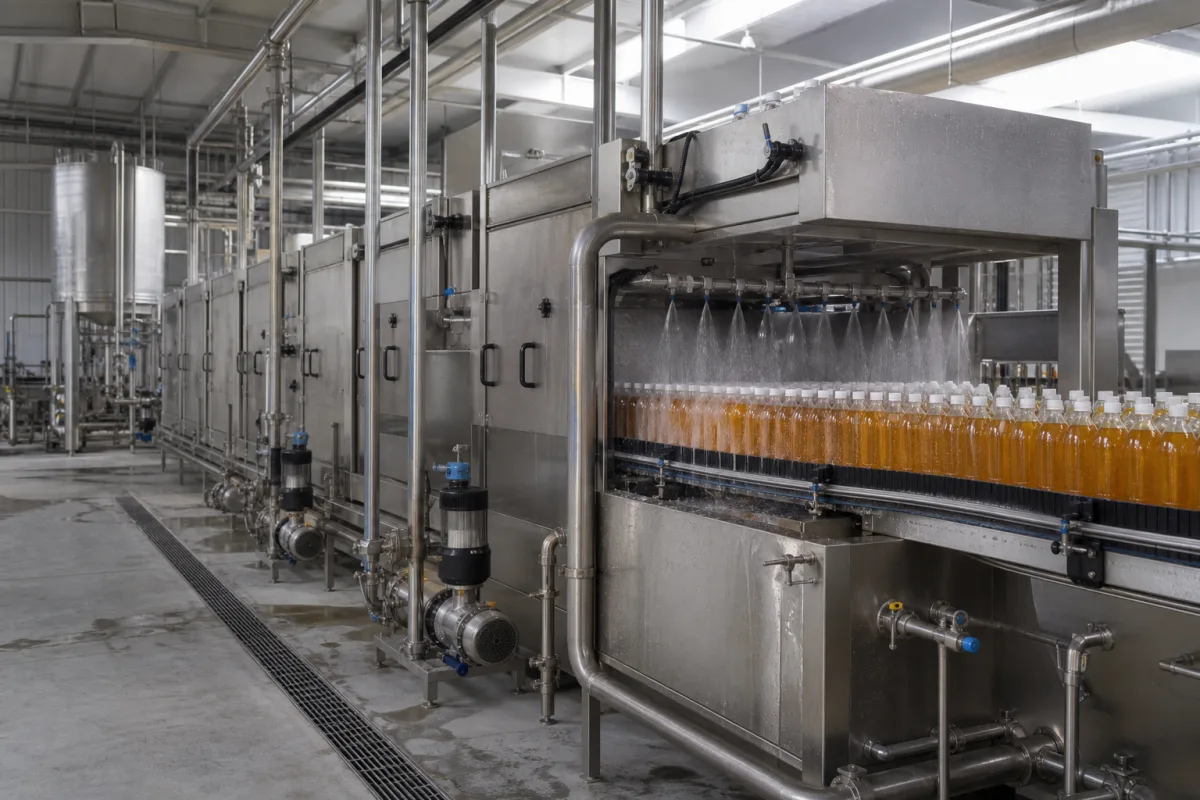
Tunnel pasteurizers for packaged beverages · Spray zones that heat, hold and cool bottles and cans, pasteurization units (PU) defined at 60 °C and calculated at the coldest spot, zone temperatures and times, control after line stoppages, published machine capacities, widths and treatment areas
A tunnel pasteurizer, or pasteurization and cooling tunnel, carries filled and closed bottles or cans on a conveyor through successive zones where water is sprayed at rising, holding and falling temperatures, so the product is heated to pasteurizing temperature for a set time and then cooled before labelling and packing. Ask three things first: what pasteurization units (PU) the product needs at its coldest point and what over-pasteurization it can tolerate, what number of zones and what spray temperatures and times the tunnel uses, and how the control keeps PU on target when the filling line stops.
Tunnel pasteurizers and pasteurization-cooling tunnels for beverages in glass bottles, cans and PET containers. Flow-through HTST pasteurisers for bulk liquids (see continuous flow pasteurization system), UHT and aseptic systems, retorts and container sterilisers are outside this page.
CNFX editorial research · Sources checked October 12, 2026 · 5 sources
Fontana and Schneider (ENCIT 2010, UFRGS and Ziemann-Liess) describe beer pasteurized in its container in tunnel pasteurizers, where bottles pass through a series of baths at different temperatures for gradual heating and cooling. They quantify pasteurization as PU = t × 1.393^(T_CS − 60), where T_CS is the temperature at the coldest spot inside the bottle at each instant, and state that PU must always be calculated at the coldest point so the target is met there. [1]
The paper warns that under-pasteurization fails to destroy microorganisms, while over-pasteurization changes beer flavour, aroma, colour and chemical stability, and that containers filled with about 5–6% headspace can break inside the machine at very high temperatures or if overfilled, because of carbon dioxide pressure. [1]
US patent 4,849,235 (Société Nouvelle Baele Gangloff, 1989) defines a unit of pasteurization as the effect of holding beer for one minute at 60 °C (140 °F); its formula uses a product constant of 60 for beer and a z parameter, a function of the bacteria to be destroyed, of 7 for beer. It divides the tunnel into a preheat zone with no PU uptake, a prepasteurization zone where uptake begins, for example 0.1 PU/min from about 53 °C for beer, a pasteurization zone held at, for example, 60 °C, and a cooling zone where containers gain a few more PU until they fall back to that threshold. It warns that over-pasteurization denatures the taste, clouds the liquid and may cook it. [2]
Editorial calculation: with z = 7, each 1 °C above 60 °C multiplies the PU rate by 10^(1/7) ≈ 1.389, close to the 1.393 base in the ENCIT formula (which corresponds to z ≈ 6.94); at 53 °C the rate is 10^(−7/7) = 0.1 PU per minute, matching the patent's figure; and 10 minutes at a cold-spot temperature of 62 °C gives about 10 × 10^(2/7) ≈ 19.3 PU. The ENCIT paper states its time t in seconds while the patent defines PU per minute, so confirm the time unit, reference temperature and z the supplier's controller uses before comparing PU numbers. [2][1]
Editorial note: the PU target, reference temperature and z-value depend on the beverage and its spoilage organisms; set them with your quality team, and ask the supplier to show the cold-spot PU, not only spray temperatures, for each container format.
Give the supplier the beverages and containers (glass, can, PET; sizes; fill and headspace), PU target and tolerance, maximum product temperature, inlet and outlet product temperatures, line output, conveyor width and deck layout, number of zones, heat recovery between zones, water treatment, steam or hot-water supply, PU control after stoppages, CIP and footprint.
02
Check zone temperatures, times and stoppage control
In the study's test rig, which reproduced real tunnel conditions with spray pumps and a hot-water tank at up to 85 °C, heating tests used baths of 30, 40, 50 and 60 °C for 280 s each on 600 mL glass beer bottles, with probes of ±0.2 °C uncertainty in the bottle's cold spot. The cold spot lagged the spray water, starting near 16 °C and reaching about 50 °C by the end of the 60 °C bath. [1]
The authors note that older machines only monitor bath temperatures and do not correct for quick stops of the filling line, so product can leave outside the quality range; in one measured run, stoppages stretched a process that should take at most 2,830 s to 4,074 s. Implementing their cold-spot model in a tunnel pasteurizer's controller put up to 95% of PU measurements inside the desired range, against 83% without it. [1]
The 1989 patent describes the same stoppage problem: if a container stays in the tunnel longer than planned, for example after a downstream jam, or the belt is slowed for a slow arrival of containers, it ends with more PU than the admissible maximum. Its answer is to split the prepasteurization and pasteurization zones into regulation sub-zones, follow one or more reference containers in each, compute their PU continuously, and trigger cooling in a sub-zone once a reference container reaches the maximum PU while all others have reached the minimum. Its example plant keeps hot water at 75 °C and cold water at 30 °C in separate reservoirs feeding three-way valves on each half-box. [2]
Editorial calculation: four heating baths of 280 s add up to 1,120 s (about 19 minutes), yet the cold spot was still about 10 °C below the last bath temperature; ask the supplier to size the heating and holding zones from cold-spot data for your container rather than from spray temperatures. [1]
03
Compare published machine data from three makers
KHS, Krones and Sidel each publish capacity, size and control data for their own tunnels; set these against a cold-spot PU record from your own containers.
KHS's data sheet for the Innopas PI/IISC modular tunnel pasteurizer lists capacities of 5,000 to 180,000 containers/hr depending on product and container size, processing widths of 2.6–7.2 m, single- and double-deck variants and glass bottles, PET bottles and cans. It bases PU control on measuring the actual temperature-time behaviour of the container being processed, uses one central heat exchanger, and offers use as a warmer or recooler. [3]
Krones's brochure for the LinaFlex Compact gives two treatment areas, 23 m² (9.6 m long, 2.4 m wide) and 27 m² (11.2 m long, 2.4 m wide), an overall machine of 13.1 m by 3.55 m by 2.1 m high, an empty weight of 8,500 kg and infeed and discharge heights of 1.2 m. Its PUC³ controller calculates product temperature and the resulting PU for each container series, adjusts spray temperature to the PU requested and already reached, and is stated to keep PU intake uniform during interruptions and stops. Krones also lists AISI 304 construction with 316L optional, energy consumption of approx. 12 kW, heating in under 15 minutes and product change-over in less than 10 minutes depending on the zone configuration. [4]
Sidel's SWING Evo page describes modules that run autonomously with the top and bottom decks moving in opposite directions (counterflow), a PRINCE X predictive control that adjusts spray conditions in real time during production stops or power fluctuations, and operation as a standalone cooler. Against its previous SWING generation, Sidel claims 10% less water, 35% less electricity and 10% less steam. [5]
Editorial note: these makers state PU control differently (measured container behaviour, calculated product temperature, predictive control); ask each for a PU record from a test container at your coldest spot through a planned stop, and for utility consumption at your output and container.
04
Shower pasteurising-cooling tunnels and tunnel pasteurizers on the listed makers' sites
Newamstar's page describes a five-stage hot-water spray with stepwise cooling; ask both makers how their control handles cold-spot PU and line stops, the points on which the KHS, Krones and Sidel data above differ.
05
Conveyor deck, spray zones, pumps, tanks, heating supply, sensors and PU controller
The patent's four zones (preheat, prepasteurize, pasteurize, cool) define the spray-zone row; the PU controller row is where the ENCIT cold-spot model and Krones's PUC³ act during line stops. [2][1][4]
Part
Role
Fix in the order
Conveyor deck
Carries containers through zones; single or double deck. [1][3]
PU definition, zone temperatures and times, container, stoppage control and output for a tunnel pasteurizer
The bath and container rows come from one 600 mL glass-bottle test, so treat them as an example and ask for the supplier's validated profile for each of your formats. [1]
2 companies list this product among what they make. Company figures are quoted from each
company's own website; every card states where the relationship came from.
Jiangsu Newamstar Packaging Machinery Co., Ltd.
Manufacturing site to be confirmed for the order
Its website lists a shower pasteurising and cooling tunnel with five-stage hot-water spraying and stepwise cooling.
Explore company information and manufacturing capabilities, then discuss the scope of your project with a relevant supplier.
Share this page
Compiled and source-reviewed by the CNFX editorial team.
Each manufacturer above links to the page on that company's own website where the product is listed, with the date we checked it. How we source and review
· Page last updated 13 October 2026
Buyer questions
What is one pasteurization unit?
A 1989 patent defines it for beer as the effect of one minute at 60 °C, with z = 7 for beer; reference values for other beverages must come from your quality team. [2]
How are pasteurization units calculated in a tunnel pasteurizer?
One study gives PU = t × 1.393^(T−60), using the temperature at the coldest spot inside the container. [1]
Why measure the cold spot rather than the spray water?
In one test the bottle's cold spot reached only about 50 °C after a 60 °C bath, so spray temperatures overstate product heating. [1]
What happens when the filling line stops?
Products stay longer in hot zones; a cold-spot control model raised in-range PU results to up to 95% from 83%. [1]
Sources and what still needs a direct check
Sources checked 2026-10-12. The ENCIT 2010 paper reports tests on bottled beer in one machine design, and the 1989 patent gives beer PU constants as examples; neither is a specification for all beverages. The machine figures come from makers' own documents. PU targets and zone design for your products must come from your quality team and the supplier's validation.