Industry-Verified Manufacturing Data (2026)

Heating Section

Based on aggregated insights from multiple verified factory profiles within the CNFX directory, the standard Heating Section used in the Beverage Manufacturing sector typically supports operational capacities ranging from standard industrial configurations to heavy-duty production requirements.

Technical Definition & Core Assembly

A canonical Heating Section is characterized by the integration of Heat Exchanger Core and Temperature Sensor Array. In industrial production environments, manufacturers listed on CNFX commonly emphasize Stainless Steel (AISI 304/316L) construction to support stable, high-cycle operation across diverse manufacturing scenarios.

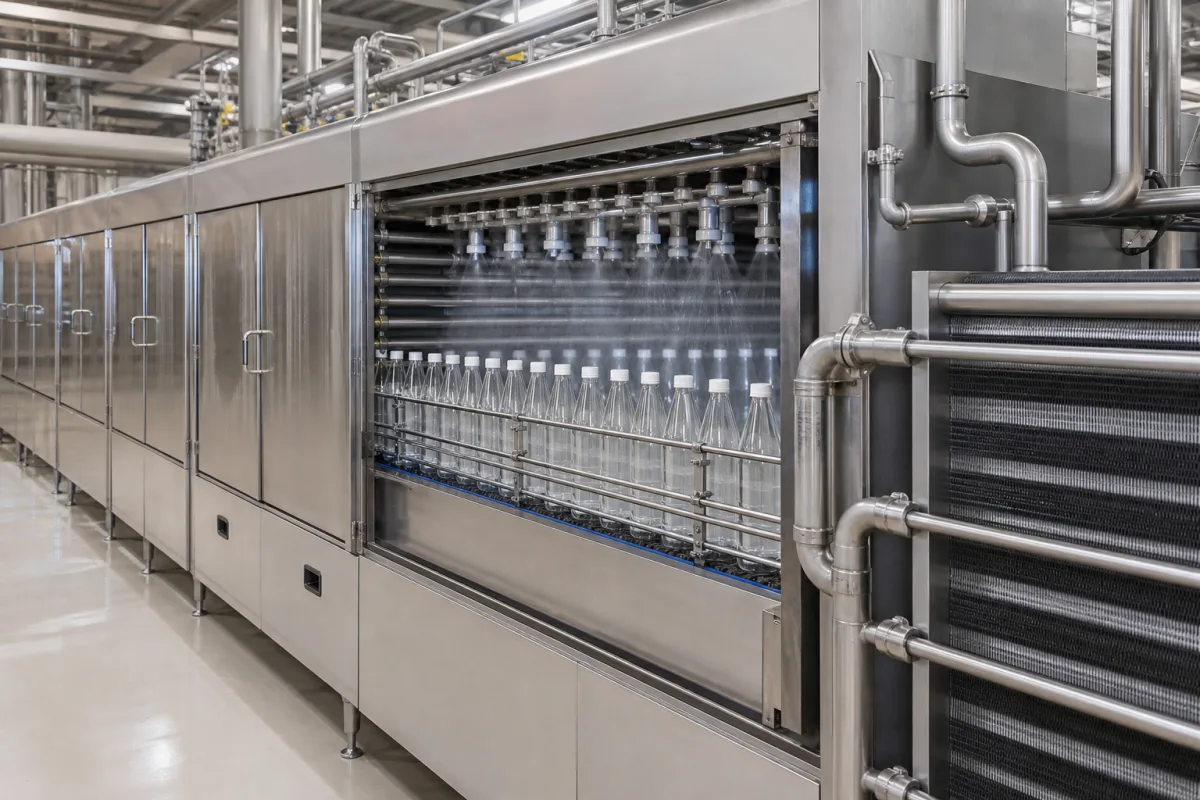
The heating section is the component within an integrated beverage pasteurization and cooling tunnel system responsible for raising the temperature of beverages to the required pasteurization level.

Product Specifications

Technical details and manufacturing context for Heating Section

Definition
The heating section is a critical component of the Integrated Beverage Pasteurization and Cooling Tunnel System. Its primary function is to uniformly and precisely elevate the temperature of the beverage product (such as juice, milk, or other liquid drinks) to a specific target range, typically between 72°C to 95°C (161°F to 203°F), to achieve effective pasteurization. This process eliminates pathogenic microorganisms and deactivates enzymes, thereby ensuring product safety and extending shelf life while maintaining the beverage's sensory and nutritional qualities. The section is designed for controlled, efficient heat transfer as the product flows through the tunnel.
Working Principle
The heating section operates by transferring thermal energy to the beverage product. This is typically achieved through indirect heat exchange. The beverage flows through a sanitary tube or plate heat exchanger. A heating medium (such as hot water or steam) circulates on the opposite side of the heat transfer surface, warming the beverage without direct contact. Precise temperature control systems (sensors, controllers, and regulating valves) maintain the target temperature throughout the section to ensure consistent pasteurization efficacy.
Common Materials
Stainless Steel (AISI 304/316L), Food-grade elastomers (for gaskets/seals)
Technical Parameters
  • Length of the heating section within the tunnel, affecting residence time and capacity. (mm) Per Request
Components / BOM
  • Heat Exchanger Core
    Provides the surface area for efficient thermal transfer from the heating medium to the beverage.
    Material: Stainless Steel
  • Temperature Sensor Array
    Monitors beverage temperature at multiple points to ensure uniform heating and precise control.
    Material: Stainless Steel housing, PTFE/PFA insulation
  • Heating Medium Control Valve
    Regulates the flow rate and/or pressure of the heating medium (steam/hot water) to control the heat input.
    Material: Stainless Steel
  • Insulation Jacket
    Minimizes heat loss to the environment, improving energy efficiency and maintaining operator safety.
    Material: Stainless Steel cladding with mineral wool or foam insulation
Engineering Reasoning
65-95°C with 0.5°C precision, 0.2-0.8 MPa pressure
Temperature exceeds 105°C causing protein denaturation threshold, or drops below 60°C failing pasteurization efficacy
Design Rationale: Thermal stress from cyclic heating/cooling causing microcrack propagation in stainless steel 316L at >80°C differentials
Risk Mitigation (FMEA)
Trigger PLC PID loop oscillation exceeding ±2°C setpoint deviation
Mode: Thermal shock cracking in heat exchanger plates
Strategy: Implement feedforward control with 0.1°C resolution RTD sensors and 10ms response time
Trigger Calcium carbonate scaling exceeding 0.5mm thickness on heat transfer surfaces
Mode: 15% reduction in heat transfer coefficient (U-value drops below 850 W/m²·K)
Strategy: Install CIP system with 2% nitric acid solution at 75°C for 20-minute cycles every 8 hours

Industry Taxonomies & Aliases

Commonly used trade names and technical identifiers for Heating Section.

Industrial Ecosystem & Supply Chain DNA

Complementary Systems
Downstream Applications
Specialized Tooling

Application Fit & Sizing Matrix

Operational Limits
pressure: Up to 6 bar (typical beverage processing)
flow rate: 1-20 m³/h (adjustable based on tunnel capacity)
temperature: 60-95°C (pasteurization range)
slurry concentration: Up to 30% solids (for pulp-containing beverages)
Media Compatibility
✓ fruit juices (acidic media) ✓ dairy-based beverages ✓ carbonated soft drinks
Unsuitable: highly abrasive slurries with >40% solids
Sizing Data Required
  • required pasteurization temperature (°C)
  • maximum beverage flow rate (m³/h)
  • initial beverage temperature (°C)

Reliability & Engineering Risk Analysis

Failure Mode & Root Cause
Thermal fatigue cracking
Cause: Cyclic thermal stress from repeated heating/cooling cycles, often due to rapid temperature changes, poor temperature control, or uneven heating distribution
Corrosion and scaling
Cause: Chemical attack from process fluids, water impurities (hardness minerals), or atmospheric contaminants combined with elevated temperatures accelerating degradation
Maintenance Indicators
  • Unusual temperature fluctuations or inability to maintain setpoint despite normal energy input
  • Visible leaks, steam/water weeping, or audible hissing/pinging noises from the heating section
Engineering Tips
  • Implement gradual startup/shutdown procedures and maintain consistent operating temperatures to minimize thermal cycling stress
  • Establish regular chemical treatment and blowdown routines for water-based systems, and install corrosion monitoring coupons for early detection

Compliance & Manufacturing Standards

Reference Standards
ISO 9001:2015 - Quality Management Systems ANSI Z21.10.3 - Gas Water Heaters CE Marking - EU Safety, Health, and Environmental Requirements
Manufacturing Precision
  • Temperature Uniformity: +/- 2°C across heating surface
  • Dimensional Stability: +/- 0.5mm after thermal cycling
Quality Inspection
  • Thermal Imaging Test for heat distribution uniformity
  • Leakage Current Test for electrical safety

Factories Producing Heating Section

Verified manufacturers with capability to produce this product in China

✓ 93% Supplier Capability Match Found

P Project Engineer from Germany Feb 06, 2026
★★★★★
"Standard OEM quality for Beverage Manufacturing applications. The Heating Section arrived with full certification."
Technical Specifications Verified
S Sourcing Manager from Brazil Feb 03, 2026
★★★★★
"Great transparency on the Heating Section components. Essential for our Beverage Manufacturing supply chain."
Technical Specifications Verified
P Procurement Specialist from Canada Jan 31, 2026
★★★★★
"The Heating Section we sourced perfectly fits our Beverage Manufacturing production line requirements."
Technical Specifications Verified
Verification Protocol

“Feedback is collected from verified sourcing managers during RFQ (Request for Quote) and factory evaluation processes on CNFX. These reports represent historical performance data and technical audit summaries from our B2B manufacturing network.”

17 sourcing managers are analyzing this specification now. Last inquiry for Heating Section from UAE (23m ago).

Supply Chain Compatible Machinery & Devices

Automated Beverage Container Sterilization System

Automated system for sterilizing beverage containers before filling.

Explore Specs →
Automated Beverage Labeling and Coding System

Integrated system for applying labels and printing codes on beverage containers.

Explore Specs →
Automated Beverage Ingredient Dispensing System

Automated system for precise dispensing of beverage ingredients into production lines.

Explore Specs →
Automated Beverage Container Deoxygenation System

Automated system for removing oxygen from beverage containers before filling.

Explore Specs →

Frequently Asked Questions

What materials are used in the heating section for beverage manufacturing?

The heating section is constructed from food-grade stainless steel (AISI 304/316L) for durability and corrosion resistance, with food-grade elastomers used for gaskets and seals to ensure hygiene and prevent contamination.

How does the heating section maintain precise temperature control?

Temperature control is achieved through a combination of a heating medium control valve, temperature sensor array, and insulation jacket, ensuring beverages reach exact pasteurization temperatures consistently.

What components are included in the heating section BOM?

The bill of materials includes: heat exchanger core, heating medium control valve, insulation jacket, and temperature sensor array - all designed for efficient heat transfer and reliable operation in beverage production.

Can I contact factories directly on CNFX?

CNFX is an open directory, not a transaction platform. Each factory profile provides direct contact information and production details to help you initiate direct inquiries with Chinese suppliers.

Get Quote for Heating Section

Request technical pricing, lead times, or customized specifications for Heating Section directly from verified manufacturing units.

Your business information is encrypted and only shared with verified Heating Section suppliers.

Thank you! Your message has been sent. We'll respond within 1–3 business days.

Need to Manufacture Heating Section?

Connect with verified factories specializing in this product category

Add Your Factory Contact Us
Previous Product
Heating Jacket/Element
Next Product
HEPA Filtration Unit