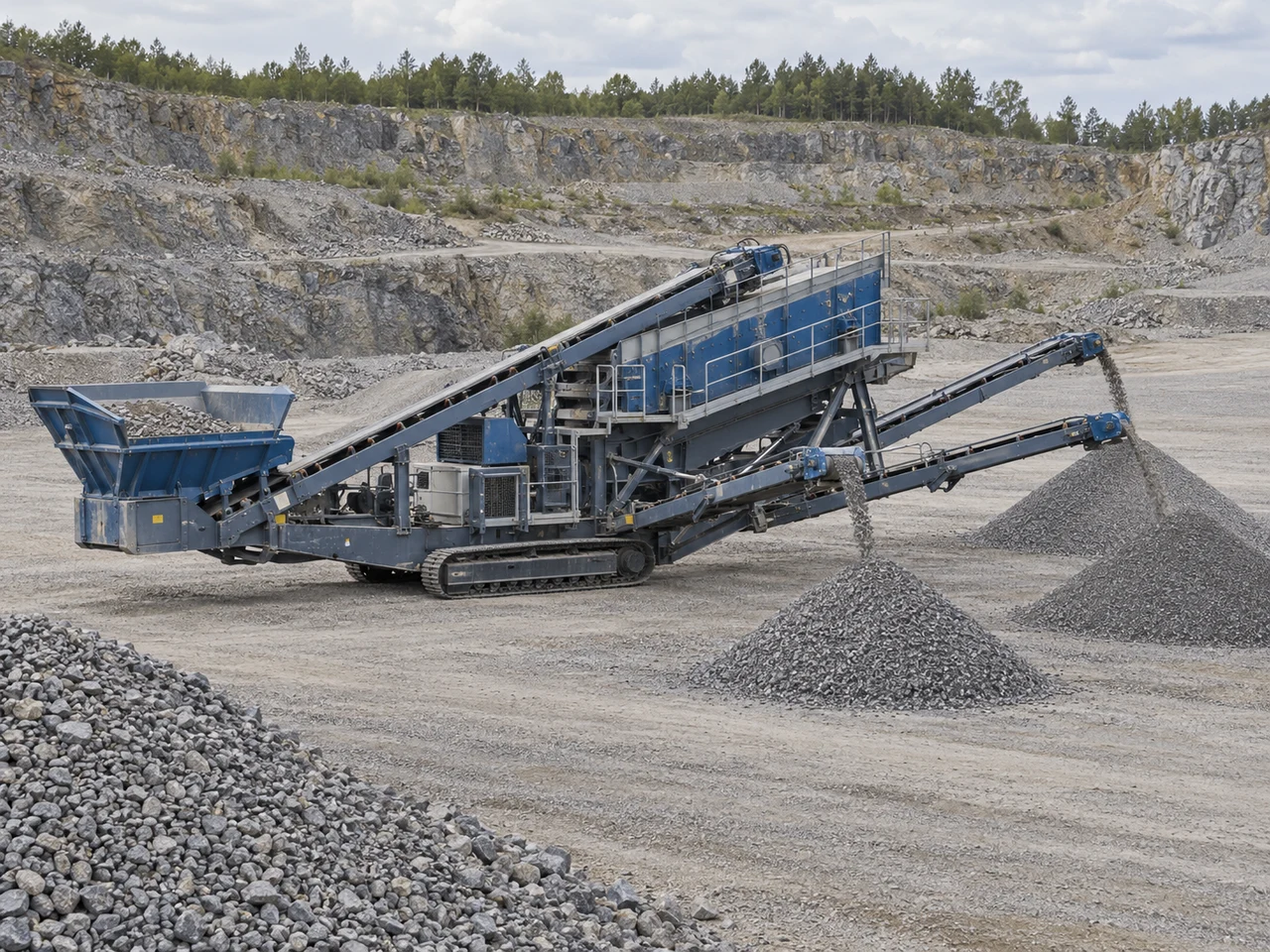
Follow the material through the decks and discharge belts. Use the SANY SCSM1860 example to separate feed capacity, product recovery and transport requirements before specifying a plant.
CNFX editorial research · Sources checked October 12, 2026 · 4 sources
Read the SCSM1860 configuration before arranging the site
SANY’s brochure describes a tracked screen with a diesel generator or external mains supply selectable to suit the site. This is a screening stage: the crushers shown in its process layouts are separate machines, not evidence of an included crushing chamber. [2]
35 t and 38 t are not interchangeable shipping instructions
The brochure labels 35 t as total weight; the web table labels 38 t as transport weight. Neither explains what is fitted or removed. The web table also gives engine power of 100 kW at 1,500 rpm and 55 kW rated whole-machine power, whereas the brochure’s 80 kW is a generator-set figure. These different quantities/configurations remain unreconciled. Obtain a serial/configuration-specific packing and electrical schedule. [1][2]
Allow room for each product stream
The conveyor heights are discharge/stockpiling data, not a storage-volume guarantee. Ask for the deployed layout, discharge trajectories, stockpile clearances and loader access as well as the transport envelope. A folded transport drawing alone cannot establish the working footprint. [2]
Item
SCSM1860
Screen
3 decks, 6000 × 1800 mm; up to 10.8 m² effective area per deck; 2 × 7 kW drive [2]
Oversize: 650 mm belt, 3,100–3,500 mm height. Large and medium fractions: 650 mm belts, 3,500 mm height; fines: 1,200 mm belt, 4,000 mm height. The table qualifies the oversize and large-fraction belt/height entries as including the final screening system; obtain the offered conveyor arrangement. [2]
Power configuration
Brochure: 80 kW diesel generator set, identified as Volvo/Cummins, or mains operation. Confirm the supplied generator, voltage, frequency, starting demand and required external connection. [2]
The feed reaches the screen surface, smaller particles work down through the material bed and pass through openings, and retained material moves to its outlet. Repeating this across decks separates size fractions. Actual cut quality also depends on the material and motion. [4]
Functional assembly / BOM reference
What it does
Construction and supply boundary
Feed hopper and transfer to the screen
Receives and delivers feed to the screening stage.
Confirm hopper wear liners and the feed-distribution arrangement. SANY identifies a 1,200 mm main belt and a 500 mm transfer belt; it does not specify their belt compound or hopper steel grade here. [2]
Screen box, decks and media
Supports the openings at which size separation occurs.
SCSM1860: three decks, 6,000 × 1,800 mm and up to 10.8 m² effective area per deck. Wire, rubber or polyurethane are media-selection questions, not confirmed standard fitment on every SCSM1860. [2][4]
Vibration drive and support system
Produces the motion that transports and stratifies the feed.
The brochure specifies 2 × 7 kW for the screen. Exciter design, bearing selection, support material and vibration settings require the maker’s assembly documents. [2]
Discharge transitions and product conveyors
Keep the separated fractions on their designated routes.
SANY lists oversize, large, medium and fine outputs. Request chute liners, belt grades, guarding and the actual conveyor configuration; do not assume stainless-steel chutes. [2]
Supporting chassis and tracks
Carries the equipment and provides site travel.
The brochure describes an excavator chassis, 37 kW travel drive and wireless control. Frame grades, weld acceptance and ground-bearing requirements are not published in this table. [2]
Electrical power and controls
Supplies and coordinates the screen, conveyors and travel.
SANY describes a touchscreen and wireless remote, with generator/mains selection. Cabinet material, IP rating and the delivered electrical diagram need confirmation. [2]
Dust-control enclosure or extraction interface, if ordered
Defines the dust-control provision at the screening and transfer points.
A complete enclosure and galvanized construction are not established by the reviewed SANY sources. Specify the site requirement and ask what is actually included; do not count this as a confirmed standard component. [2]
This is a functional reference for defining the order, not a fabrication bill of quantities. The brochure does not establish material grades for the whole plant.
03
Understand what the capacity figure depends on
SANY qualifies its 300 t/h as depending on the characteristics of the raw material [2].
Send a gradation curve
Give the supplier a sieve analysis of the feed and the product cut sizes you need.
Ask for a screen calculation
Request the predicted rate and grading curve of each product, plus a defined efficiency for each deck, using your feed analysis and moisture conditions. [4]
Match the crusher
Compare crusher output, screen feed and any return stream in the same mass balance. They are different rates, especially in a closed circuit. [4]
Feed gradation
Near-aperture undersize has fewer successful chances to pass than much smaller particles; its share of the feed matters, not only the largest lump. [4]
Moisture and clay
For ordinary dry screening, sticking fines can prevent separation. Wet screening is a separately designed process; “drier is easier” is not a rule for every wet-screen application. [4]
Distribution and bed depth
Even feed helps use the width. Too much bed depth delays fines reaching the deck; an excessively thin bed can also lose effective contact through bouncing. Reducing feed indefinitely does not guarantee improvement. [4]
The limiting stage
Check the screen against the upstream crusher and required product curves. Changing media cannot by itself cure an undersized screening stage. [3]
04
Keep deck settings separate from engine and travel ratings
Specification field
Evidence and order detail
Screening area · m²
Up to 10.8 per deck in the SANY brochure. Adding three deck areas does not give 32.4 m² available to a single cut. Identify usable area and media open area separately. [2][4]
Throughput · t/h
300 in the SANY table, expressly dependent on raw material. Define whether the quoted rate is feed or a particular output, and state moisture, feed grading and product limits. [2]
Number of decks
Three for this SCSM1860 reference. Confirm the cut on each deck and routing of every outlet. [2]
Vibration frequency · Hz or rpm
No operating screen frequency is supplied in these SANY tables. The web page’s 1,500 rpm belongs to the engine; it is not the screen’s vibration frequency. [1]
Power · kW
Separate the screen’s 2 × 7 kW, travel’s 37 kW, generator’s 80 kW, and web engine/whole-machine figures. A sum of motor nameplates does not establish external supply or starting demand. [2][1]
Aperture and media geometry · mm
Specify each deck’s opening, shape, thickness and open area. Nominal aperture alone does not establish the actual separation size. [4]
Operating temperature · °C
Ambient and feed-temperature limits are not stated here. Request limits for the offered media, drives and electrical equipment. [2]
Vibration amplitude / stroke · mm
Not published in these SANY tables. Ask for the operating setting, its measurement convention and permitted adjustment with the selected media. [2][4]
Noise · dB(A)
No noise result or measurement conditions are given here. Request the applicable test declaration, measurement quantity and operating conditions. [2]
Mass · t
Brochure total weight: 35; web transport weight: 38. Reconcile the configuration, liquids, accessories and dismantled items before transport planning. [2][1]
Ingress protection
No cabinet or motor IP code is established by these sources. Identify the rated item, rather than assigning one code to the entire plant. [2]
Screen inclination · degrees
Not specified in the reviewed table. The published 9° is maximum climbing angle, not deck inclination. Obtain the operating deck angle and its adjustment limits. [2]
05
Name the denominator before quoting screening efficiency
Metso’s handbook defines screening efficiency per deck and distinguishes retained-product cleanliness from recovery of undersize. Its detailed definitions are more precise than the 2021 blog’s shorthand linking 90% efficiency to 10% recirculation. Use the agreed definition in the acceptance test. [4][3]
A 90% recovery can leave a 46 t/h retained stream
Illustrative mass balance, not a SANY test: suppose one deck receives 100 t/h containing 60 t/h undersize and 40 t/h oversize. At 90% undersize recovery, 54 t/h passes and 6 t/h of undersize remains. Assuming no oversize passes and no material is lost, the retained stream is 46 t/h, with 6 ÷ 46 = 13.0% undersize contamination. If all retained material returns upstream, that is 46 t/h—not 10 t/h. The example applies the handbook’s recovery definition. [4]
Measure
Calculation and meaning
Undersize recovery
Undersize mass rate passing the deck ÷ undersize mass rate in that deck’s feed × 100%. This needs feed composition and stream rates; the handbook says “The efficiency of undersize recovery is most commonly referred as screening efficiency”. [4]
Undersize contamination of the retained stream
Undersize in a representative retained-stream sample ÷ total sample mass × 100%. This describes that stream’s composition, not recovery from the feed. A single sample fraction does not supply a plant mass balance. [3][4]
Return load
Identify the actual stream returned upstream and the rate against which its percentage is quoted. It cannot be obtained by subtracting undersize recovery from 100%. [4]
Agree a representative sampling and weighing method for the feed and outputs under steady conditions; any belt sampling must follow the site’s approved isolation/access procedure. Record product sieve curves as well as efficiency. Metso notes that a high efficiency does not by itself prove the required product grading. [4]
06
Pick screen media and deal with moisture
Specify the media and attachment system for each deck. The Metso article’s rubber-versus-wire figures describe its comparison; they are not a guaranteed life ratio or change-out time for the SCSM1860. [3]
Calculate downtime without calling it recovered sales
The Metso article illustrates four wire changes taking six hours each: 24 stopped hours, or 72 person-hours with three people. At an assumed 200 t/h, 24 × 200 = 4,800 t of gross processing opportunity. That is not guaranteed saleable production or the net saving from rubber: subtract its own change-out time and check yield, other stoppages, demand and storage. [3]
Inspect the feed pattern before changing the media
Metso uses wear near the feed on the second deck as an example of a normal pattern; concentrated mid-deck wear can indicate a feed-distribution problem. It also discusses nearby anti-blinding rods for suitable installations. Have the supplier confirm the arrangement and clearances, then follow its service procedure. [3]
Item
Modular rubber media
Wire mesh
Wear and fit
Obtain a wear-life basis for the actual feed and compatible modular mounting.
Compare aperture, wire size, open area and expected wear on the same duty.
Change-out
Confirm isolation, access, lifting and work scope for the offered modules.
Record the number of people, lifting equipment and time for the offered panels.
Moisture and blinding
Ask whether resilient media or a compatible anti-blinding system suits the feed.
Check sticking and pegging during a material trial; do not infer performance from aperture alone.
SANY describes hydraulic lifting of the screen, main conveyor and fines conveyor to create space for screen replacement. Confirm the maker’s isolation, mechanical support and access procedure; hydraulic adjustment alone does not define a safe maintenance condition. [1]
07
Describe the feed, the cuts and how acceptance will be measured
Paste it into your enquiry below or into an email to a maker, then replace every bracket.
Material and application [ ]; feed sieve curve attached [ ]; bulk density [ ]
Maximum lump [mm]; moisture range [%]; clay/sticky fraction [ ]; temperature [ ]
Fresh feed [t/h]; upstream crusher [ ]; proposed return stream and rate [ ]
Required size fractions [mm]; grading limits and tonnage of each product [ ]
Deck count [ ]; aperture/shape/media/open area per deck [ ]
Agreed recovery or contamination definition for each deck [ ]; sampling/test method [ ]
Feed hopper/liners, conveyors, guards and dust-control scope [ ]
Deployed layout, discharge heights, stockpiles and loader clearance [ ]
Generator or mains mode [ ]; voltage/frequency [ ]; running/starting supply requirement [ ]
Transport configuration, itemized weights/dimensions and dismantling [ ]
Site ground/access conditions, travel restrictions and operating deck angles [ ]
Media replacement procedure, wear parts and isolation/access instructions [ ]
Guaranteed outputs on stated feed conditions and supporting trial [ ]
Quantity [ ]; destination [ ]; delivery date [ ]
SANY and SBM publish tracked aggregate screening plants. Read each scope before selecting a supplier.
SANY Group
Manufacturing site to be confirmed for the order
SCSM1860 is explicitly listed as a mobile screening plant. Its web and brochure weight/power labels differ as discussed above. Request the actual configuration and feed-dependent product guarantee; group branding does not identify the contracted manufacturing site.
SBM (Shibang Industry & Technology Group Co., Ltd.)
Manufacturing site to be confirmed for the order
Explicitly publishes a tracked mobile screening plant for aggregates and other materials. The same page headline says up to 800 t/h while its introduction says up to 400 TPH, without a model/configuration mapping. Resolve that discrepancy in a signed specification. The footer names Shanghai Shibang Machinery Sales Co., Ltd.; establish the seller and manufacturing entity.
Publishes custom vibrating screens for mining, aggregate and other bulk materials, with vibrating-motor, electromagnetic and exciter drive options. This establishes a screen offering, not a complete tracked plant with hopper, conveyors and power package.
Publishes shafted and shaftless trommel screens for slag, solid waste, aggregates and minerals, with mobile or fixed customization. This is a rotary-drum alternative; confirm the full plant scope and duty rather than transferring SCSM1860 vibrating-deck figures.
Explore company information and manufacturing capabilities, then discuss the scope of your project with a relevant supplier.
Share this page
Compiled and source-reviewed by the CNFX editorial team.
These notes describe the opened company pages. They do not certify factory ownership, output, compliance or interchangeability. How we source and review
· Page last updated 13 October 2026
Buyer questions
What screening efficiency should a screen reach?
Agree the definition and product grading first. Metso’s handbook treats undersize recovery as a per-deck ratio of recovered undersize to undersize in its feed. Its discussion of 90–95% as high practical performance is not a universal purchase guarantee, and 90% recovery does not mean 10% plant return load. [4]
How do I measure screening efficiency?
Use representative feed and output samples with measured stream rates to calculate recovery at the selected cut. Sieving only the retained-stream sample gives its undersize contamination, not recovery from the feed. Use the site’s approved sampling and isolation procedure. [4][3]
Rubber or wire screen media?
Compare compatible media at the required cut, open area and feed duty, then include wear life, change-out access and downtime. Metso’s article gives one rubber-versus-wire comparison, not a universal fourfold life or a promised sub-30-minute change on this plant. [3]
How big is the SANY SCSM1860 screen?
SANY’s brochure specifies three decks, a 6,000 × 1,800 mm screen size and up to 10.8 m² effective area per layer. Each cut uses its own deck; three layers do not create one 32.4 m² deck. [2]
Sources and what still needs a direct check
Sources checked 2026-10-12. Standards bodies and regulations define the requirements; manufacturer pages show published ranges for those models only. CNFX does not certify products or suppliers.