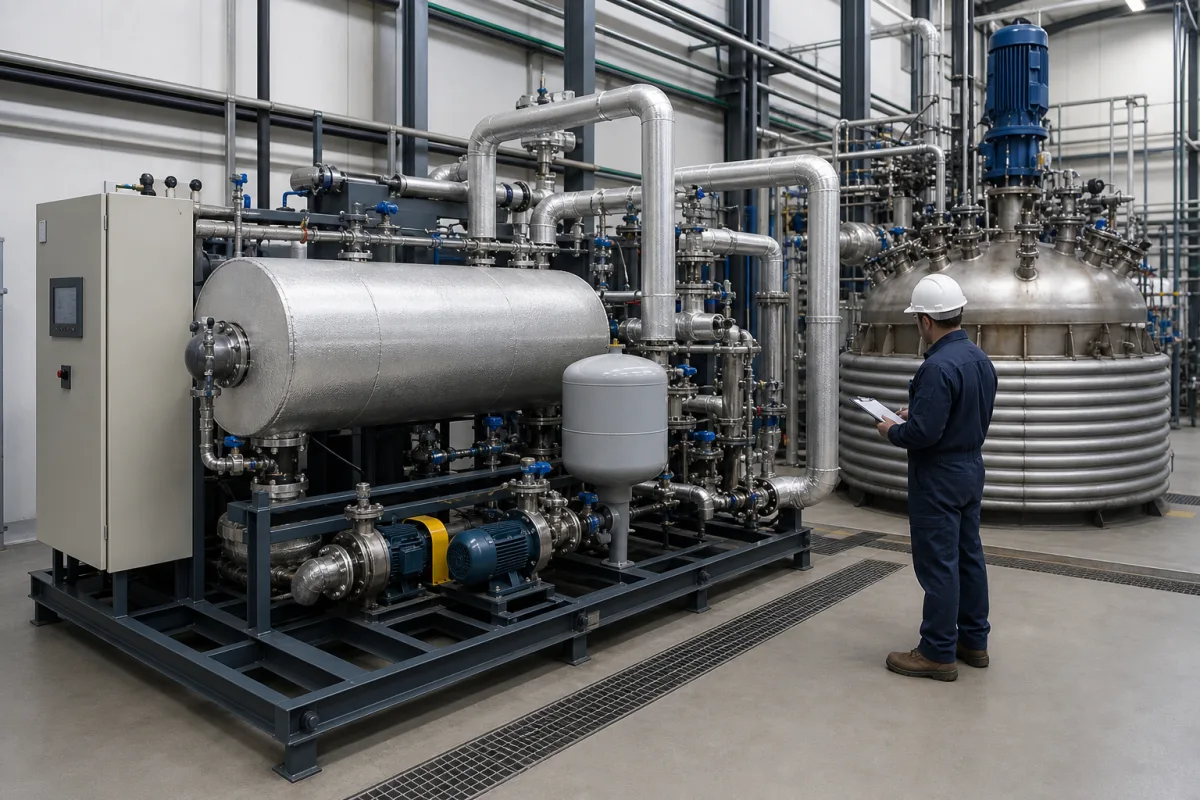
Thermal fluid (hot oil) heating system for process heating
Thermal fluid (hot oil) heating systems · heater rating, fluid bulk and film temperature limits, expansion and inert blanketing, flow regime
A thermal fluid (hot oil) heating system heats a heat-transfer oil in a fired or electric heater and pumps it in a closed loop to reactor jackets, tank coils, presses or heat exchangers, with an expansion tank taking up the oil's volume change. Ask three things first: what heat output and supply temperature the users need, what maximum bulk and film temperatures the chosen fluid allows, and how the expansion tank, inert blanketing and pumps are sized for the loop.
Closed-loop thermal fluid heating systems: fired or electric hot oil heaters, circulation pumps, expansion tanks and controls, including skid-mounted packages, and the heat-transfer fluid they use. Band heaters for barrels are covered on the Band heaters page; steam boilers, induction heating and heated clothing are outside this page.
CNFX editorial research · Sources checked October 12, 2026 · 3 sources
Keep the heater within the fluid's bulk and film temperature limits
Eastman's bulletin for its Therminol 58 synthetic heat transfer fluid gives a maximum bulk temperature of 300 °C, a maximum film temperature of 339 °C, a normal boiling point of 352 °C, a flash point of 195 °C (COC) and an autoignition temperature of 351 °C, and states that operation at or below the recommended maximum bulk and film temperatures can provide long service life. It also states that the fluid, despite its relatively high flash point, is not classified as fire-resistant, so protective devices may be required. [1]
The bulletin lists the minimum liquid temperature for fully developed turbulent flow (Reynolds number above 10,000) as 69 °C at 10 ft/s (3.048 m/s) and 47 °C at 20 ft/s (6.096 m/s) in a 1 in tube, and for transitional flow (above 2,000) as 26 °C and 14 °C. Where fluid in the expansion tank may be heated above 80 °C, it says the fluid should be protected from air, and Eastman recommends an inert gas blanket, or keeping the tank below 80 °C or using a cold seal trap. [1]
Fulton describes its FT-C fuel-fired vertical coil heater as passing flue gases over both sides of each coil to reduce the fluid's peak film temperature and so extend its life. [2] Editorial calculation: with Therminol 58, the film limit leaves 339 - 300 = 39 K between the hottest fluid at the heater wall and the bulk limit, so ask the heater supplier for the calculated film temperature at full firing and minimum flow.
Give the supplier the users and their heat loads, supply and return temperatures, fluid type and volume, heater type and fuel or electrical supply, flow rate and pump redundancy, expansion tank and blanketing, piping layout and elevations, controls and safety devices, hazardous-area classification and site conditions.
02
Size the heater output and the expansion the tank must take
Fulton lists its FT-C vertical coil thermal fluid heater in models from 800,000 to 14,000,000 BTU/hr output, capable of temperatures up to 750 °F (400 °C), fired on natural gas, dual fuel, propane, #2 fuel oil or bio-fuel, with a four-pass double helical coil and an integrated air-preheating economizer, and states that heaters can be combined in modular engineered systems. [2]
Eastman's property table for Therminol 58 gives a liquid density of 883 kg/m³ at 20 °C, 830 kg/m³ at 100 °C, 759 kg/m³ at 200 °C and 679 kg/m³ at 300 °C. [1] Jinan Changtong describes its thermal-oil heating and storage tank system for bitumen as using an indirect heat-transfer-oil circuit for heating, circulation and transfer, with tank quantity and capacity chosen around storage volume and operating cycle. [3]
Editorial calculation: 800,000 BTU/hr is about 800,000 × 0.000293 ≈ 234 kW and 14,000,000 BTU/hr about 4,100 kW. Between 20 °C and 300 °C, Therminol 58 expands by 883 ÷ 679 ≈ 1.30, so a loop holding 1,000 litres when cold holds about 1,300 litres when hot, and the expansion tank must accept about 300 litres of swell on top of its normal reserve. [2][1]
03
Jinan Changtong thermal-oil heating for bitumen
Jinan Changtong lists thermal-oil heating and storage tanks for bitumen and heat-transfer-oil assisted asphalt melting equipment. Ask for heater output, fluid, expansion tank and controls.
04
Heater, fluid, pumps, expansion tank and users in one hot-oil loop
The heater has to keep the fluid below its film limit and the expansion tank has to take the fluid's growth on heating; pumps, users and controls complete the loop.
Part
Role
Fix in the order
Heater (fired or electric)
Heats the oil; coil design affects film temperature. [2]
Heater output, bulk and film temperature limits and sheath temperature
For Therminol 58 the bulk limit is 300 °C but the film limit is 339 °C, so the heater surface or sheath temperature row matters as much as the output row.
Field
What it means and published values
Ask the supplier for
Heating capacity (kW)
Example: 800,000-14,000,000 BTU/hr (about 234-4,100 kW) in one range. [2]
Net output to the fluid.
Operating temperature (°C)
Example: Therminol 58 bulk to 300 °C; heater to 400 °C. [1][2]
Supply and return.
Operating pressure (MPa)
Loop and expansion tank pressure.
Design pressure.
Temperature control accuracy (°C)
At the users.
Accuracy.
Supply voltage (V AC)
Pumps, burner or electric heater.
Voltage and load.
Electrical power (kW)
Pumps and controls, or heater if electric.
Connected load.
Ingress protection
Electrical equipment rating.
Rating and area class.
Heating element material
For electric heaters.
Material.
Sheath material
For electric heaters.
Material.
Max sheath temperature (°C)
Must keep fluid below its film limit, 339 °C for Therminol 58. [1]
Calculated film temperature.
Weight (kg)
Skid weight with fluid.
Weight.
Dimensions (L×W×H) (mm)
Skid footprint.
Drawing.
06
Send the load, fluid and loop data together
Paste it into your enquiry below or into an email to a maker, then replace every bracket.
Explore company information and manufacturing capabilities, then discuss the scope of your project with a relevant supplier.
Share this page
Compiled and source-reviewed by the CNFX editorial team.
Each manufacturer above links to the page on that company's own website where the product is listed, with the date we checked it. How we source and review
· Page last updated 13 October 2026
Buyer questions
What is the difference between bulk and film temperature?
Bulk is the fluid's mixed temperature; film is the hottest fluid at the heater wall. Eastman lists 300 °C bulk and 339 °C film for Therminol 58. [1]
How much does hot oil expand?
Using Eastman's densities, Therminol 58 expands by about 30% from 20 °C to 300 °C (editorial calculation). [1]
Does the expansion tank need a nitrogen blanket?
Eastman recommends an inert gas blanket when tank fluid may exceed 80 °C, or keeping it below 80 °C or using a cold seal trap. [1]
What size are fired thermal fluid heaters?
Fulton lists its FT-C from 800,000 to 14,000,000 BTU/hr, combinable in modular systems. [2]
Sources and what still needs a direct check
Sources checked 2026-10-12. Eastman publishes data for its Therminol fluids; Fulton describes its own thermal fluid heaters; Jinan Changtong describes its thermal-oil heated tanks.